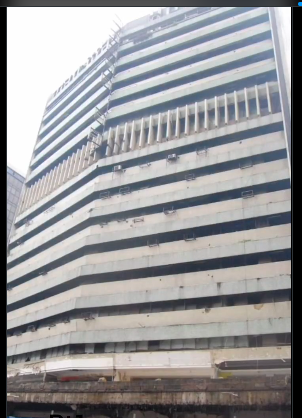

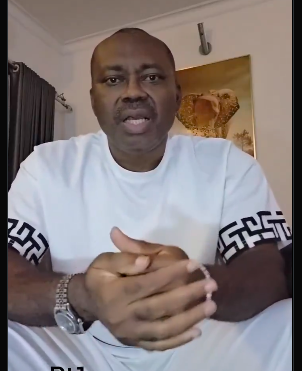
LAGOS — A high-stakes property dispute has erupted between the Lagos State Government and a prominent real estate investor, Onuorah Eze Okafor, over the ownership and structural custody of the landmark Mandilas building on Lagos Island. In a poignant public testimony, Okafor detailed what he characterized as a devastating administrative assault on his investment, alleging that the state government is attempting to forcefully seize the multi-billion naira commercial asset after he repeatedly incurred massive bank liabilities to reconstruct it.
The asset—historically associated with the Mandilas Group but officially divested to private ownership—has been a focal point of intense regulatory and economic scrutiny following structural and environmental crises in the Lagos Central Business District (CBD).
The Debt-Funded Acquisition and Initial Demolition
According to Okafor, his acquisition of the high-rise commercial facility was heavily capitalized through significant commercial financing secured via a structural loan from Zenith Bank PLC. However, shortly after taking possession, the property became the target of a partial demolition exercise executed by regulatory agencies under the Lagos State Ministry of Physical Planning and Urban Development.
While the state government initially justified the enforcement as a response to structural integrity anomalies and building code violations, Okafor noted that authorities subsequently refused to rebuild the demolished sections or provide immediate pathways for remediation, leaving the heavily indebted investor in a financial quagmire.
The Bureaucratic U-Turn and Re-financing Traps
The dispute took a more complex logistical turn after state authorities allegedly relented and issued formal, statutory approvals allowing the investor to embark on full-scale reconstruction.
- Secondary Liabilities: Relying on the validity of the government’s newly granted reconstruction approvals, Okafor returned to the financial market, leveraging additional capital through secondary credit facilities to rebuild the commercial complex to required engineering codes.
- The Takeover Enforcement: In a sudden administrative reversal, agents of the Lagos State Government reportedly returned to the site, not to regulate, but to execute a total, forceful institutional takeover of the entire building. The action has effectively locked out the primary developer while leaving his massive debt obligations to Zenith Bank active and compounding.
The Ethnic and Socio-Cultural Dimensions of the Mandilas Dispute
Beyond a standard regulatory conflict, the unfolding legal and financial confrontation has rapidly expanded to ignite a broader, sensitive national discourse regarding ethnic socio-economic dynamics in Nigeria’s commercial capital. For an analytical, university-educated audience, the controversy surrounding Okafor’s investment is being increasingly viewed by key socio-political observers through the lens of long-standing ethnic tensions and allegations of economic marginalization targeting Igbo entrepreneurs in Lagos by dominant regional actors.
The Context of Economic Marginalization Allegations
The prompt and aggressive institutional takeover of the multi-billion naira asset after massive private, debt-funded reconstruction has led several Igbo socio-cultural groups and traders’ associations to question the underlying motivations of state regulatory enforcement. Critics argue that while urban renewal, building codes, and safety compliance are legitimate functions of the Lagos State Government, the execution of these policies often appears disproportionately focused on high-density commercial hubs dominated by South-East traders, such as Alaba International, Computer Village, and Lagos Island markets.
Socio-political commentators point to a perceived pattern of selective enforcement, where properties owned or operated by Igbo investors face rapid demolition, sealing, or outright expropriation under the guise of urban planning anomalies, while similar structural infractions in other sectors are granted structural concessions or long-term regularization periods.
State Regulatory Denials and the Push for Equity
In response to these persistent allegations of ethnically motivated marginalization, the Lagos State Government and its agencies, including the Lagos State Building Control Agency (LASBCA), have consistently maintained that enforcement exercises are completely blind to ethnicity or regional origin. State officials assert that the primary driver behind interventions—especially in fire-prone or structurally compromised zones like the Mandilas axis—is strictly the preservation of human lives and the restoration of public safety and orderly town planning.
However, regional analysts warn that against the backdrop of highly polarized political rhetoric from recent electoral cycles, any aggressive state action against prominent eastern investors risks worsening existential anxieties. For national stability and economic cohesion to be sustained, observers note that the administration must ensure absolute transparency, adhere strictly to the rule of law, and provide verifiable proof that its regulatory mechanisms are applied with equal weight to all stakeholders, regardless of ethnic background.