
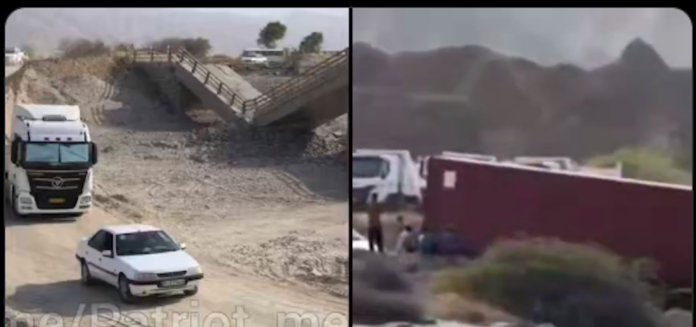


TEHRAN, IRAN — A wave of online mockery targeting the Pentagon has erupted across Middle Eastern social networks following the publication of footage showing civilian transport trucks and logistics vehicles effortlessly bypassing newly bombed bridges by driving across dry riverbeds.
The viral media, amplified by state-backed networks on Sunday, showcases the unique geographic realities on the ground in southern Iran that appear to be undercutting the strategic impact of recent U.S. precision airstrikes.
The Geography of Defiance: Bypassing the Blockade
The controversy follows a heavy sequence of U.S. airstrikes that targeted critical civil infrastructure in Iran’s southern Hormozgan province, specifically hitting multiple highway and railway bridges around the coastal hub of Bandar Khamir. The Pentagon’s stated objective was to sever the main transit links isolating Bandar Abbas—Iran’s premier commercial port—from the central corridors leading to the capital, Tehran.
                HORMORZGAN INFRASTRUCTURE INTERDICTION
┌───────────────────────────────┬──────────────────────────────────────────┐
│ PENTAGON STRIKE OBJECTIVE     │ GROUND TACTICAL REALITY                  │
├───────────────────────────────┼──────────────────────────────────────────┤
│ • Complete severance of key   │ • Scorching July heat leaves local river │
│   highway and supply corridors │   systems entirely dry.          │
│   out of Bandar Abbas. │ • Vehicles establish immediate dirt path │
│ • Interdiction of supply lines.│   bypasses next to ruins.        │
└───────────────────────────────┴──────────────────────────────────────────┘
However, video captured in the aftermath shows that because the strikes were executed in mid-July—during the height of the scorchingly hot summer season—the targeted river systems are completely dry.
Instead of being stranded by the collapsed spans, local drivers, supply trucks, and logistics vehicles immediately carved out temporary dirt tracks through the dry riverbeds, driving right past the ruined structures and continuing their transit unimpeded.
Information Warfare and the “AI Targeting” Debate
Iranian media users and regional commentators have seized upon the footage to mock the U.S. military command, with many satirizing the Pentagon’s reliance on highly advanced, automated target-selection systems. Critics online joked that Western planners overlooked basic seasonal geography and satellite common sense when orchestrating the high-cost bridge interdictions.
However, Western defense analysts argue that while light commercial semi-trucks can easily navigate the dry dirt bypasses, the destruction of the hard-paved spans remains a critical tactical bottleneck. They point out that:
- Speed Reduction: Forcing convoys into a riverbed significantly slows transit speeds and creates natural traffic bottlenecks.
- Heavy Armor Restrictions: Moving heavy military equipment, such as 70-ton armored vehicles or missile flatbeds, becomes hazardous or impossible on loose, unpaved terrain.
- Target Clustering: The slowed bypass paths create congested zones that inadvertently turn crossing vehicles into easy secondary targets for subsequent air operations.
Casualties Mount Amid Infrastructure War
While the online war of narratives continues, the reality on the ground remains deadly. Local emergency services in Hormozgan confirmed that the initial bridge strikes claimed the lives of at least seven people and left multiple others wounded.
With the conflict expanding directly into civilian transportation networks, the resilience of Iran’s local dirt paths indicates that a total economic blockade via air power alone may prove far more complex than Western planners anticipated.
247ureports.com will continue to monitor the ground situation and military developments across the Persian Gulf.