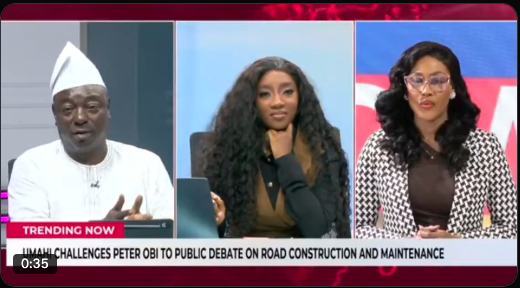

LAGOS — Public affairs analyst Biodun Sowunmi has launched a scathing attack on the governance credentials of the Labour Party’s 2023 presidential candidate, Peter Obi, dismissing his celebrated infrastructure footprint as a political myth.
Sowunmi’s remarks add fuel to an ongoing national debate regarding the fiscal and structural legacies of past governors, specifically contrasting Obi’s administrative philosophy with the core engineering drives of subsequent federal administrations.
“Adeosun Made It Clear”
Invoking the previous administrative critiques leveled by former Minister of Finance, Kemi Adeosun, Sowunmi argued that Obi’s heavily marketed economic models often collapse under rigorous policy scrutiny.
According to Sowunmi, Adeosun had long exposed fundamental flaws in Obi’s mathematical and economic arguments, particularly his signature approach of saving public funds at the expense of executing critical, high-impact capital infrastructure project layouts.

The Road Competency Debate: Obi vs. The Engineers
Sowunmi further attacked Obi’s capacity to oversee complex national infrastructural development, drawing a sharp line between political rhetoric and actual technical expertise.
- The Professional Contrast: Sowunmi noted that the oversight of massive highway networks requires technical competence, pointing out that a qualified Engineer serving as Minister of Works inherently understands the structural demands of durable road construction—a level of comprehension he claims Obi entirely lacks.
- The Village Road Accusation: Turning his attention directly to Obi’s tenure as Governor of Anambra State, Sowunmi rubbished the narrative that the state witnessed a golden era of road networks. He alleged that internal roads across Anambra were notoriously decrepit during Obi’s administration, asserting that the governor failed so thoroughly on infrastructure that even the vital access road leading to his own country home was left in a deplorable condition.
The Two Opposing Governance Schools of Thought
The public friction highlights a deeper, systemic argument between two prominent schools of economic thought currently dominating Nigerian political discourse:
| Administrative Philosophy | Primary Economic Target | Critical Structural Risk |
| The Peter Obi / Savings Model | Emphasizes aggressive fiscal conservatism, cutting overhead costs, and building massive cash reserves/endowments. | Critics argue it starves the state of vital capital expenditure, leading to the long-term decay of roads, bridges, and hospitals. |
| The Infrastructure / Expansion Model | Prioritizes aggressive borrowing and heavy capital deployment to build expansive highway networks and transport hubs. | Critics argue it drives the nation into unsustainable debt traps if the built infrastructure fails to quickly generate revenue. |
With the 2027 electoral cycle quietly taking shape, Obi’s legacy as a two-term governor remains the primary battleground for his supporters and detractors. While his loyalists frequently point to his achievements in education, security, and prudent financial management, critics like Sowunmi are determined to keep public attention focused on the alleged deficits in his physical infrastructure record.