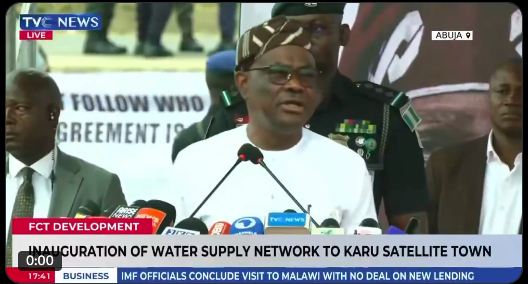


ABUJA — The internal battle over municipal authority and revenue collection in the nation’s capital took a dramatic turn on Wednesday, July 1, 2026, as the Minister of the Federal Capital Territory (FCT), Nyesom Wike, issued a fierce public warning to the Chairman of the Abuja Municipal Area Council (AMAC), Christopher Maikalangu.
The minister strictly cautioned the council boss against the unauthorized commercialization and naming of streets constructed across Abuja by the FCT Administration (FCTA). Speaking at the official inauguration of newly completed inner roads in the Gaduwa District, Wike explicitly accused AMAC officials of exploiting multi-billion Naira federal infrastructure projects to line local council pockets through arbitrary, unapproved naming rights.
Adding heavy political weight to the administrative crackdown, Senate President Godswill Akpabio, who represented President Bola Tinubu at the commissioning ceremony, backed Wike entirely, warning the AMAC chairman not to name federally funded roads after “his mother” or a “palm wine tapper” from his village.
“Don’t Use Our Projects to Collect Revenue”
Taking center stage during the ceremony, Minister Wike did not mince words as he tackled the ongoing jurisdictional friction between the FCTA and the municipal area council regarding revenue generation.
The minister emphasized that while he acknowledges the local government’s statutory claim to street naming, it remains a severe administrative infraction to arbitrarily slap individual names onto highways and layouts financed entirely by the federal government without official clearance.

“Let me warn the Chairman of AMAC: give names to streets where you put your money. Don’t wait for us to construct roads, then we wake up in the morning to see the names of streets being named after people we don’t know. Don’t use us to collect revenue. Carry your own money to construct roads, then name them after those you want.”
— Barrister Nyesom Wike, FCT Minister
Wike, drawing from his personal administrative history as a former local government chairman in Rivers State, noted that “condition make crayfish bend,” pointing out that federal or state authorization must be formally secured whenever superior government tiers execute local infrastructure.
The Jurisdiction vs. Monetization Breakdown
The fierce public rebuke spotlights an ongoing under-the-table racketeering network within the municipal territory, where highly placed council brokers allegedly “sell” street-naming slots to wealthy individuals for millions of Naira without centralized urban planning oversight.
| Administrative Tier | Financial Responsibility | Legitimate Authority | Key Conflict Flashpoint |
| FCT Administration (FCTA) | Allocates massive capital expenditure for metropolitan connectivity, asphalt layouts, and district engineering. | Retains ultimate authority over federal territory modifications and primary city centers. | Accuses AMAC of unilaterally mounting nameboards on freshly asphalted federal bypasses immediately after construction. |
| Abuja Municipal Area Council (AMAC) | Manages grassroots and local council internal revenue generation mechanisms. | Holds statutory local government functions for community registry and municipal identification. | Allegedly operates a transactional “cash-for-street-names” system targeting affluent individuals to bypass federal vetting. |
He Who Pays the Piper: Akpabio’s Brutal Pushback
Corroborating the minister’s stance, Senate President Godswill Akpabio warned that the National Assembly and the presidency would no longer tolerate the visual devaluation of national infrastructure.
Akpabio emphasized that public infrastructure must be used as a tool to genuinely immortalize figures who have made historic, verifiable contributions to Nigerian society—such as outstanding sports icons, statesmen, and philanthropists—rather than being traded off to the highest bidder.
“It’s important for you to note that he who pays the piper detects the tune,” Akpabio stated directly to the AMAC boss. “So if you wanted to name this road after just anybody, you should have constructed it. It’s not when the federal government has finished that you would find one palm wine tapper in your village and name the road after the person.”
With the Gaduwa District roads officially opened to the public, the FCTA has placed its task forces and mobile enforcement teams on standby. Moving forward, any street signs mounted on federally constructed corridors without an explicit written sign-off from the Office of the FCT Minister will be dismantled as illegal structures, marking a definitive end to unauthorized municipal revenue racketeering in the heart of Abuja.