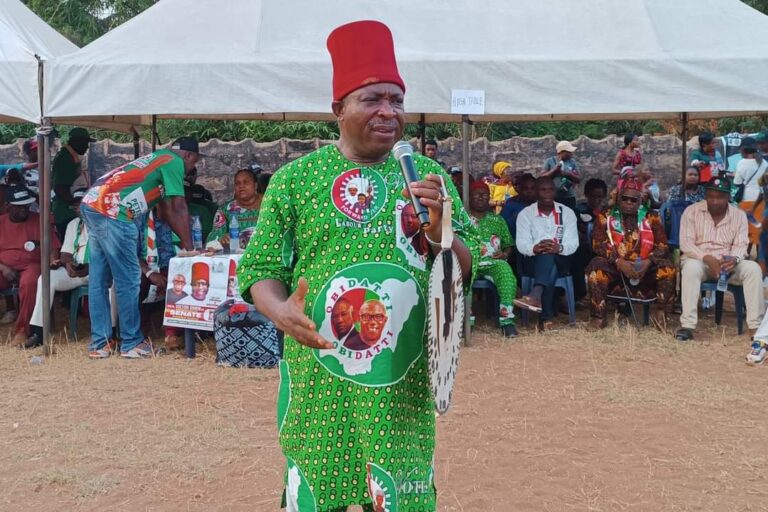
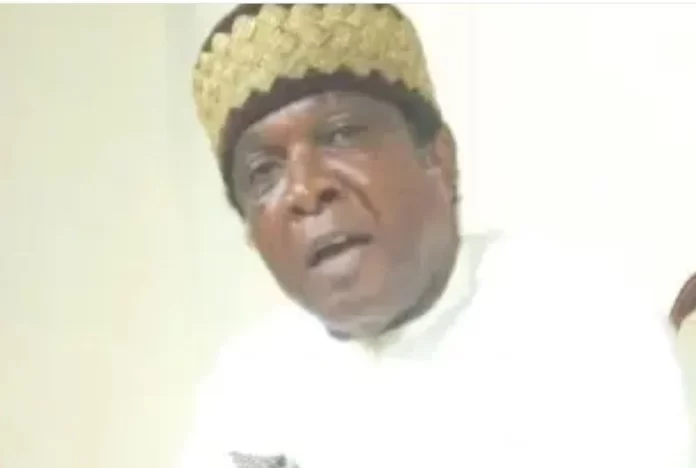
Gunmen have reportedly attacked the campaign convoy of Oforchukwu Egbo, the Peoples Democratic Party (PDP) candidate for Enugu North/South Federal Constituency,
Loading ...
During the attack, the hoodlums killed the driver of one of the buses in the convoy.
According to reports, his body was burnt with the vehicle.
It was gathered that the incident happened at Eke-Otu in Amechi Awkunanaw, Enugu South Local Government Area of the State.
Recall that some gunmen had also attacked and killed the Labour Party senatorial candidate for Enugu East senatorial district, Mr. Oyibo Chukwu, with five of his supporters in Amechi.
Efforts to speak with the State Police Public Relations Officer, DSP Daniel Ndukwe, proved abortive as he could not be reached on telephone as at the time of filing this report.
There was an outburst of joy and jubilation in Awka, Anambra State on Thursday, as as Appeal Court upheld the candidacy Chief Victor Umeh as the senatorial bearer of the Labour Party (LP) in Anambra Central for the 2023 general election.
Loading ...
Although information is still sketchy about the court judgement, videos are currently trending online, showing Umeh’s supporters chanting victory songs at the court.
Recall that a High Court sitting in Awka, Anambra State capital, on Friday, January 27, disqualified Chief Umeh from contesting the February 25 senatorial election.
The court, presided over by Justice H. A. Nganjiwa, declared that Umeh violated the provisions of the Electoral Act by standing for elections in same senatorial zone under two different political parties. It also ruled that Umeh’s name was still in the membership register of the All Progressive Grand Alliance (APGA) as at the time he emerged the Labour Party’s senatorial flag bearer for the zone on Sept 30, 2022.
The court further revealed that there was no evidence that the resignation letter purportedly submitted by Chief Umeh to APGA was actually received by the party leadership. It therefore nullified Umeh’s candidacy and faulted the publication of Umeh’s name as LP senatorial candidate for Anambra Central by the Independent National Electoral Commission (INEC).
To cap up its ruling, the court also issued an injunction restraining Umeh from parading himself as a senatorial candidate.
However, an Appeal Court sitting in Awka, on Thursday, upturned the High Court judgement and upheld Umeh’s candidacy, barely 48 to hours to the election.
Information available to 247ureports.com indicates the insecurity sweeping across the south east geopolitical zone appears to show no evidence of easing up. This is as group of unknown gunmen attacked the country home of a retired to official of the Department of the Security Services [DSS] and killed his blood sister. The house was set on fire and completely destroyed. The gruesome attack occurred on the early morning hours of Tuesday February 21, 2023.
Loading ...
The attack is suspected to be politically motivated.
According to the information gathered, the retired DSS official – Chuks Ngwu – who hails from Okigwe in Imo State, retired from the DSS in the year 2018/19 as an Assistant Director General following a successful career at the DSS. He rose to the level of top boss in charge of the legal department of the DSS national headquarters.
Following his retirement, Chuks Ngwu who was considered a “big man” in his Okigwe community and well known in his community as a former DSS official – had erected a befitting edifice of a home in his village. An impressive complex.
He joined active partisan politics. A source indicates he joined the ruling party in Imo State, the All Progressive Congress [APC] and was actively involved in the day to day political grind towards the buildup to the general elections of March 11 and February 25.
In the malaise of insecurity in Imo State where the State Government find themselves virtually at war with the unidentified elements within the community, police sources suspect Chuks Ngwu was caught in the middle of the war.
Bauchi State Governor, His Excellency, Senator Bala Abdulkadir Mohammed has called on citizens and residents of Bauchi state to exercise their franchise peacefully without participating in thuggery or anything that will sabotage the state’s hard-earned peace, saying to him, the security their lives and properties is a treasure which he said structures have been put on ground to make it safe and secure.
Loading ...
Governor Bala made the call when he received in audience, the Community Leaders Association Association on a courtesy visit at Bauchi Government House where he reiterated his administration’s commitment partnering with security agencies to ensure no miscreant, charlatan, hooligan or bandit sabotages or weakens the state’s unity, peace and security.
He added that his administration has after declaring an emergency on education, built schools and functional primary health care and centers in each ward across the state.
Mohammed said his administration has in collaboration with international donors built, equipped and upgraded PHCs and General Hospitals in addition to the employment of doctors, nurses and midwives in an effort to improve human capital.
On the revival of education, Bala Mohammed said more than 5000 classroom blocks have been built to address the out of school syndrome in the state considering its size and population.
He added that the construction of good roads in urban and rural areas by his administration is in line with his commitment improve the state’s economy, saying the IGR has been upgraded from 300,000000 to 1billion monthly without causing a pain on the course.
In July 2009, the so called Islamist and jihadist rebel group, Boko Haram started an armed rebellion against the government of Nigeria. The insecurity situation in the country seemed to have assumed higher and more complex dimensions. Apart from the frequency and intensity of deadly attacks and carnages, the insecurity situation in Nigeria cuts across cities, towns, and villages in northeast, Nigeria. Life was challenging for both urban and rural based dwellers. Billions of property were destroyed. People live in misgiving almost everyday.
As such, insecurity has taken different forms in several parts of the country, armed robbers have taken position within the southwest, and cross-border bandits operate smoothly in the north, while kidnapping issues are common in the south-south. In Nigeria, insecurity is supported by corruption and some rich, selfish and unpatriotic citizens in different sectors.
According to the country’s Humanitarian Minister Sadiya Farouq, “Since 2016, 35 aid workers have died, 72 (have been) wounded and 28 kidnapped. The jihadist violence has killed over 40,000 people and displaced around two million from their homes in the northeast since 2009.
In addition, according to the UN, Boko Haram and rival ISWAP are notorious for kidnapping women, children, and aid workers. They have been engaged in a 12-year-old conflict that has killed more than 40,000 people and displaced around two million Nigerians. By the end of 2021. In general, conflict had led to the deaths of almost 450,000 people and forced millions from their homes. Millions of vulnerable people in Borno, Adamawa, and Yobe states in north-east Nigeria are facing a humanitarian and protection crisis due to conflict.
Moreover, according to the report, due to the weak performance in the job-elastic sectors, and low labour absorption of sectors that will drive growth, the nation’s population growth estimated at 3.2 percent will lead to a decline in real per capita income. The report noted that the country’s GDP growth is also expected to moderate to 2.98 percent, as economic growth will be subdued in 2023 due to strains on investment and low productivity in critical sectors.
Also, the Conflict has caused widespread internal displacement, alarming food insecurity and malnutrition, and outbreaks of diseases such as cholera, malaria and other communicable diseases. The impact of climate change, coupled with high prices of food and essential commodities, and increased population, have aggravated the crisis. Nigeria is on the frontline of the climate crisis. Climate-related shocks continue to exacerbate the needs of the most vulnerable people, as witnessed in the historic flooding across the country last year affecting 4.4 million people. Nigeria Humanitarian Response Plan 2023 reveled.
The country’s unemployment rate will hit 37 percent in 2023. The group in its 2023 Macroeconomic Outlook report titled “Nigeria in Transition: Recipes for Shared Prosperity, said the country’s poverty headcount will also rise to 45 percent.
Therefore, Journalists should apply cultivation media theory to educate the populace about the factors that, of course, lead to crime, and bridge the gap between government and masses by: Organising debates among different political parties whereby flag-bearers are invited and given chance to share their manifestos. By so doing, the public is given the impression that politics is not a do-or-die affair. For instance, the BBC and Trust TV among other national and local media organizations have recently organized this kind of discussion which in return people will have a good sense of reasoning which will help them to analyze the capability and quality of any candidate so as to know who to elect as their leaders with the hope of good governance, as bad governance is among the top phenomena that has been holding the progress of this country back.
Media education can be in different dimensions: it is done in terms of creating awareness by placing different jingles on electronic media and adverts on print media on the negative impact of violence in any form and need for people not to avail themselves to be used or participate in any thugs. For instance, a radio show in Rwanda which focused on promoting tolerance enhanced listeners’ willingness to express dissent while encouraging them to resolve community problems without deferring to officials, suggesting that positive changes in the community can be made in the short run.
Shun away corruption,” it is the cause of inequality and the unequal distribution of the wealth of nations among their citizens. Corruption at all levels must be eliminated in such a way that equal rights apply to all and rights and privileges of people are not agreed upon based on bribery and tribe but on merit, defined in relation to their Character content, their mental efficiency, and their efficiency; where there will be no discrimination”. Government should provide room for public execution to whoever is caught guilty of a crime, and corruption activities and allow the media to cover the events.
Education is the prerequisite and backbone of any development in the country. Proper education is the process of teaching, training, and learning, especially in schools, to improve knowledge and obtain skills. As such, the media should advocate for free and quality education for the citizens.
Finally, security agencies should collaborate with media agencies so as to join and to have a roadmap for information dissemination. And If possible avenue should be created for public feedback.
Shamsuddeen A. Musa, writes from Bayero University, Kano and can be reached through amusashamsuddeen@gmail.com
“It’s up to the artist to use language that can be understood, not hide it in some private code. Most of these jokers don’t even want to use language you and I know or can learn, they would rather sneer at us and be smug, because we ‘fail’ to see what they are driving at. If indeed they are driving at anything, obscurity is usually the refuge of incompetence.” – Robert A. Heinlein
The constant insults targeted at our dear President, the name calling being peddled by certain state governors et al are as a result of their wicked and malicious intentions towards next Saturday. No more or less!
Loading ...
Nigerians must understand that any individual or group that calls for the rescinding of the use of N500 and N1000 Naira Notes which have been replaced by New designs by the Nigerian Central Bank, we must understand that going back on this very painful yet important policy will only push us to economic annihilation. Secondly, Presidential Candidates like Peter Obi and Senator Rabi’u Musa Kwankwaso who do not process huge war chests will easily watch as they are reduced to non entities during the elections.
With this policy, President Buhari wants us to Vote whoever we want and from whichever Party. Luckily, Nigerians from all over the country, Muslims, Christians and even those godless people are uniting in accepting the new policy with clear statements that we accept to sacrifice for the next few weeks till the system removes more than N900 billion Naira in the hands of governors and more than 2 trillion Naira in the hands of politicians and their cohorts.
The most painful thing is, these humongous sums of money are not stored in banks but in air conditioned houses. If the money is not in any bank, this means the common man on the streets who sells newspapers, the corn and akara seller cannot benefit economically from the such largess. This means, the money isn’t in circulation. This explains why we are where we are economically.
I cannot recall how many times I granted TV interviews where I said our biggest problem as a country are our state governors. The reason they are so confused is because their stolen wealth cannot serve them. They chose to go to court after a certain meeting at night and coming up with what they know how to do best, influence the Supreme Court through inducements so as the decision is reversed. Each of them know the repercussions of rescinding such important policy. As I said above, doing so will only amount to total collapse of our economy. Remember what happened to the Zimbabwean currency when the late Robert Mugabe decided to hand farmlands back to his citizens. The sabotage and smear campaigns against him and his government from the western countries, made his currency exceptionally worthless.
If we go back to the mid 1930s, just after the First World War, Germany was a victim of the League of Nations and was also crippled economically to the point that it if an individual wanted to buy a loaf of bread, he must transport the money on wheelbarrows. Imagine a wheelbarrow with hundreds of thousands just to purchase bread! That was what befell Germany and ultimately tens of millions lost their lives on the war that followed, the Second World War! This is exactly what would befall us as a nation if we go back on that policy. Any person who stands with these criminals is indeed a worse criminal than they are.
For the first time in a long time, I am witnessing Nigerians uniting towards this common goal with the satisfaction and preparedness to bear the brunt until after these elections where people like Kwankwaso and Peter Obi can also have their votes count. I see no reason why politicians should be hurt because of this multi trillion Naira mop up. It’s because their wings are severed by the General.
Lastly, I will call upon President Muhammadu Buhari GCFR, to quickly institute preparations for the arrest of loads of people who served under his administration as they stole probably far more than was stolen during the administration of President Goodluck Jonathan GCFR. Arrest the state governors as soon as they lose their so called immunity because of their wickedness towards us. Remember these are individuals who stole the Paris Club Refund, Bailout Funds, COVID Palliatives, Ecological Funds, Agricultural and Educational Incentives such as the School Feeding Programme talk less of salaries, gratuities of civil servants. These are just mentions of a very Few of their misdeeds. We wish to see them cough out that which they stole and be tried in a swift court case or even public hearings where we will watch as they are brought to shame for the sake of deterrence. Examples must be made of them. It’s as important as this Naira Redesign Policy Mr. President.
Now that the old soldier found his groove back, please remember the words of Bob Marley and deal with the “big fish, who always try to eat down, the small fish.”
“…they would do anything to materialize their every wish. Woe to the down pressers who eat up the bread of sorrow.” – Bob Marley
*Bello Mukhtar* write from Kaduna; bellomukhtar@icloud.com
Nigeria’s population is projected to reach 400 million by 2050, doubling the current estimate. This represents a demographic nightmare for the country that is already beset with several development challenges ranging from acute poverty to governance and political instability.
Loading ...
Current UN estimates put Nigeria’s population at about 211 million. The annual growth is 2.4 percent, which is an additional five million people in the population pool each year. Although the country’s population growth rate is high, more than the global average which is around 1.1 percent, it is not the highest in Africa.
Several African countries have a much higher population growth rate and in fact, the three countries with the highest population growth in the world are in Africa. They are Niger, Angola, and Burkina Faso, which have annual population growth rates of 3.8 percent, 3.3 percent, and 3.0 percent, respectively. However, because Nigeria’s absolute population size is much larger than these countries, it means even with a lower annual growth rate, it contributes more to Africa’s overall population growth.
By 2050, with about 400 million people, Nigeria’s share of the global population would have increased from 2.7 percent to 4.2 percent. It would be the third most populous nation in the world, only behind China and India. Nigeria is seventh right now in terms of global population ranking but in 2050 it would have overtaken Brazil, Pakistan, Indonesia, and the United States to become the third most populous country.
What are the possible implications of this population explosion on socioeconomic and development indicators? How would the demographic changes impact Nigeria’s religious and cultural profile? Where would the major shift in population growth come from?
A high population or active population growth is not necessarily bad. Many countries have leveraged high populations to achieve or accelerate economic growth and development. A case in point is China. A large population confers many advantages to China, including a large labor force and market size. This means that there is always an organic market for the country’s goods and services, one that is not impacted by complex regulations that govern international trade, as well as the existence of a ready labor force. Sometimes, small countries have to provide great incentives to attract skilled or even unskilled workers to fill necessary quotas. China does not have these problems.
Nigeria, however, has not been able to leverage its high population to achieve developmental goals. In fact, as the Nigerian population increases over the years, so have poverty and other developmental challenges. At independence in 1960 with a population of about 43 million people, the poverty ratio was estimated at 15 percent. In the 1980s and 1990s, with a population less than the 100 million mark, the World Bank estimates that about 46 percent of Nigerians were poor due to factors such as political instability, corruption, and economic mismanagement.
By the early 2000s, during the first few years of the Olusegun Obasanjo administration, the poverty estimates had increased to about 70 percent of the total population of about 130 million. However, the poverty ratio was reduced under the Obasanjo administration, which demonstrates a direct correlation between good governance and better economic opportunities.
But why have nations such as China and to some extent India, two countries that bear a lot of demographic similarities to Nigeria at independence, been able to achieve high economic status and Nigeria has not? One significant reason for this may be differences in population structures.
China, by design or accident, has a population structure that provides it with a ‘population dividend,’ where the working-age population is larger than the dependent population of children and the elderly. This has allowed it to achieve high rates of economic growth as a result of increased productivity and savings. Unlike China, Nigeria is not blessed with a population dividend but rather has a ‘youth bulge,’ which means it has a very young median population, in which about 60 percent of its total population is below the age of 25. This leads to higher demand for education, healthcare, and employment opportunities than the country can provide.
The difference in population structure is only half of the story, however. China has also invested heavily in education and training to develop its human capital, leading to a highly skilled workforce that has been critical to the country’s economic success. The government has also implemented policies to encourage innovation and entrepreneurship, which has led to the development of thriving industries. The quality of Nigeria’s education is poor for those lucky enough to be in school and nonexistent for millions of other children. Over time, the parlous condition of Nigeria’s education system is reflected in the country’s economic performance and other developmental indices.
And these developmental indicators tell of a country that is failing. On the human development index, Nigeria is ranked 161 out of 191 countries with a score of 0.539. It is ranked 149 out of 180 countries in Transparency International’s corruption perception index. Nigeria is rated first in the number of out-of-school children with over 20 million kids who are not in school. Nigeria has one of the highest maternal mortality ratios in the world, with an estimated 512 maternal deaths per 100,000 live births. This means that for every 100,000 live births in Nigeria, approximately 512 women die due to pregnancy or childbirth-related complications. Sixty percent of Nigerians, according to the National Bureau of Statistics, are multi-dimensionally poor. And the list could go on and on until infinitum.
Now, the big concern is this: if Nigeria’s economic and overall development indicators are this poor with a population of little over 200 million people, what would they be like in 2050 when the demography is expected to double to about 400 million? Recall that historical precedent shows that Nigeria has never taken advantage of its population bulge, which it treats more as a liability than an asset. The only conclusion one can arrive at therefore is that the country would face more severe economic and political pressures, leading to worsening conditions.
Pause. Consider slowly all the challenges that the country currently faces: insecurity, poverty, inequality, corruption, poor infrastructure, ethnic and religious tensions, as well as governance and political instability. They would be two or three times worse in 2050 if the current trends hold and there is no intervention from a government with a long-term vision.
On the social front, the significant population growth would lead to notable changes in Nigeria’s religious characteristics. As of 2015, the population of Christians and Muslims in Nigeria was almost equal, with the Muslims having a slight edge. A study published by the Pew Research Centre in 2019, based on 2015 data, put the ratio of Christians in Nigeria at 48.1 (86.6m) and Muslims at 50.1 (90m), with the differences being made up by traditional worshippers and irreligious people. But, according to the Pew Centre, by 2060 the total Muslim population would have increased to over 283 million, or 60.1 percent of the population; while although the Christian population would have increased to over 174 million, its share of the total Nigerian population would have decreased to 37. 2 percent from about 48 percent. This may embody socio-political challenges considering how Nigerian politics is interwoven with religion.
In conclusion, Nigeria’s population would experience significant changes in form and volume in years to come. Given the country’s lack of foresight and proactiveness, it is doubtful that it can adequately prepare and take advantage of these population shifts to leverage growth and development. The converse sadly may be true.
–
Ogunro is the Director of Research and Strategy at Future Now Initiative (FNI), an Abuja-based civil society
Just barely 48 hours to the much-awaited 2023 general election, unidentified gunmen have shot dead a senatorial candidate of the Labour Party in a south-eastern state.
Loading ...
The deceased, Mr. Oyibo Chukwu, was the Labour Party for Enugu East Senatorial District in the proposed Saturday general election.
It was gathered that Chukwu was killed at Amechi, Awkunanaw Local Government Area of Enugu on his way back from a political rally.
He was also murdered alongside five of supporters who were with him inside his car.
The killers were also said to have burnt his corpse and those of his supporters after killing them.
Reacting to the incident, the gubernatorial candidate of the Labour Party in the state, Chijioke Edeoga, who also confirmed it to newsmen, said his party members are long being targeted for assassination by political parties which felt threatened by the rise of the Labour Party in the state.
It would be recalled that the Labour Party Presidential Candidate, Peter Obi, who is one of the popular and forefront candidates for the general election, hails from the South+east.
It would also be recalled that unknown gunmen and suspected militants have been on rampage and vowed to cripple election in the region — a threat the security agencies have always told the people to disregard, as they are fully prepared and on ground to ensure peaceful and hitch-free election in the area.
While the Enugu LP guber candidate, Edeoga insists that Chukwu’s killing was politically motivated, the Enugu State Police command is yet to issue any official statement or reaction on the incident.
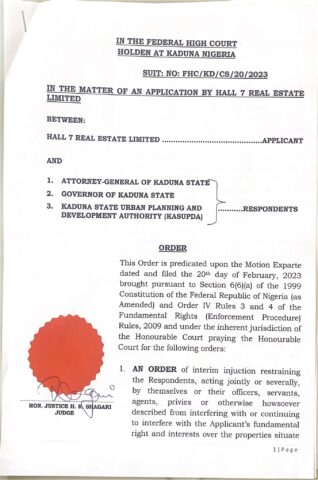
A federal high court sitting in Kaduna has restrained the Kaduna State government from stopping a property development firm from enjoying its rights over properties situate at Plots 292067 and 292070, No. 2 8 Muhammadu Buhari Way (Waff Road), Kaduna State.
Loading ...
The order was granted in favour of a property development firm, Hall 7 Real Estate Limited
The court also stopped the Kaduna State government from taking further steps in connection with the said plots of land pending the pending the hearing and determination of the originating motion filed alongside the exparte application for interim injunction.
The court stopped the Kaduna State government from taking any action against the property as it ordered parties to maintain Status quo Antebellum.
In an originating summons attached to the exparte application, the firm is asking for an order nullifying and setting aside the “Notice of Revocation/Withdrawal of Right of Occupancy” over the subject properties as well as the letter dated 17th October 2022 and entitled “Re: Building Permission S/N. 1460 purporting to withdraw the Building Permission granted to the Applicant on the properties, for being unconstitutional, null and void, and of no effect whatsoever.
It also asked for an order directing the Kaduna State government to pay N5,000,000,000.00 (Five Billion Naira) to the Applicant as compensation/damages for the violation of its Fundamental Right to its Properties stated above.
It also asked for an order of perpetual injunction restraining Kaduna State government from interfering with and or continuing to interfere with the Applicant’s enjoyment of its rights, interests and investments on the said properties.
The Governor of Imo State, Senator Hope Uzodimma has said that the New World Order is about digital economy, just as digital literacy, he insists, is the real literacy.
Loading ...
The Governor made the remarks at the Skill-Up Imo Project Cohort I, Batch I, Graduation Ceremony of 5,000 Imo youths at the Landmark Event Centre, in Owerri on Wednesday.
Addressing the granduands and their invited guests, the Governor congratulated them for accepting the programme and for showing determination to participate in it which he said “has snowballed in the graduation of the first batch of 5,000 out of the proposed 300,000 youths.”
He said the Skill-Up Imo Project represents three things; Technology, Opportunity and the People, explaining that “the New World order is about Digital Economy and Digital Literacy is the real Literacy which is all about technology.”
Governor Uzodimma who added that the Skill-Up Imo Project gives the youth the opportunity to learn a skill that can make them earn a living for life further noted that “the third aspect of the entire programme is about the person which is the Imo future and the Imo of tomorrow and that is the youths.”
The governor added flavour to the graduation ceremony when he announced that 2,500 of the granduands will go home with Brand New Modern Laptops while the other 2,500 will go home with various Start-Up Kits on their areas of Skills specialization with a promise that soon, the programme will graduate another batch.
Governor Uzodimma emphasized that with the progamme, the beneficiaries can become self-employed and even employers of labour.
“When many of the youths must have acquired skills and being employed it will bring an end to the activities of banditry, and unknown gunmen and in fact, other social vices in Imo State and Nigeria in general.”
He then charged the granduands and all Imo youths not to “forget where they are coming from, but rather, go out there to be good ambassadors, God fearing, humble and to be themselves.”
In rounding off his remarks, the governor commended the efforts of the Commissioner for Digital Economy and E-Government, Dr. Chimezie Amadi for living up to the dream of the project.
He also commended the Special Guest of Honour, the Minister of Communications and Digital Economy, Prof. Isa Ali Ibrahim Pantami for seconding Dr. Amadi to the Imo State Government, expressing satisfaction that the Minister is not disappointed in his expectations from Amadi based on what happened at the graduation ceremony.
In his remarks, Prof. Pantami congratulated the Governor for coming up with the initiative and expressed happiness to be in Imo State to witness the graduation of 5,000 Skill-Up graduates.
Prof. Pantami said from what he saw, Dr. Amadi has been able to coordinate properly the activities in the two areas of Hard and Soft Skill Courses.
He said that “the programme will provide Skill on employment for the youths at the National and International levels, create potential job employers instead of job employees,” and emphasized that “today’s world economy is driven by Digital Innovation and Digital Entrepreneurship.”
Prof. Pantami challenged the Nigerian leaders on the need to ‘’think out of the box on how to solve the problem of unemployment through the digital economy,” noting that “the world economy is no more based on natural resources, rather on digital technology initiatives.”
He noted that the “training is a foundation for the youths to base their life expectations and not the end of the journey to their successes in life,” adding that “the youths must have passion for invention, customers intercity and long time thinking.”
The Minister then urged Imo youths to continue to partake in critical thinking so that the future world critical thinkers will emerge from Imo State and Nigeria in general.
In his welcome address, the Commissioner for Digital Economy and E-Government, Dr. Chimezie Amadi thanked the Governor for the Skill-Up initiative, insisting that the graduation of 5,000 participants was the brain child of Governor Uzodimma whom, he said, encouraged his Ministry to take responsibility and implement the project.
Dr. Amadi said the programme is a subset of Imo Economic Agenda (2022-2026) which has the target of Up-Skilling Imo youths by providing free training and support to 300,000 of them in new innovation that would equip them to be productively employed or self-employed.
The Commissioner informed that the project draws its inspiration from the National Digital Economy and that “Imo is the first State in the Federation to draw from it which is aimed at reducing youth unemployment.”
He used the opportunity to thank government partners, including Zinox Computer, assuring that “with what Imo is doing now it will surely emerge as the Africa’s Digital Skills Hub through massive training of Imolites from all works of live in the areas of Digital Literacy Skills.”
In their appreciation, Mr. Ikechukwu Ukonu who is the Chairman of the College of Course representatives, poured encomium on the Governor and the Commissioner for giving them the opportunity to be part of the Skill-Up Project, saying it has provided them with life opportunity.
He promised that they will support the Governor in his programmes and policies through the polling booths.
The Governor was joined at the event by the Deputy Governor, Prof. Placid Njoku, the Chief of Staff, Barr. Nnamdi Anyaehie and members of the State Expanded Executive Council.
The Vice Chancellor Federal University of Technology, Owerri, Prof. Nnenna Otti, the Vice Chancellor of K.O. Mbadiwe University, Ideato, Prof. Ikechukwu Dozie, the Chairman Imo Elders Council, HRH Eze (Dr.) Cletus Ilomuanya and other traditional rulers were also in attendance.
The highpoints of the ceremony was the presentation of Start-Up Kits to some of the graduates by the Governor assisted by the Minister.

 Loading ...