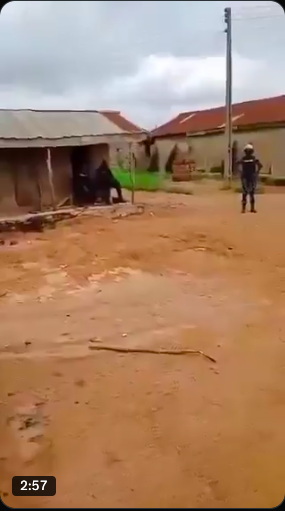


ILORIN — The full, chilling scale of Nigeria’s rural security crisis came to the forefront following the shocking discovery by police operatives that the entire town of Owa Onire, located in the Ifelodun Local Government Area of Kwara State, has been completely deserted by its inhabitants.
A routine security sweep of the agrarian community left law enforcement officers stunned as they encountered a literal ghost town. Every single man, woman, and child has fled the locality, leaving behind empty homes, abandoned markets, and silent streets.
Even domestic animals were conspicuously absent from the landscape, signifying a total, panic-driven evacuation by a population fleeing the unyielding terror of armed bandits and insurgent forces.
The Anatomy of an Absolute Evacuation
Local intelligence sources reveal that the total abandonment of Owa Onire did not happen overnight but was the climax of repeated, brutal raids, kidnappings for ransom, and a complete absence of permanent federal protection.
For months, the community faced a continuous barrage of attacks from armed groups operating from the expansive forest reserves connecting Kwara to neighboring states in the North-Central and South-West regions. Left to their fate, the villagers chose absolute displacement over systematic slaughter, packing whatever belongings they could carry to seek refuge in larger urban centers.
“It is a heartbreaking reality that the government continues to downplay,” said an official from a regional development association. “When an entire ancient town vanishes into thin air because citizens are terrified of being murdered in their beds, you cannot tell the world that the security situation is under control.”
Widening Evacuation Across the Federation
The chilling silence of Owa Onire is no longer an isolated incident. Security monitors warn that this level of mass desertion has quietly become the norm across countless rural communities stretching from the North-West and North-East to the North-Central, and increasingly, parts of the South-West.
Critics and civil society groups have fiercely blasted the federal administration, accusing the current regime of spending millions of dollars on international public relations campaigns in Washington, D.C., to manufacture a false narrative of stability.
Activists argue that while the government heavily invests in telling the global community that “it is not happening,” the real, unvarnished truth is written in the empty, pillaged towns across the Nigerian heartland.
The Controversial “Rehabilitation” Policy Under Fire
Compounding the deep public fury is the highly controversial federal policy of capturing, rehabilitating, and reintegrating so-called “repentant” terrorists into society.
Angered citizens and victims’ rights groups argue that the system has created a distorted universe where terrorists who murder, molest, and displace terrified families are given a hero’s welcome into VIP transitional centers. These facilities, critics note, provide comfort and resources to perpetrators while the actual victims are left to rot in squalid Internally Displaced Persons (IDP) camps without food, dignity, or hope of returning home.
The stark contrast between the pampered status of captured insurgents and the absolute devastation of towns like Owa Onire has fueled warnings that the state is actively incentivizing criminality.
A Ticking Societal Timebomb
The complete collapse of the social fabric in communities like Owa Onire represents a severe, long-term threat to the survival of the country.
With vast swathes of fertile land completely emptied of human life, agricultural production has ground to a halt, worsening a national food crisis and driving economic migration into overstretched cities.
As the ghost towns multiply, security analysts emphasize that no amount of state-sponsored propaganda or financial covering will block the harsh reality forever, warning that the government will soon realize there are structural collapses that money simply cannot fix.