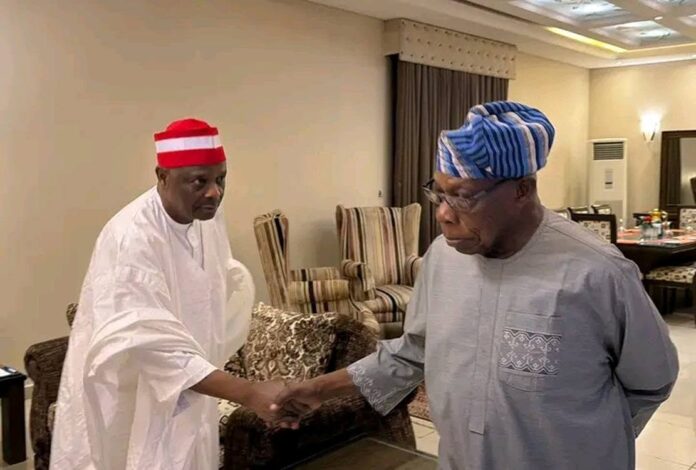


KANO, NIGERIA — Ahead of the 2027 general elections, the political landscape in Northern Nigeria witnessed a major strategic movement on Thursday night, June 25, 2026, as the Vice Presidential Candidate of the Nigeria Democratic Congress (NDC), Senator Rabiu Musa Kwankwaso, paid a high-profile courtesy visit to former President Olusegun Obasanjo.
The private meeting, which took place at Obasanjo’s temporary residence in Kano, comes at a time of heightened political realignment across the country following Kwankwaso’s recent move to the NDC alongside his coalition partner, Peter Obi.
Kwankwaso was accompanied to the closed-door session by Comrade Aminu Abdulsalam Gwarzo, the newly minted NDC Governorship Candidate for Kano State.
A Confluence of History and 2027 Calculus
While official statements from the Kwankwasiyya movement framed the late-night visit as a cordial exchange of views while the former president was in Kano on an official assignment, political analysts view the meeting as a significant consulting step for the emerging opposition axis.
The relationship between the two leaders is deeply rooted; Kwankwaso served as Nigeria’s Minister of Defence during President Obasanjo’s second cabinet from 2003 to 2007, and was later appointed as a Special Envoy to Somalia and Darfur under the same administration.
According to sources close to the development, the discussions focused heavily on national stability, the state of the economy, and the blueprint of the newly formed “OK Movement”—the powerful political alliance between Peter Obi’s support base and Kwankwaso’s mass structural machinery in the North.
Solidifying the NDC Grip on Kano
The presence of Comrade Aminu Abdulsalam Gwarzo at the meeting signals the NDC’s intent to aggressively lock down Kano State—traditionally Kwankwaso’s core stronghold—ahead of the next electoral cycle. Having finalized internal party structures and primary consensus under the NDC banner earlier this month, the Kwankwasiyya leadership is rapidly transitioning from internal party organizing to high-level stakeholder mapping.
Former President Obasanjo, who has historically positioned himself as an influential elder statesman guiding opposition mergers, is widely believed to be receptive to a strong, unified alternative platform capable of challenging the ruling All Progressives Congress (APC) in 2027.
The outcomes of the closed-door dialogue remain highly guarded, but the optics of the visit send a powerful signal to rival political camps that the NDC’s northern mobilization strategy is entering a critical, institutional phase.