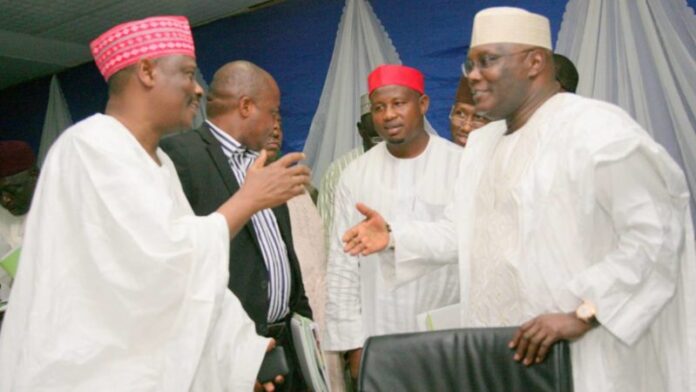

ABUJA — A high-stakes battle for the political soul of Northern Nigeria is intensifying ahead of the 2027 presidential election, setting up a fierce, direct confrontation between former Vice President Atiku Abubakar and the leader of the Kwankwasiyya movement, Senator Rabiu Musa Kwankwaso.
The rivalry between these two political titans has split the northern electorate along distinct ideological, structural, and generational lines.
With both leaders anchoring separate opposition platforms following the dramatic political realignments of May 2026, analysts are closely parsing who commands the authentic mandate of the North.
The Structural Divide: ADC vs. NDC
The race to present a unified northern front against the ruling All自动 Progressive Congress (APC) has effectively fractured into two competing partisan vehicles.
The ADC Establishment Ticket
Alhaji Atiku Abubakar has solidified his position under the umbrella of the African Democratic Congress (ADC), securing its presidential ticket. The ADC has become the preferred vehicle for the traditional northern political establishment, retired diplomats, and a network of elite power brokers who view Atiku as the most reliable custodian of northern interests.
The NDC Populist Front
Conversely, Senator Kwankwaso and former Anambra State Governor Peter Obi orchestrated a high-profile exit from the ADC to anchor the newly formed Nigeria Democratic Congress (NDC). Within this new alignment, stakeholder consensus strongly points toward a unified, cross-regional ticket. This structural split means the northern opposition vote will be fundamentally divided, with Atiku pulling from formal party apparatuses and Kwankwaso relying on deeply entrenched grassroots structures.
Cultural Identity: The “Cosmopolite” vs. The “Populist”
The core northern electorate—particularly the talakawa (working class) and conservative religious demographics—views both candidates through vastly different cultural lenses.
Atiku: The Cosmopolitan Elite
Atiku is frequently perceived by core northern voters as a “diluted” regional representative. Critics paint him as an elite businessman who is more at home in the boardrooms of Abuja, Lagos, or Dubai than the local markets of the Northeast.
His pro-market economic stances and his cautious handling of sensitive regional flashpoints—such as the deletion of his social media post regarding the Deborah Samuel tragedy—have alienated hardline northern conservatives who view him as ideologically compromised for national political expediency.
Kwankwaso: The Mass Champion
In contrast, Kwankwaso is viewed as an “undiluted” son of the soil. His red-capped Kwankwasiyya movement commands an almost religious devotion throughout Kano and parts of the Northwest.
By prioritizing local language rhetoric, mass weddings, and local educational scholarships, Kwankwaso has positioned himself as a fierce defender of the northern masses. However, political analysts warn that this intensely localized appeal acts as a double-edged sword; while it secures a fortress of votes in the Northwest, it often alienates voters in the Southern part of the country.
Persistence vs. Desperation: The 1999 Baggage
A significant narrative hurdle for the former Vice President is his long-running quest for the nation’s top job. Having contested in nearly every presidential cycle since 1993—either as a frontline aspirant or a flagbearer—Atiku faces an aggressive “desperation” label from opponents.
While his loyalists attempt to reframe this decades-long persistence as a testament to institutional experience, resilience, and readiness to govern, critics successfully weaponize it. To an increasingly cynical electorate, the continuous bids portray a politician driven by personal ambition rather than a modern national vision, hindering his ability to attract independent and younger voters.
The Generational Factor: Age and Campaign Stamina
As the demands of a nationwide presidential campaign loom, physical stamina and age have emerged as critical metrics for the electorate.
Atiku’s Octogenarian Hurdle
Born in November 1946, Atiku Abubakar will be 80 years old during the 2027 election cycle. In a country where over 60% of the population is under the age of 30, his advanced age is a significant political liability. Opponents are already grouping him with the passing generation of old-guard politicians and questioning his capacity to withstand the rigors of governance.
Kwankwaso’s Generational Edge
Born in October 1956, Kwankwaso will be 70 years old in 2027. While far from a youth candidate, being a decade younger than Atiku gives him a distinct advantage in perceived energy, physical presence on the campaign trail, and relatability to a younger voting demographic seeking an alternative to octogenarian leadership.
Verdict: Regional Spread vs. Local Intensity
Ultimately, the battle for northern dominance will come down to a choice between geographical spread and local intensity. Atiku retains the ability to pull moderate, elite-driven votes across all nineteen northern states due to his extensive network.
However, Kwankwaso possesses an unmatched, highly concentrated voter turnout machine in the most populous voting corridors of the Northwest. How these two forces cancel each other out will ultimately determine whether the North can mount a unified challenge to the incumbent presidency in 2027.