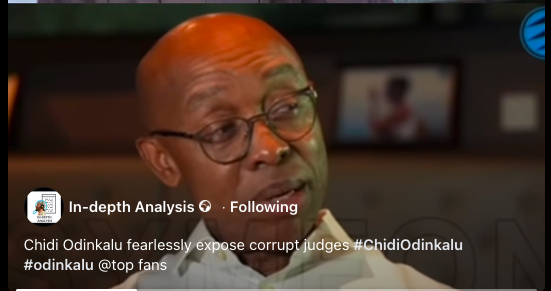


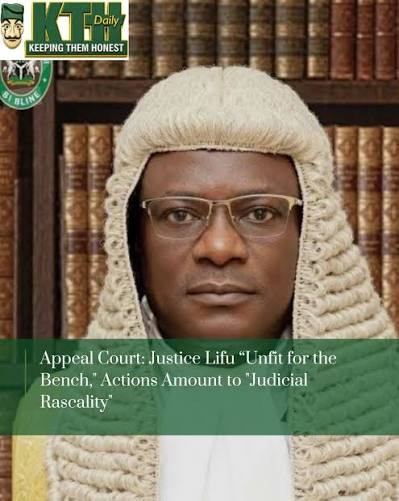
ABUJA, NIGERIA — Human rights activist and former Chairman of the National Human Rights Commission (NHRC), Professor Chidi Anselm Odinkalu, has launched a blistering assault on the integrity of Nigeria’s federal judiciary. He raised dark questions over how a High Court judge, reportedly recovering from a stroke, could have authored a complex, 103-page verdict.
The controversy follows a shocking judgment delivered by Justice Peter Lifu of the Federal High Court in Abuja, which ordered the Independent National Electoral Commission (INEC) to de-register five political parties. The ruling has been heavily criticized by the Court of Appeal as an act of “judicial rascality,” given that the appellate court had already ordered a stay of proceedings on the matter.
“I Don’t Think Our Judges Write Their Judgments”
Speaking on the suspicious circumstances surrounding the sudden emergence of the lengthy verdict, Odinkalu openly questioned the authorship of the text. He suggested that the document may have been drafted by external political interests and handed down to a compromised or incapacitated bench.
“Peter Lifu is sick and recovering from stroke,” Odinkalu stated bluntly. “How could he have written a 103-page judgment? I don’t think our judges write their judgments anymore.”
The academic and legal expert argued that the phenomenon of “verdict without justice” has devolved into a system where powerful politicians retain judicial actors on their personal payrolls to rubber-stamp illegalities.
“To be a successful politician in Nigeria today,” Odinkalu added with deep cynicism, “you need to have a judge in your pocket.”
The Anatomy of “Lifusprudence”
Justice Lifu’s judgment targeted the African Democratic Congress (ADC), People’s Progressive Party (APP), Action Alliance (AA), Alliance for Democracy (AD), and Zenith Labour Party (ZLP), directing their immediate exclusion from future election ballots.
| Controversy Axis | Breakdown of the Outcry Surrounding Justice Lifu |
| The Disregarded Order | Delivered judgment 25 days after the Court of Appeal expressly ordered a stay of all proceedings. |
| Physical Impossibility | Integrity advocates question how an ailing judge wrote 103 pages of technical text. |
| Appellate Rebuke | The Court of Appeal labeled Lifu’s actions “the highest form of judicial impertinence”. |
| Systemic Threat | Civil society groups warn that “purchasable jurisprudence” threatens the integrity of the 2027 general elections. |
Legal analysts have noted that the suit, brought forward by the Incorporated Trustees of the National Forum of Former Legislators (NFFL), shouldn’t have been heard because the plaintiffs lacked the legal standing (locus standi) to bring the case forward in the first place.
Furthermore, evidence presented in court confirmed that the targeted political parties had actually won elective seats across the federation. Justice Lifu simply chose to re-interpret the Constitution, ruling that lawmakers who defected to the ruling party after winning their seats no longer counted toward their original party’s performance metrics.
A Call for the NJC to Step In
The Court of Appeal has moved rapidly to vacate the controversial judgment and stay its execution, protecting the targeted opposition groups from immediate de-registration. However, the incident has sparked widespread demands for institutional accountability.
A coalition of civil society organizations, led by the Tap Initiative for Citizens’ Development, has submitted a formal petition to the National Judicial Council (NJC) and the Chief Justice of Nigeria. The petition demands an immediate investigation into Justice Lifu’s professional conduct.
Activists warn that if the NJC fails to penalize judges who disregard appellate court orders to serve political godfathers, the public’s trust in the judiciary will be completely ruined ahead of the upcoming 2027 electoral cycle.