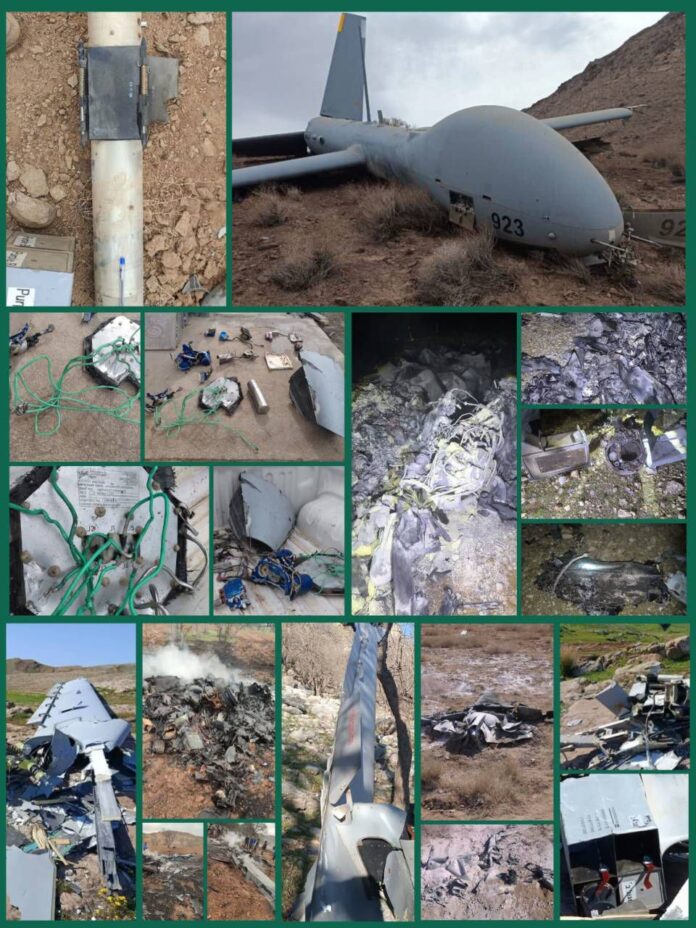


TEHRAN / WASHINGTON — In a serious escalation that threatens to shatter a fragile, externally mediated peace framework, the Islamic Revolutionary Guard Corps (IRGC) has announced the successful shootdown of yet another United States military MQ-9 Reaper drone.
The high-tech, unmanned surveillance and strike aircraft—valued at roughly $30 million—was reportedly intercepted and blown out of the sky over the southwestern city of Andimeshk in Iran’s Khuzestan Province.
The Interception: Debut of a New Air Defense System
According to an official communique released by the public relations department of the IRGC, the operation was executed cleanly by the force’s elite Aerospace Division.
Iranian military authorities claim the advanced American drone was actively tracked immediately upon breaching monitored boundary zones before being neutralized.
“An enemy MQ-9 drone was intercepted and destroyed in the skies over Andimeshk by the IRGC Aerospace Force’s new air defense system.”
— Official Statement via Tasnim News Agency
Tehran has capitalized on the incident to showcase its domestic military engineering, explicitly noting that the hardware utilized to bring down the Reaper drone represents a newly deployed, highly modern tier of its integrated air defense network.
A Fragile Ceasefire Fractures
The loss of the Reaper drone comes at a highly volatile diplomatic juncture. Tensions between Washington and Tehran had recently shown signs of stabilization following a complex, Pakistan-mediated memorandum of understanding aimed at formalizing a cessation of hostiles on all major fronts.
However, the reality in the skies and waterways tells a completely different story:
        THE CEASEFIRE MEMORANDUM                 THE OPERATIONAL FRICTION
 ┌──────────────────────────────┐             ┌───────────────────────────────┐
 │ • Pakistan-mediated pact     │             │ • Continuous U.S. drone       │
 │   intended to halt attacks.  │     VS.     │   reconnaissance sweeps.      │
 │ • Designed to chart a path   │             │ • U.S. naval escorts passing  │
 │   toward lasting regional    │             │   through disputed corridors  │
 │   de-escalation.             │             │   in the Strait of Hormuz.    │
 └──────────────────────────────┘             └───────────────────────────────┘
Iranian defense officials argue that U.S. flights represent a direct breach of territorial sovereignty. The IRGC claims its aggressive response is a direct reaction to what it characterizes as ongoing American attempts to illegally escort commercial vessels through unapproved lanes in the vital Strait of Hormuz maritime corridor.
The Mounting Toll on U.S. Unmanned Systems
This latest downing adds to a growing and highly problematic tally for the United States Air Force and naval operations in the Middle Eastern theater. The MQ-9 Reaper is a linchpin of American intelligence collection, but it has proven increasingly vulnerable to the sophisticated anti-air capabilities being deployed by Iran and its regional affiliates.
| Drone Model | Estimated Per-Unit Cost | Primary Mission Parameters | Vulnerability Status |
| MQ-9 Reaper | ~$30 Million | Long-endurance, high-altitude surveillance & precision strikes. | Multiple units confirmed lost to ground-to-air defense systems. |
The Response from Washington
The United States Department of Defense and U.S. Central Command (CENTCOM) have yet to release a detailed validation statement confirming the operational loss of the asset over Iranian soil. Historically, U.S. officials maintain that their unmanned surveillance assets operate strictly within international airspace or authorized corridors, frequently accusing Iranian forces of reckless and unlawful behavior in international transit zones.
With billions of dollars in hardware lost over the duration of recent regional friction, this latest shootdown signals to Washington that despite ongoing backdoor diplomatic negotiations, Iran’s military apparatus remains fully operational, highly reactive, and completely unwilling to tolerate American presence within its domestic radar envelopes.