
.
.
.
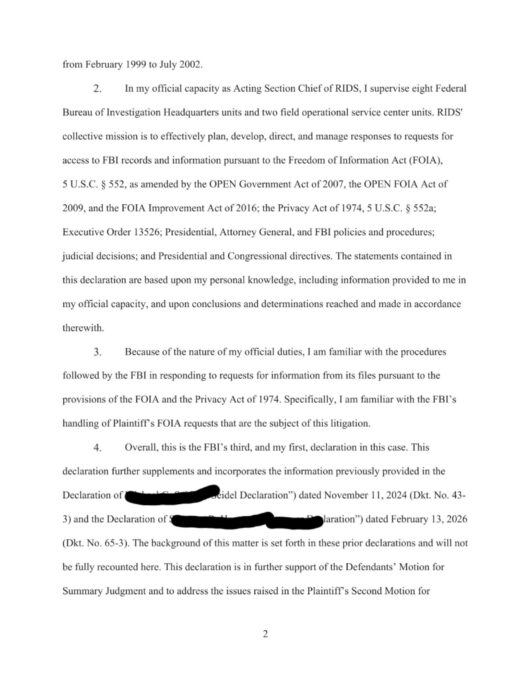
WASHINGTON — A newly filed FBI declaration in a long-running Freedom of Information Act lawsuit states that records at issue in the case were compiled as part of an investigation into “multiple individuals” for drug trafficking crimes, according to court documents submitted in the U.S. District Court for the District of Columbia.
The declaration is the latest filing in Aaron Greenspan v. Executive Office for United States Attorneys, et al., Civil Action No. 1:23-cv-1816 (BAH), a case transparency activist and PlainSite founder Aaron Greenspan brought in June 2023 after several federal agencies refused to confirm or deny the existence of records he sought.
Background
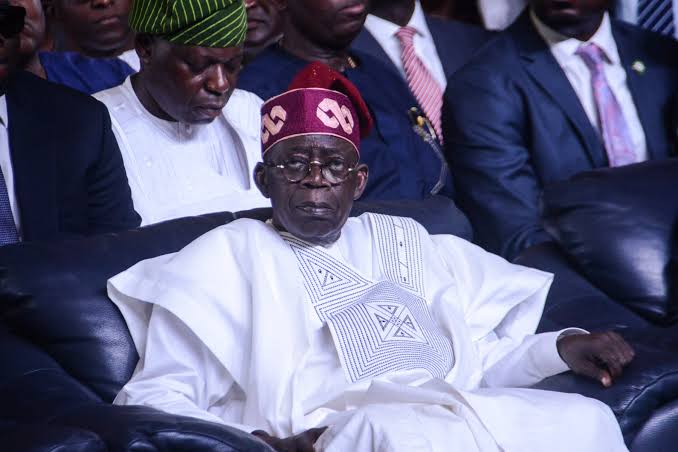
Between 2022 and 2023, Greenspan filed 12 FOIA requests with six federal agencies — including the FBI, the Drug Enforcement Administration (DEA), the IRS, the State Department, U.S. Attorneys’ offices in Indiana and Illinois, and the CIA — seeking investigative records tied to a Chicago-based heroin trafficking and money-laundering operation from the early 1990s. The requests named four individuals allegedly connected to the case: Nigerian President Bola Ahmed Tinubu, Lee Andrew Edwards, Mueez Abegboyega Akande, and Abiodun Agbele.
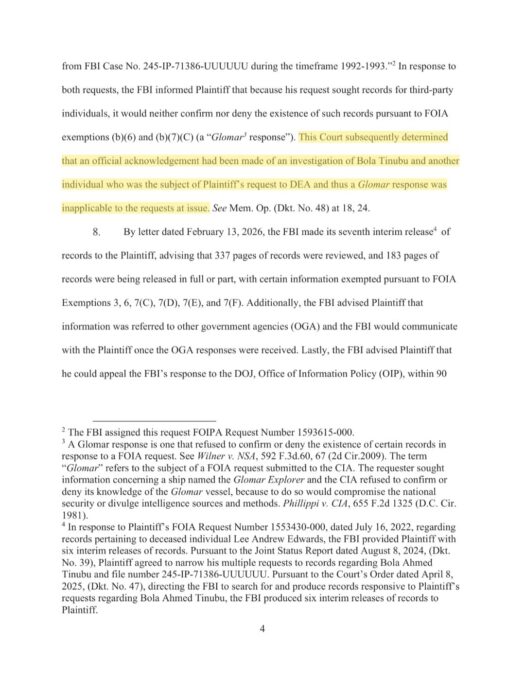
Most agencies initially issued so-called “Glomar” responses — declining to confirm or deny that responsive records existed. Greenspan challenged those responses in court. The judge overseeing the case, Beryl Howell, ruled that an official acknowledgment had already been made that Tinubu, along with another individual named in Greenspan’s request to the DEA, was the subject of an investigation — meaning a Glomar response was no longer available to the government on those requests. That ruling established, as a matter of the court record, that Tinubu had been under federal investigation.
The Latest Filing
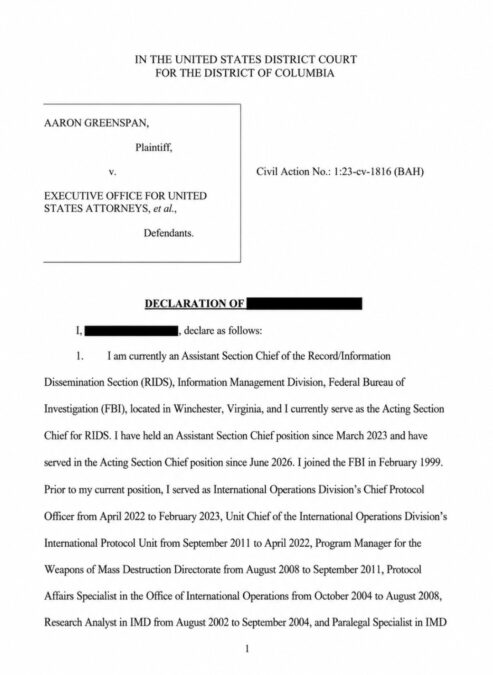
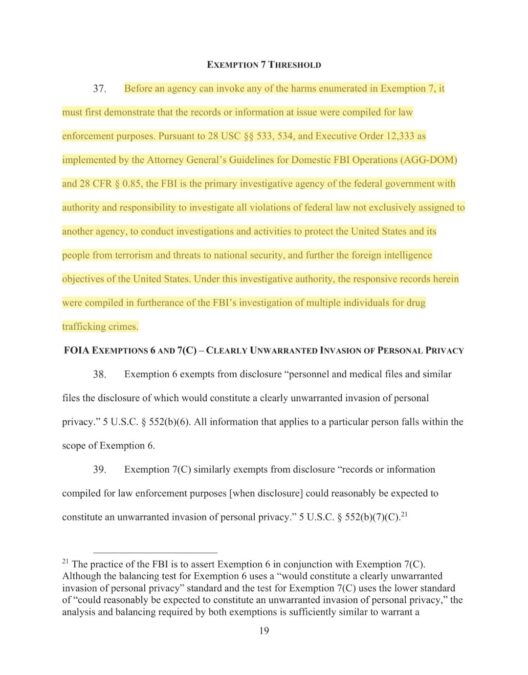
The declaration, submitted by an Acting Section Chief in the FBI’s Record/Information Dissemination Section, is the bureau’s third in the case and was filed in support of the government’s motion for summary judgment. In it, the FBI lays out its legal basis for withholding certain material under FOIA Exemption 7, which shields records “compiled for law enforcement purposes” from disclosure under specified conditions.
Citing its statutory authority to investigate violations of federal law, the FBI states that the records at issue “were compiled in furtherance of the FBI’s investigation of multiple individuals for drug trafficking crimes.” The filing does not, in the portion made public, break down that description name-by-name among the four individuals originally identified in Greenspan’s requests. But because the court has already established on the record that Tinubu was one of the people the government’s Glomar response could no longer shield — and the records at issue stem directly from the same requests naming him — the filing is being read by parties following the case, including Greenspan’s counsel, as further confirmation that Tinubu was among those investigated.
Elsewhere in the filings, the FBI separately invokes Exemptions 6 and 7(C), both of which are aimed at shielding personal information whose release would constitute an unwarranted invasion of privacy — arguing that essentially any information tied to a specific individual falls within Exemption 6’s scope.
The Broader Fight Over Disclosure
The dispute has escalated in recent weeks. The FBI has separately asked the court for permission to submit additional, classified-style declarations ex parte and in camera — meaning privately, without Greenspan or the public seeing them — arguing that fully explaining certain withholdings on the public record could disclose law enforcement techniques or endanger someone’s safety. Greenspan has opposed that request.
President Tinubu has also intervened directly in the litigation. Through his legal team, he has urged the court to reject Greenspan’s motion for summary judgment and to let the FBI and DEA retain redactions in records already produced, citing privacy grounds. Tinubu has denied any wrongdoing in connection with the underlying allegations, which date to a 1993 civil forfeiture proceeding involving roughly $460,000 in funds authorities linked to him at the time.
As of late August 2026, the case remained before Judge Howell, with both sides continuing to file competing motions over how much of the FBI’s historical file should be made public.