


Washington, D.C. — August 29, 2026
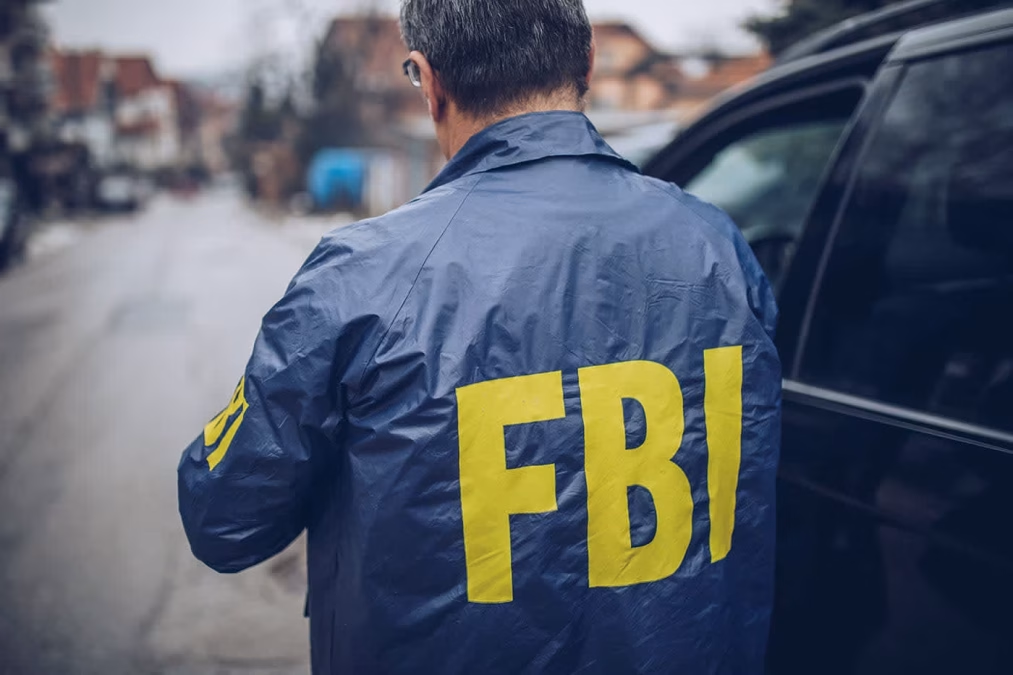
The Federal Bureau of Investigation has submitted records relating to Nigerian President Bola Ahmed Tinubu to U.S. District Judge Beryl A. Howell for private review, marking the latest turn in a three-year-old Freedom of Information Act (FOIA) battle over decades-old investigative files tied to the Nigerian leader.
According to reports from Peoples Gazette Nigeria and Punch Newspapers, the FBI filed the material under seal on Friday, August 28, 2026, in compliance with a court deadline set earlier in the month. The submission was made ex parte and in camera — meaning it was shown only to the judge, not to the plaintiff or the public — while the court weighs the agency’s arguments for continuing to withhold portions of the records.
What the FBI Is Arguing
The FBI’s push for confidential review is not new. In a four-page motion filed on August 20, 2026, government lawyers asked Judge Howell for permission to submit declarations explaining, outside the public record, the full basis for withholding certain information. The motion was filed in the case of Aaron Greenspan v. Executive Office for U.S. Attorneys, et al., Civil Action No. 23-1816 (BAH), and was submitted on behalf of the government by U.S. Attorney Jeanine Ferris Pirro and Assistant U.S. Attorney Samantha-Josephine Baker.
A proposed order attached to the filing asked Howell to grant the request “for good cause shown.” Greenspan’s legal team opposed the move.
Court filings cited by multiple Nigerian outlets indicate the FBI is relying on several FOIA exemptions covering personal privacy, protection of confidential sources, sensitive law-enforcement techniques, and information the agency says could endanger the safety of individuals if disclosed. The records at issue involve two separate requests — one for the FBI’s complete file on Tinubu, and another for interview reports, known as Form 302s, connected to an FBI case dating back to 1992 and 1993.
The Underlying Case
The dispute traces back to a lawsuit filed in June 2023 by American transparency activist Aaron Greenspan, founder of the legal-records site PlainSite. Greenspan had filed twelve FOIA requests with six federal agencies between 2022 and 2023, seeking records involving four individuals — Tinubu, Lee Andrew Edwards, Mueez Abegboyega Akande, and Abiodun Agbele — reportedly tied to a 1990s narcotics investigation. The suit named the Executive Office for U.S. Attorneys, the State Department, the FBI, the IRS, the DEA, and the CIA as defendants.
Several of the agencies initially responded with what is known in U.S. law as a “Glomar” response — refusing to even confirm or deny that responsive records existed. Judge Howell rejected that position in April 2025, ruling that the FBI and DEA had not shown a sufficient legal basis for concealing whether such records existed at all. She found that the agencies had failed to establish a privacy interest sufficient to justify secrecy over the fact that Tinubu had been the subject of a criminal investigation. Howell described the agencies’ position as “neither logical nor plausible.”
A Contested Timeline
The case has moved in fits and starts through 2026, with the government repeatedly seeking more time. On August 19, 2026, Howell rejected a request from government lawyers for a full ten-day extension to comply with her disclosure order, granting only four additional days and setting a new deadline of August 21 — while noting the case had already been pending for more than three years. The extension request had come from the office of U.S. Attorney Jeanine Pirro, with Tinubu’s own legal team — Christopher W. Carmichael and Victor P. Henderson of Henderson Parks, LLC — joining that motion.
A Washington-based lobbying and policy advisory firm, Von Batten-Montague-York, which has been tracking the case closely on social media, suggested the requested delay could have given Tinubu’s team more time to lobby U.S. officials against release of the records — an allegation that has not been independently verified.
Following the denial of the full extension, Howell set August 28, 2026, as the deadline for the FBI, DEA, Department of Justice, and Tinubu’s legal team to file their final oppositions to public release of the records. The FBI’s sealed submission on that date appears to be its response to that directive.
What Happens Next
With the material now before her, Judge Howell must determine which portions of the records can lawfully remain withheld under FOIA exemptions and which — if any — must ultimately be released to the public. The judge’s private review does not itself constitute disclosure; the records remain sealed and inaccessible to Greenspan’s legal team, the press, or the public pending her ruling.
The Nigerian Presidency has previously maintained that the records in question contain no new or incriminating information, arguing that reports connected to the decades-old investigation have long been in the public domain. That claim has not been tested against the sealed material, which only the judge has now seen.
No timeline has been given for when Judge Howell is expected to rule on the FBI’s request to withhold the material, or on the broader summary judgment motion in the case.