


[
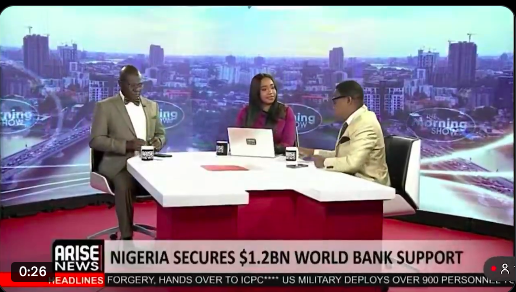
ABUJA — Tensions flared live on air during Thursday morning’s broadcast of The Morning Show on Arise News, as co-anchors Dr. Reuben Abati and Rufai Oseni clashed over a brewing budgetary scandal in the presidency.
The live television friction erupted when Oseni attempted to steer the broadcast toward the widening controversy surrounding the Chief of Staff to the President, Rt. Hon. Femi Gbajabiamila, and a controversial ₦1.3 billion allocation to a “phantom” presidential council.

The Clashing Editorial Approaches
As Oseni began introducing the multi-billion Naira financial discrepancy involving the Presidential Foreign Intervention Promotion Council (PFIPC), Abati quickly and firmly intervened to cut off the line of questioning.
- Abati’s Position: The veteran journalist and former presidential spokesperson insisted that the topic was entirely outside the pre-arranged editorial schedule for the morning’s program. Abati firmly maintained that the panel had a responsibility to stick strictly to the agreed-upon agenda rather than introducing unvetted, breaking updates mid-broadcast.
- Oseni’s Stance: Oseni, known for his aggressive, public-interest approach to governance and fiscal accountability, appeared visibly restricted by the intervention but eventually complied as the program moved forward into its scheduled segments.
Why the Subject Remains Highly Volatile
The on-air standoff mirrors the broader political sensitivity surrounding the issue in Abuja. The controversy stems from a stark contradiction between official public statements and the 2026 Federal Government budget:
| Public Official / Document | Official Position on the Council |
| Rt. Hon. Femi Gbajabiamila (Chief of Staff) | Issued an explicit public disclaimer asserting that the Presidential Foreign Intervention Promotion Council (PFIPC) does not exist within the structure of the Tinubu administration. |
| 2026 FGN Appropriation Act | Explicitly captures the entity under Code 0111062001 with an approved total allocation of ₦1,302,978,784 for personnel, overhead, and capital expenses. |
The quick shutdown of the discussion on national television has already fueled intense conversations among viewers and media watchdogs across Nigerian digital spaces. While some argue that sticking to pre-production agendas is essential for structured live television, critics contend that the immediate squashing of the ₦1.3 billion budgeting discrepancy prevents a necessary public-interest dissection of executive accountability.







