


By Izunna Okafor, Awka
Football is often described as more than a game. It is emotion, identity, culture, community and, for millions around the world, a way of life.
Across continents, football clubs command extraordinary loyalty from supporters who invest not only their money but also their hearts, time, energy and emotional well-being into the fortunes of their beloved teams.
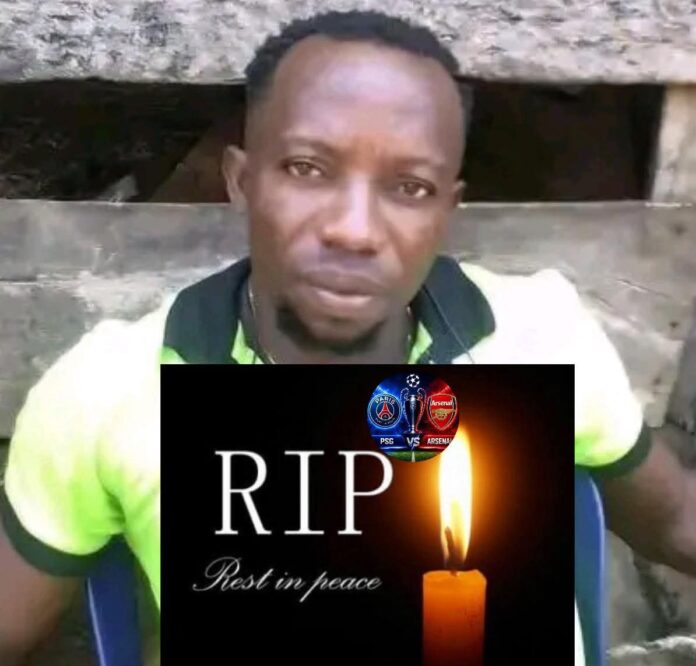
That is why the tragic death of Mazi Chibuzor Nzediegwu, a devoted Arsenal Football Club fan and supporter from Umudieleke Umuoru Village in Uga community, Aguata Local Government Area of Anambra State, Nigeria, has resounded far beyond his immediate family and community.
Reports indicate that Nzediegwu, a popular poultry and livestock trader at Orie Uga Market, suffered a fatal heart attack on Saturday, May 30th, 2026, while watching Arsenal’s UEFA Champions League final encounter against Paris Saint-Germain (PSG). He was said to have collapsed amid the tension and emotional intensity of the match when the PSG scored the equalizing goal against Arsenal, and was immediately rushed to the hospital, where he was later confirmed dead despite efforts to save his life. Nze reportedly left behind his wife, mother, little children and other family relatives.

His burial, which took place the following day in his hometown, drew family members, friends, neighbours, sympathizers and community leaders. Videos from the emotional ceremony have continued to trend endlessly on social media, drawing reactions from football lovers across Nigeria and beyond.
While death can come under different circumstances and while medical experts rightly caution against drawing simplistic conclusions regarding sudden cardiac events, the symbolism of this particular tragedy cannot be ignored. Here was a man whose passion for Arsenal was so deep that the final moments of his life were spent following the fortunes of the club he loved.
Based on the foregoing, a pertinent question therefore arises: Should Arsenal Football Club simply move on, or should the club acknowledge the sacrifice and loyalty of a fan and supporter whose devotion remained firm and steadfast until his final breath?
Across the football world, there is this growing recognition and acknowledgement that supporters are not merely customers but stakeholders, custodians of tradition and the living soul of every football institution. Modern football clubs increasingly understand that their greatest asset is not television revenue, sponsorship deals or transfer budgets, but the emotional bond that exists between the club and its supporters/fans.
Over the years, this philosophy and understanding has given rise to a culture of remembrance, solidarity and compassionate outreach whenever tragedy strikes members of a club’s fan base.
Arsenal FC itself has a history of recognising and honouring loyal supporters. In December 2015, the club publicly paid tribute to lifelong fan, Ernie Crouch, who died in an accident on December 5, when high winds blew him into the side of a moving bus near Finchley Central station as he was traveling to watch an Arsenal match against Sunderland. Arsenal FC expressed condolences to the family of the deceased who died at the age of 90, while players and former club legends joined in paying tribute to his decades of loyalty.

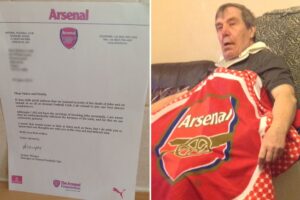
In another touching example, former Arsenal Manager, Arsène Wenger, in June 2015, personally sent a letter of condolence to the family of lifelong Arsenal supporter, John Cook following his death. Wenger’s message acknowledged the fan’s dedication and expressed gratitude on behalf of Arsenal Football Club for his staunch support. The gesture deeply touched the bereaved family and became a shining example of the human side of football.
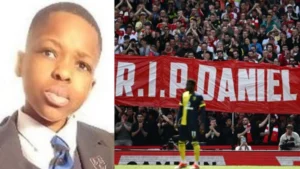
Similarly, Arsenal FC supporters and the club community, in May 2024, paid tribute to a 14-year-old fan, Daniel Anjorin, a British-Nigerian, who was tragically murdered by a sword-wielding attacker in London on April 30th.
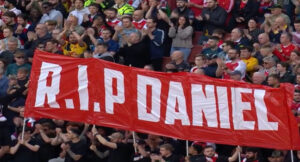
In their game against Bournemouth on Saturday that week, the Gunners paused play in the 14th minute as fans clapped in honour of the 14-year-old Anjorin whose favourite player was Bukayo Saka. A moment of remembrance was observed for him at the Emirates Stadium, as the scoreboard beamed Daniel’s image with banners reading “R.I.P Daniel” displayed in various parts of the Emirates Stadium in honour of the late teenage Arsenal fan, showing that football clubs can play a meaningful role in helping families and communities heal from their loss and pains.

Arsenal is not alone in this tradition. In November 2016, Crystal Palace FC publicly extended condolences and solidarity to the family of supporter Dane Chinnery after he lost his life in a tragic accident. The club’s leadership, players and staff united in expressing sympathy and support.




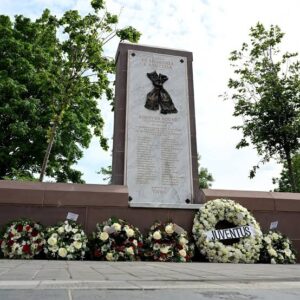
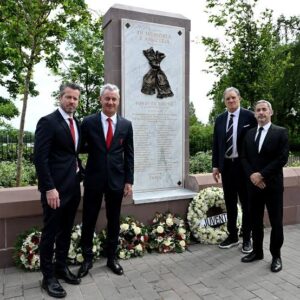
Liverpool Football Club has also established a global reputation for memorialising supporters and victims of football-related tragedies. From Hillsborough to Heysel, the club has repeatedly demonstrated that remembrance is not merely ceremonial but a moral obligation. Liverpool’s recent unveiling of a new memorial honouring victims of the Heysel disaster reinforces the principle that football clubs must preserve the memory of those whose lives became intertwined with the game.

These examples reflect what has become an international best practice in modern football administration: clubs should maintain meaningful relationships with their supporter communities and respond compassionately when tragedy affects those communities.
Indeed, the governing philosophy behind supporter engagement frameworks promoted throughout European football is that clubs owe a duty of care and moral responsibility toward the people whose loyalty sustains them. While there may be no legal requirement compelling a club to intervene whenever a supporter dies, there is undoubtedly a powerful ethical expectation that clubs should acknowledge extraordinary acts of loyalty and devotion.
It is within this context that Arsenal Football Club should consider taking steps to honour the memory of Chibuzor Nzediegwu.

Such gestures need not be extravagant. It could be by a letter of condolence from the club’s leadership, message from the Club’s Manager, Mikel Arteta; a commemorative jersey presented to the family, a signed memorabilia package, a mention on the club’s official platforms, a video message from players, an invitation for a family representative to visit the Emirates Stadium, or any other befitting was. Any of these would send a strong message that Arsenal values not only trophies and titles but also the supporters whose passion fuels the club’s existence.
For the grieving Nzediegwu family, such recognition would provide comfort during this unimaginably difficult period of sorrow. For millions of Arsenal supporters across Africa, it would demonstrate that the club genuinely appreciates the loyalty of its global fan base.




The significance of such a gesture extends beyond one family. Nigeria remains one of Arsenal’s largest international support bases. Across cities, towns and villages, countless supporters wake up at odd hours, spend hard-earned income on subscriptions and merchandise, and passionately follow every kick of the ball. These supporters may never set foot inside the Emirates Stadium, yet they remain emotionally invested in the club’s fortunes.
Chibuzor Nzediegwu represented this global Arsenal family. He was one of millions whose connection to the club transcended geography, language and nationality.
His death should not be reduced to another viral social media story or a fleeting news headline. It should serve as a reminder of the serious emotional influence football exerts over people’s lives.
Football clubs often celebrate their supporters during moments of victory. The true measure of their humanity, however, is revealed in how they respond during moments of grief.
Arsenal Football Club has an opportunity to demonstrate that its famous slogan, “Victoria Concordia Crescit” (Victory Through Harmony) extends beyond the pitch and into the lives of the supporters who make the club what it is.
As tears continue to flow in Umudieleke Umuoru Village, Uga, and as the family of Chibuzor Nzediegwu struggles to come to terms with the reality of this irreplaceable loss, there is this simple hope and expectation among many football lovers across Nigeria that Arsenal Football Club will reach out, stand with the family, and honour the memory of a loyal Gunner whose love for the club endured until the very end of his life.
Although, such a gesture would not change what happened. However, it would ensure that Chibuzor Nzediegwu is remembered not merely as a fan who died watching football, but as a devoted supporter whose loyalty was recognised by the club he loved and cherished till the very last breath of his life.
======================
Izunna Okafor writes from Awka, Anambra State, Nigeria. He writes at izunnaokafor70@gmail.com .
*******************************