
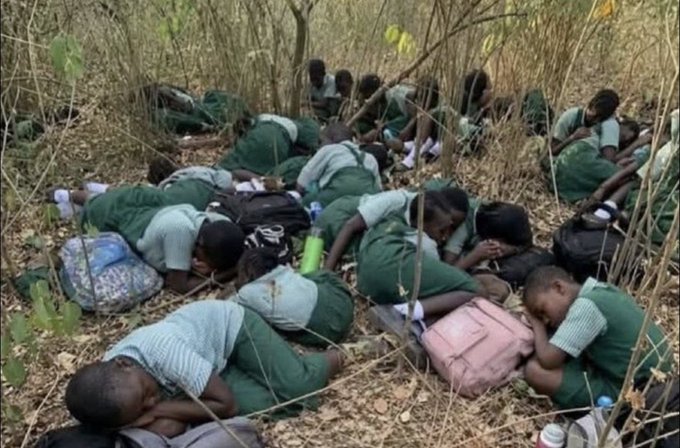


The safe return of the 45 pupils and teachers abducted from Oriire Local Government Area of Oyo State after 56 days in the belly of the forest is, by all accounts, a profound relief. In a nation where kidnapping has institutionalized itself as a grim lottery, any outcome that does not end in mass graves or shallow trenches deserves a moment of thanksgiving.
Yet, as the dust settles, the triumphalist narrative being spun by the state is running headlong into a wall of public cynicism. The recent revelations by retired Assistant Director-General of the Department of State Services (DSS), Mohammed Ngoshe, paint a picture of brilliant tactical patience—a masterclass in waiting out the enemy until the children were safely handed over before launching a retributive offensive.
It is a neat, comforting story. But for a Nigerian public long accustomed to the theater of security propaganda, the official script leaves too many pages blank.
The first point of friction lies in the sheer timeline of the ordeal. For nearly two months, children were subjected to the brutal elements of the Old Oyo National Park. We are told that security forces deliberately held back their kinetic might to avoid collateral damage—a standard and defensible hostage-negotiation protocol. But this explanation fails to address the foundational question: How did an armed convoy manage to abduct scores of citizens in a state that boasts multiple security architectures, and vanish into the bush without immediate interception? The “patience” praised by the authorities looks, to the aggrieved families, dangerously like an afterthought following a catastrophic failure of initial deterrence.
Furthermore, the mechanics of the release demand deep scrutiny. We are asked to believe that the terrorists—a group sophisticated enough to hold the state at bay for 56 days—naively handed over their only bargaining chips, their human shields, under the delusion that the military would simply pack up and let them walk away. To suggest that hardened criminals surrendered their leverage out of tactical ignorance insults the intelligence of the public.
This brings us to the unspoken elephant in the room: the money. The federal government has consistently maintained a policy of non-negotiation and zero ransom payments. Yet, the history of the Nigerian kidnapping industry tells a vastly different story of covert transactions, nocturnal cash drops, and intermediaries operating in the shadows. Did the Oriire terrorists truly collapse under the weight of a logistical siege, or did they walk away with bags of cash, leaving behind a face-saving narrative for the security agencies?
The Senate’s recent refusal to launch a deep, independent legislative probe into the Oyo incident only deepens these suspicions. By substituting a thorough structural investigation with a ₦50 million compensatory package for the families of fallen heroes, the parliament chose optics over accountability. Payouts are necessary, but they cannot buy the silence of a democracy.
Operational secrecy is vital during a crisis; no one expects the military to broadcast its coordinates on the radio while children are in jeopardy. But once the captives are out, the curtain must be drawn back. The absolute lack of post-operation transparency—the refusal to parry skepticism with verified facts, arrested suspects, or detailed debriefings—is what transforms a legitimate tactical success into a breeding ground for conspiracy theories.
If the security high command wishes to defeat public cynicism, it must stop treating Nigerians like spectators in a theater of shadows. We celebrate the return of the Oriire children, but we refuse to applaud a system that demands blind faith while keeping the truth locked away in the forest. Accountability is not an enemy of national security; it is its ultimate foundation.