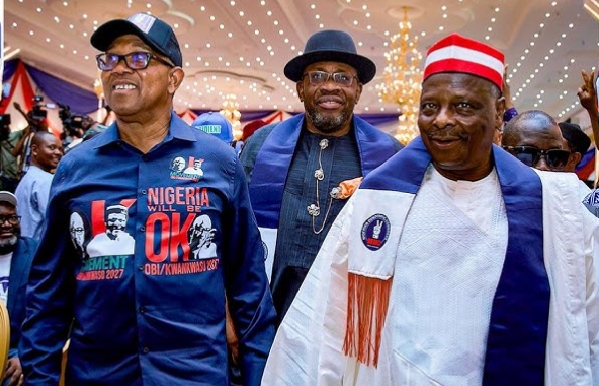


ABUJA, Nigeria — The ambitious political alliance designed to unseat the ruling All Progressives Congress (APC) in 2027 is facing a dual crisis of internal betrayal and state-sponsored disruption. Fresh details from within the newly formed Nigeria Democratic Congress (NDC) have revealed an explosive leadership battle between its National Leader, Seriake Dickson, and its 2027 vice-presidential candidate, Senator Rabiu Musa Kwankwaso.
This severe internal friction is unfolding against the backdrop of what opposition stalwarts describe as a highly coordinated, cloak-and-dagger campaign by the Bola Tinubu administration to systematically destabilise rival political platforms—including the Labour Party (LP), the New Nigeria Peoples Party (NNPP), and the African Democratic Congress (ADC)—using the judiciary and federal institutions to enforce a de facto one-party state.
The Early Warnings Peter Obi Ignored
The foundation of the current NDC crisis traces back to the party’s formative stages. Political insiders reveal that former Anambra State Governor Peter Obi was explicitly warned by political colleagues against forming an alliance with the former Bayelsa State Governor, Seriake Dickson.
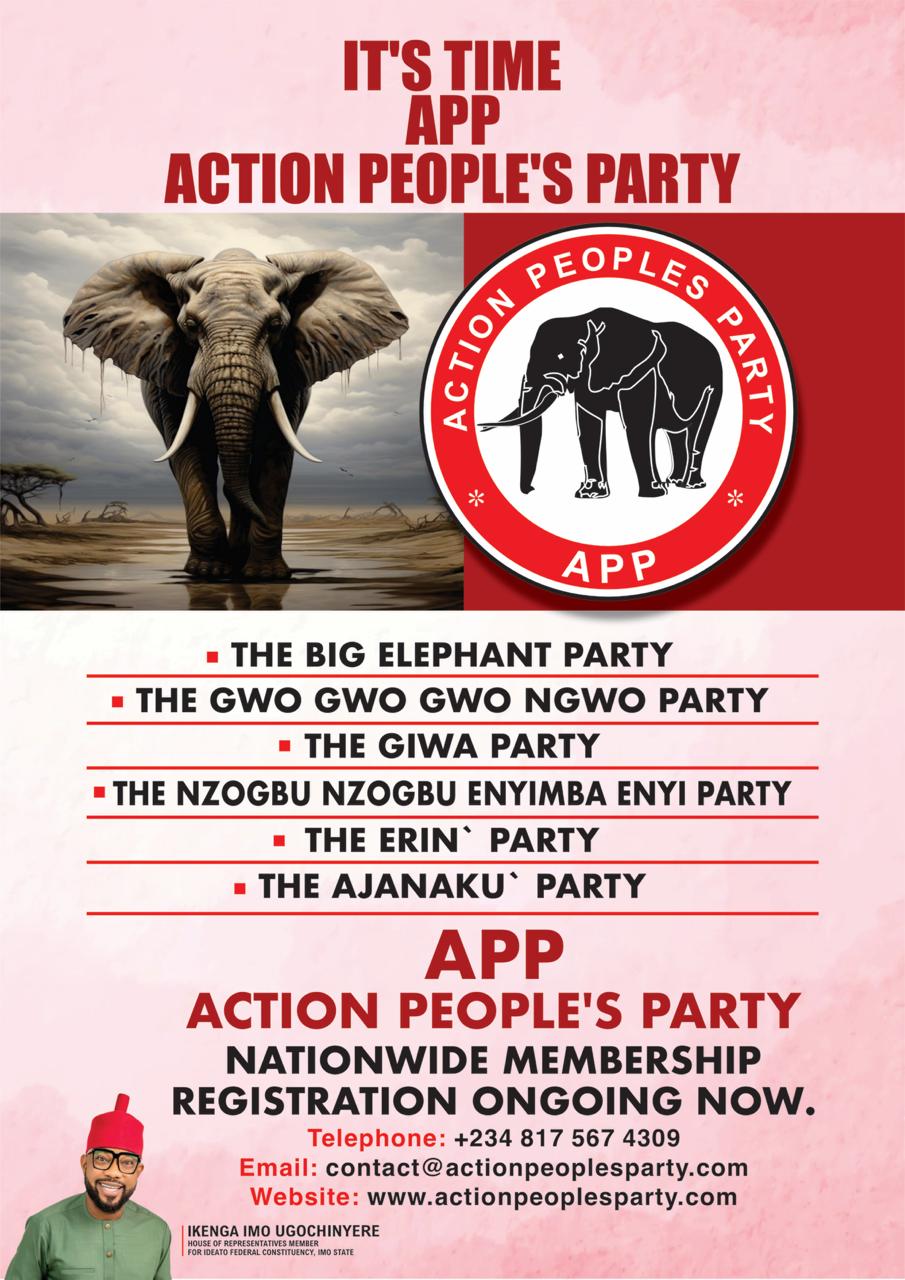
Colleagues had strongly advised Obi to steer clear of establishment politicians and instead build a movement under “more virgin” or lesser-known platforms, such as the Action Peoples Party (APP). However, Obi reportedly deflected these concerns, stating that his decision to merge forces was driven strictly by a desire to solve Nigeria’s systemic problems rather than personal ambition. Obi reportedly maintained that because he wanted nothing personal from the party structure, he would not find himself in situations that would trigger personal conflicts with Dickson.
Presently, however, followers of both Peter Obi and Kwankwaso strongly suspect that Dickson may be working hand-in-hand with the APC and the Tinubu administration to sabotage the opposition coalition from within. While there is no readily available evidence proving direct collusion, the escalating internal wrangling and administrative roadblocks within the NDC heavily suggest foul play.
The Kwankwaso-Dickson War: The Battle for Kano’s NDC Structure
The fragile alliance between Kwankwaso and Dickson has collapsed publicly over the control of the NDC structure in Kano State. Pioneer leaders of the party, originally appointed by Dickson before Kwankwaso and Peter Obi joined the coalition, have launched an open revolt. They accuse Kwankwaso of an aggressive “power grab” aimed at hijacking the party and completely shutting out non-Kwankwasiyya aspirants.
The conflict reached a boiling point after the NDC National Working Committee, backed by Dickson, took the drastic step of replacing several candidates submitted by the Kwankwasiyya faction for federal and state legislative seats.
- The Broken 60/40 Deal: Dickson had previously brokered a peace agreement granting Kwankwaso’s bloc 60% control of the Kano structure, leaving 40% for founding members. However, founding Northwest NDC leaders petitioned Dickson, claiming Kwankwaso completely breached the deal to enforce absolute dominance.
- The Retaliation: In response to the replacement of his candidates, Kwankwaso boycotted a high-stakes NDC National Executive Committee (NEC) meeting. Sources within the Kwankwasiyya movement warn that Kwankwaso is now actively reconsidering his stay in the NDC, threatening to pull his entire political machinery out of the coalition if his candidates are not immediately reinstated.
Detailed Analysis: How Tinubu and the APC are Cloak-and-Daggering the Opposition
Strategic analysts point out that the internal crises plaguing Nigeria’s opposition parties are not entirely organic. Instead, they are being fueled by sophisticated, clandestine tactics engineered by the ruling party to render opposition platforms legally dead before the 2027 ballots are cast.
1. Judicial Weaponisation and Sponsored Litigations
The primary tool in the APC’s playbook is the exploitation of leadership disputes through the courts, creating a state of perpetual legal paralysis.
- The NNPP Decapitation: Before Kwankwaso migrated to the NDC coalition, his former party, the NNPP, was targeted by state-backed factions. Expelled or parallel executives suddenly received swift judicial recognition and favourable orders, leading to the Board of Trustees “suspending” Kwankwaso. Even as the courts issued conflicting directives, the Independent National Electoral Commission (INEC) has been accused of selectively obeying orders to favor anti-Kwankwaso factions, leaving the party tied up in endless litigation.
- The Labour Party Leadership Trap: A similar script has played out within the Labour Party, where sponsored parallel executives have used judicial injunctions to lock down the party’s national secretariat, challenge primary outcomes, and cast doubt on the legitimacy of its leadership, successfully distracting Peter Obi’s core base.
2. The INEC “Delisting” Strategy and Factional Engineering
The administration has effectively used INEC as an administrative weapon to foster internal chaos.
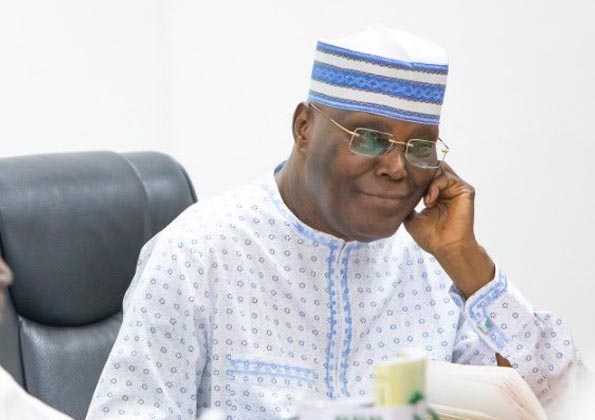
- The Splintering of the ADC: The African Democratic Congress (ADC) was recently hit by an engineered crisis where a breakaway faction emerged to challenge its legitimate leadership. In a highly controversial move, INEC deleted the recognized David Mark-led leadership structure from its portal. This has split the ADC into three warring factions, forcing prominent figures like Atiku Abubakar and Rotimi Amaechi—who purchased ₦90 million presidential forms under the platform—into defensive legal battles rather than active campaigning.
3. State Coercion and Induced Defections
Beyond the courtroom, the ruling party is deploying raw state power and financial inducements to hollow out opposition structures at the state level.
- The Kano Squeeze: Kwankwaso recently raised the alarm, revealing that state lawmakers, local government chairmen, and key political appointees in Kano are being subjected to extreme duress. They are being forced by federal agents and APC-linked actors to sign documents aligning themselves with the APC-backed Gandujiyya movement or face state-level persecution. This relentless pressure successfully triggered the high-profile defection of Governor Abba Kabir Yusuf to the APC, stripping the opposition of its most valuable executive stronghold.
- The Electoral Act 2026 Trap: The newly enacted Electoral Act 2026 contains strict provisions restricting cross-party movements after membership registers are submitted. By launching these disruptive legal and political operations now, the APC is trapping opposition politicians within broken, litigious party structures, effectively blocking them from cleanly migrating to healthier platforms before the statutory deadlines.
The 2027 Outlook
By fueling the Kwankwaso-Dickson animosity, starving opposition parties of legal certainty through court battles, and coercing sitting executives into defection, the Tinubu presidency is systematically dismantling the opposition’s capacity to build a united front. If Kwankwaso pulls his Kwankwasiyya movement out of the NDC due to Dickson’s candidate swaps, the grand opposition mega-alliance faces near-total collapse, leaving the APC with a clear, uncontested path to retaining power in 2027.