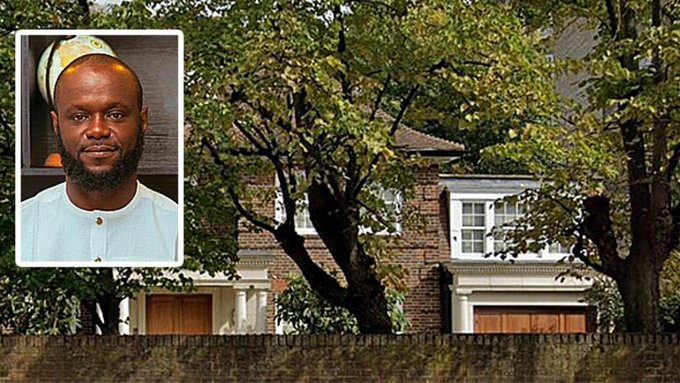


ABUJA, NIGERIA — Nigeria’s First Family is facing an avalanche of public backlash following what citizens have labeled a “deeply insensitive and hypocritical” contrast between the economic survival advice given by First Lady Senator Oluremi Tinubu and the ultra-luxury lifestyle of the President’s son, Seyi Tinubu.
The online storm erupted after the First Lady publicly urged struggling citizens to tackle the nation’s severe economic hardship by starting small-scale ventures like selling akara (bean cakes), roasted corn, and kuli-kuli. Almost instantly, critics countered her remarks by recirculating verified reports of her stepson Seyi Tinubu’s ownership of a massive $11 million (approx. ₦16.5 billion) mansion in one of London’s most elite neighborhoods.
The First Lady’s “Akara” Economy Spark
Speaking to State House correspondents following a meeting of her Renewed Hope Initiative at the Presidential Villa, Mrs. Tinubu defended her administration’s palliative measures, explaining that her foundation was distributing small business grants rather than loans.
“We’re trying to give hope, and to start an Akara business doesn’t take a lot of money. To start roasting corn, or somebody even said kuli-kuli, doesn’t take much,” the First Lady stated in a video that went viral on Friday. “We didn’t give them a loan; we gave it to them as a grant. So we’ve encouraged Nigerians as best as we could.”
The remarks drew immediate outrage across social media platforms, with citizens pointing out the harsh irony of a billionaire first family lecturing Nigerians—who are grappling with historic inflation and subsidy removal—on the virtues of frying bean cakes to survive in 2026.
The $11 Million Counter-Punch
Prominent public commentator Opeyemi Babalola and thousands of other X (formerly Twitter) users quickly contrasted the First Lady’s survival manual with the reality of Seyi Tinubu’s international wealth.
“This is what Akara business got Seyi Tinubu,” Babalola mockingly remarked, sharing the corporate footprint of the younger Tinubu’s multi-million-dollar real estate holdings.

British corporate documents and global investigative leaks, including the Pandora Papers, show that Seyi Tinubu owns a luxury 7,000-square-foot mansion located at 32 Grove End Road in the ultra-exclusive St. John’s Wood neighborhood of North London. The three-floor private residence features an eight-car carriage driveway, two massive private gardens, a private gym, and electric security gates.
Worse still for the administration’s image, the mansion was purchased in late 2017 for £9 million ($11 million) through an offshore shell company, Aranda Overseas Corporation, registered in the British Virgin Islands—a notorious tax haven.
A Entangled Paper Trail and Public Cynicism
The controversy runs deeper than just elite opulence. At the time Seyi Tinubu’s offshore company acquired the North London property, it was actively entangled in a federal asset-recovery investigation by the EFCC. The mansion originally belonged to Kola Aluko, an energy magnate accused of multi-billion-dollar oil fraud under the Jonathan administration. While Nigerian prosecutors were supposedly trying to seize the asset as proceeds of crime, it was quietly sold off to the company controlled by the President’s son.
The juxtaposition has triggered a wave of cynicism regarding the Tinubu administration’s economic policies.
“While they sit on billions of naira and buy prime London real estate through offshore havens, their highest plan for the populace is poverty evangelism—asking university graduates to roast corn and fry akara,” remarked one viral post.
Neither the Presidency, the office of the First Lady, nor legal representatives for Seyi Tinubu have issued a response to the trending “Akara vs. London Mansion” debate, but the uproar has firmly positioned the First Family at the center of a worsening public relations crisis over Nigeria’s biting economic realities.