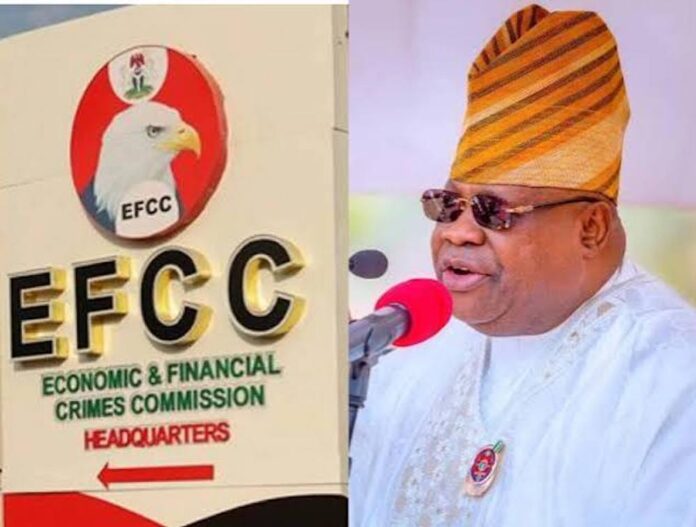


SPECIAL FEATURE — When President Olusegun Obasanjo signed the Economic and Financial Crimes Commission (EFCC) Establishment Act into law in 2003, the move was hailed domestically and internationally as a watershed moment for Nigeria. After decades of military rule and systemic looting that turned the nation into a global pariah for financial fraud, the creation of a specialized anti-graft agency promised a new era of accountability.
Two decades and five presidential administrations later, that early promise has collapsed under the weight of executive interference, political arm-twisting, and selective prosecution. What was envisioned as an institutional shield for the public treasury has increasingly come to be viewed by citizens as a political cudgel deployed to reward loyalty, crush dissent, and enforce compliance across successive regimes.
The Obasanjo Era (2003–2007): The Genesis of Political Weaponization
Under its pioneer chairman, Nuhu Ribadu, the EFCC initially earned widespread acclaim for confronting advanced fee fraud syndicates and arresting high-profile public figures once considered untouchable.
However, as the 2007 general elections approached and President Obasanjo’s controversial third-term constitutional amendment bid gathered momentum, the agency’s focus visibly shifted. The EFCC became central to executive battles against political adversaries. Governors who opposed the third-term agenda—including Joshua Dariye of Plateau, Ayo Fayose of Ekiti, and Diepreye Alamieyeseigha of Bayelsa—found themselves targeted with swift impeachment proceedings orchestrated under heavy security presence, often spearheaded by EFCC dossiers.
The most glaring manifestation of partisanship emerged during the fierce fallout between Obasanjo and his Vice President, Atiku Abubakar. The EFCC issued investigative reports that were promptly utilized by the presidency to disqualify Abubakar from the 2007 presidential race—a move later overturned by the Supreme Court. By the end of Obasanjo’s tenure, the narrative was established: the EFCC was effective, but its mandate stopped where executive interest began.
The Yar’Adua Administration (2007–2010): Compromise and Institutional Paralysis
Following the ascension of President Umaru Musa Yar’Adua in 2007, the agency entered a phase marked by institutional intrigue and political compromise. In a move widely interpreted as political payback to powerful ex-governors who funded the 2007 ruling party campaign, Ribadu was abruptly demoted, sent on a compulsory course, and ultimately dismissed.
Under his successor, Farida Waziri, public skepticism deepened. Critics pointed to the deliberate slowing down of high-profile prosecutions involving influential political figures—most notably former Delta State Governor James Ibori, whose charges were initially dismissed in Nigeria before his eventual conviction in a United Kingdom court.
While Yar’Adua’s supporters framed the administration’s approach as adherence to the “rule of law,” citizens saw an anti-graft agency hamstrung by political pacts, setting a precedent that political alignment with the ruling party offered safe harbor from prosecution.
The Jonathan Years (2010–2015): Selective Prosecutions Amid Mass Scandals
Under President Goodluck Jonathan, who appointed Ibrahim Lamorde to head the commission following Waziri’s removal in 2011, the EFCC faced intense criticism over its handling of massive public sector scandals.
Despite the exposure of multi-billion-naira leakages in the 2012 fuel subsidy scheme, pension funds, and arms procurement, high-profile convictions of political elites remained rare. Opposition figures, particularly within the newly formed All Progressives Congress (APC), routinely accused the administration of utilizing the EFCC to pressure defecting PDP governors and lawmakers back into line.
The agency’s perceived passivity in tackling corruption within the ruling party’s inner circle, contrasted with sporadic raids on opposition figures ahead of the 2015 general elections, reinforced the conviction that the EFCC had become incapable of operating independent of the presidency.
The Buhari Era (2015–2023): The Era of “Join APC and Your Sins Are Forgiven”
President Muhammadu Buhari came into power in 2015 on a core anti-corruption platform, promising to rebuild institutions and wage an uncompromising war on financial crime. Under acting EFCC Chairman Ibrahim Magu, the agency launched high-visibility campaigns, including the “Dasukigate” arms probe.
However, the campaign quickly drew criticism for its overwhelming focus on opposition figures, former Jonathan ministers, and PDP chieftains. Public cynicism reached an all-time high when prominent politicians facing EFCC investigations—such as former governors Orji Uzor Kalu, Godswill Akpabio, and Senator Musiliu Obanikoro—crossed over to the ruling APC, after which their legal troubles noticeably eased or stagnated.
The institutional decay was further highlighted by internal power struggles. Magu remained unconfirmed by the Senate for over five years due to adverse security reports from the Department of State Services (DSS)—an executive agency under the same president—before his eventual removal. His successor, Abdulrasheed Bawa, suffered a similar fate, getting suspended and detained following conflicts with political figures within the administration.
By the end of Buhari’s eight-year tenure, the slogan “Join APC and your sins are forgiven”—famously articulated by then-APC National Chairman Adams Oshiomhole—had become the defining public perception of the nation’s anti-graft drive.
The Tinubu Presidency (2023–Present): Deepening Cynicism and the Push for Reform
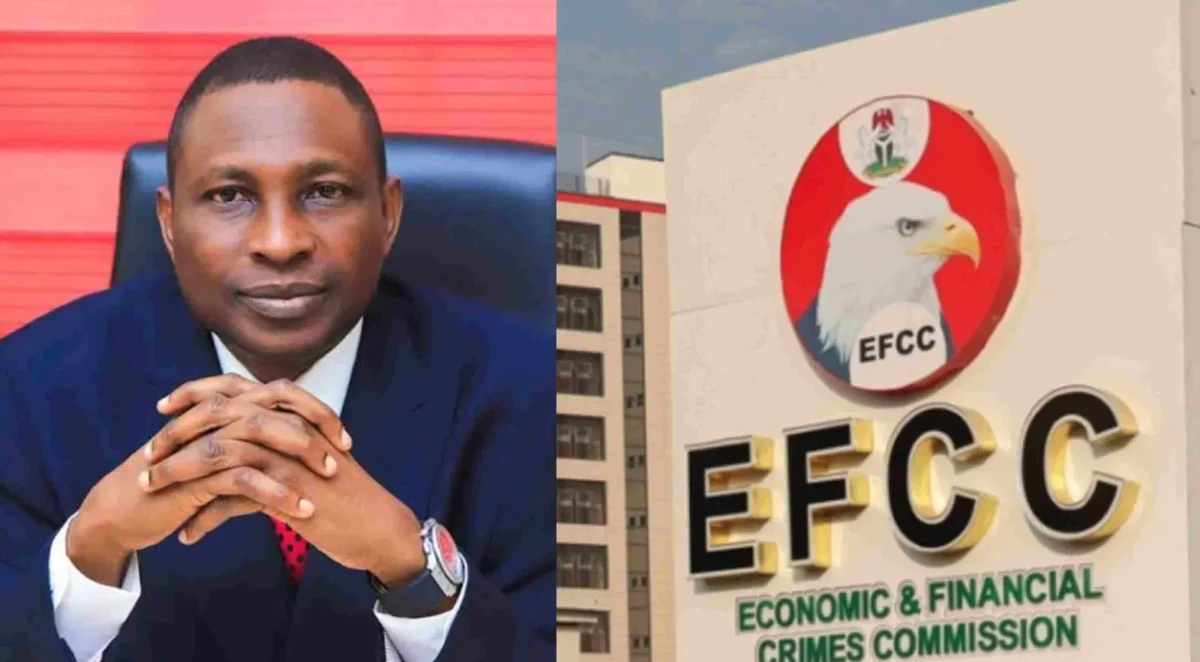
Under President Bola Ahmed Tinubu, the appointment of Ola Olukoyede as EFCC Chairman was met with cautious skepticism, given Tinubu’s own historical brushes with anti-corruption investigations and the deep-seated politicization of the agency.
Recent events have done little to dispel public doubts. The commission’s dramatic enforcement actions—such as the high-profile standoff with former Kogi State Governor Yahaya Bello and the abrupt freezing of Osun State government accounts—have sparked allegations of impulsive, selective, and politically motivated execution.
When the EFCC acts aggressively against certain former officials while maintaining silence on current cabinet members and allies facing severe corruption allegations, the public views the actions through a partisan lens.
The Path Forward: Structural Autonomy as the Only Remedy
The historical trajectory from Obasanjo to Tinubu demonstrates a systemic flaw: as long as the EFCC Chairman is directly appointed and removable at the whim of the President, and dependent on executive budgetary allocations, the agency cannot function impartially.
Governance experts, legal scholars, and civil rights groups maintain that restoring public trust requires fundamental constitutional and legislative overhauls:
- Decoupling Appointments from the Executive: Removing the President’s exclusive power to appoint and dismiss the EFCC Chairman, transferring the nomination process to an independent judicial or multi-stakeholder council.
- Financial Autonomy: Securing direct statutory funding for the commission, drawn directly from the Consolidated Revenue Fund to eliminate budgetary blackmail by the executive.
- Statutory Protection Against Arbitrary Removal: Ensuring the EFCC Chairman enjoys security of tenure, removable only through a two-thirds majority vote by the Senate for proven misconduct.
- Strict Adherence to Judicial Process: Ending media trials, extrajudicial freezes, and proxy arrests that undermine constitutional rights and turn law enforcement into public spectacles.
Without these structural safeguards, the EFCC will remain trapped in a cycle of political subordination—functioning not as an independent defender of the public trust, but as an instrument of executive power.