
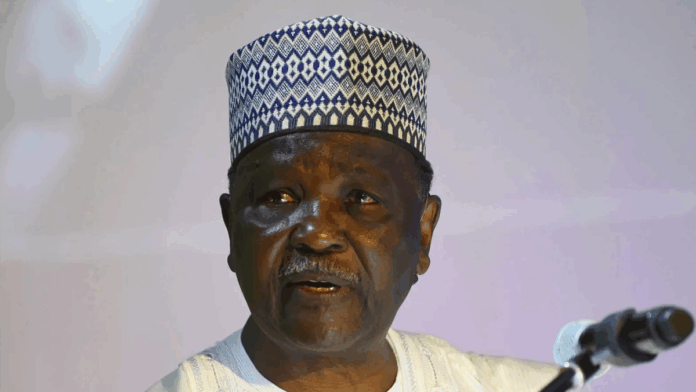


ENUGU, NIGERIA — Former Military Head of State General Yakubu Gowon has re-ignited historical trauma across Nigeria following a controversial broadcast interview on Arise Television [thewhistler.ng]. Defending the actions of the Nigerian Armed Forces during the 1967–1970 Civil War, Gowon claimed that upon touring the defeated Biafran enclave, he observed bullet-pitted vegetation and concluded that “most of the bullets fired by the Nigerian army hit palm trees, not people.”
The remark has drawn fierce condemnation from historians, survivors, and South-East leaders who label it a grotesque minimization of a conflict that claimed an estimated three million lives [dailypost.ng]. Rather than proving military restraint, critics argue the bullet-ridden trees stand as physical evidence of the indiscriminate, heavy-handed bombardment of civilian sanctuaries by federal troops.
Indiscriminate Firepower and the Reality of the Frontline
Military analysts and eyewitness accounts sharply contradict Gowon’s sanitised narrative of the war. The presence of dense bullet scars across the South-East’s terrain does not indicate that federal troops were aiming at plants; rather, it confirms a scorched-earth campaign where heavy artillery and automatic weapons were unleashed blindly into forests and rural villages.
The true nature of the Nigerian military’s wartime conduct reveals a pattern of structural violence far removed from Gowon’s defensive rhetoric:
- The Asaba Massacre: In October 1967, federal troops under the command of the Second Division overran the non-combatant town of Asaba. Hundreds of unarmed men and boys who gathered to welcome the troops were systematically lined up and executed in open daylight.
- The Market Bombings: Towns like Aba, Umuahia, and Owerri faced relentless, low-altitude aerial bombardments by the Nigerian Air Force, directly hitting crowded open-air markets, hospitals, and feeding centres packed with internally displaced persons.
- A Strategy of Starvation: The bullet was not the deadliest weapon used against the Biafran population. The federal government’s enforcement of a total land, sea, and air blockade intentionally cut off all food and medical supplies. This weaponisation of hunger resulted in the slow, agonizing starvation of over one million children, who succumbed to severe malnutrition and kwashiorkor.
The Genesis of the Crisis: The Betrayal of the Aburi Accord
To understand the devastation of the civil war, historians point to the systematic breakdown of political trust in the late 1960s, specifically engineered by the military hierarchy in Lagos.
Following the bloody anti-Igbo pogroms of 1966 across Northern Nigeria, where tens of thousands of Easterners were massacred, ethnic tensions pushed the country to the brink of dissolution. In a desperate bid to avert total war, the military leaders met in Aburi, Ghana, in January 1967 under the auspices of Ghanaian Head of State General Joseph Ankrah.
The resulting Aburi Accord offered a peaceful, constitutional framework to save Nigeria:
- The Agreement: Gowon and the Military Governor of the Eastern Region, Colonel Chukwuemeka Odumegwu Ojukwu, signed a binding agreement to restructure Nigeria into a loose confederation of regions. Each region was to retain control over its resources, internal security, and local administration, reducing the friction at the federal center.
- The Reneging: Upon returning to Lagos, the Gowon administration, heavily influenced by federal permanent secretaries and centralist bureaucrats, unilaterally reneged on the agreement. Lagos feared that a confederation would weaken federal power, particularly over the oil-rich Niger Delta located in the Eastern region.
- Decree 8 and Escalation: Gowon subsequently issued Decree 8, a heavily distorted version of the Aburi agreements that stripped the regions of autonomy instead of granting it. Ojukwu and the Eastern consultative assembly rejected this bad-faith manipulation, stating: “On Aburi we stand.”
By fundamentally violating the terms of the Aburi Accord and subsequently splitting the Eastern region into three states without consultation, the Gowon administration backed the East into a corner. Left with no constitutional guarantees for the safety of its people, the Eastern region declared independence as the Republic of Biafra on May 30, 1967.
Shifting the Historical Blame
General Gowon’s latest attempt to frame the carnage as an accidental targeting of palm trees represents a continuation of the state-sponsored amnesia that has blocked genuine reconciliation for over half a century. By refusing to acknowledge the severe excesses, massacres, and the devastating impact of the starvation blockade, the ruling elite continues to protect its historical legacy at the expense of transitional justice.
For the families of the millions who perished, the bullet marks on the palm trees are not a sign of military discipline—they remain the enduring scars of an unprovoked barrack revolt that destroyed a peace treaty and turned a nation’s guns against its own citizens.