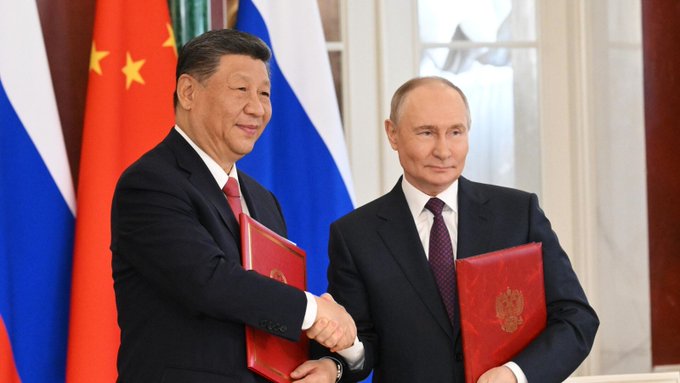


BEIJING/MOSCOW – In a move that has fundamentally reshaped global geopolitics, China and Russia have officially operationalized a comprehensive strategic pact with Iran. The agreement, finalized this week, marks the birth of a coordinated “Triple Axis” designed to counter Western military dominance and economic sanctions through unprecedented levels of intelligence and technological integration.
While officials in Tehran, Beijing, and Moscow have avoided the term “mutual defense treaty” to sidestep a direct NATO-style confrontation, the depth of the coordination suggests a partnership that functions as a de facto military alliance.
A New Security Umbrella
The pact moves beyond diplomatic rhetoric into the realm of tactical synergy. According to high-level defense sources, the agreement centers on several critical military pillars:
- Intelligence Integration: Moscow has reportedly established a direct “intelligence bridge” to Tehran, sharing real-time satellite reconnaissance and tactical data refined during the conflict in Ukraine.
- Technological Shielding: Iran has been granted full access to China’s BeiDou navigation system. Analysts note this is a game-changer, as it allows Iranian precision-guided assets to operate independently of the Western-controlled GPS, rendering traditional jamming techniques less effective.
- Advanced Surveillance: The deal includes the deployment of sophisticated Chinese-made radar and electronic warfare suites along the Persian Gulf, significantly enhancing Iran’s ability to track stealth aircraft and monitor maritime traffic in the Strait of Hormuz.
Financial Sovereignty and the Petroyuan
Crucially, the pact includes an economic “firewall” designed to make Western sanctions obsolete. A core provision of the agreement is the settlement of energy trades in Petroyuan, bypassing the dollar-dominated SWIFT system entirely. By linking their central bank digital currencies, the three nations have created an independent financial corridor that secures Iran’s oil exports to China while facilitating the flow of Russian military hardware to Tehran.
“This isn’t just about weapons; it’s about a new world order,” said a senior geopolitical consultant in Singapore. “They are building a self-sustaining ecosystem where Western economic pressure no longer carries the weight it once did.”
Strategic “Division of Labor”
Intelligence assessments suggest a clear strategic split: China acts as the industrial and technological engine, providing the microchips and infrastructure necessary for modern warfare, while Russia provides the combat-proven doctrine and intelligence. Iran, in turn, serves as the regional operational hub, utilizing these advanced tools to project power across the Middle East.
Global Repercussions
The White House and its European allies have reacted with alarm, characterizing the pact as a “destabilizing force” that threatens maritime security and global trade. In an emergency session at the UN, diplomats argued that the level of “shadow support” provided by Beijing and Moscow has fundamentally emboldened Tehran, complicating efforts to reach a diplomatic resolution to the current regional conflict.
As the conflict in the Middle East enters a new and more complex phase, the “Triple Axis” stands as a formidable challenge to the existing global security architecture. The message from the capitals of the East is clear: the era of unipolar influence has ended.