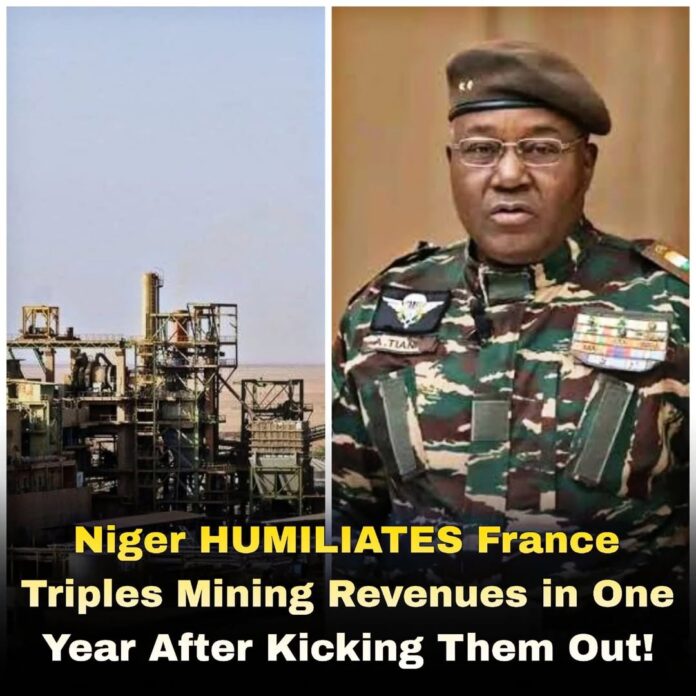

NIAMEY, NIGER — In a move hailed by the military junta as a landmark victory for “economic sovereignty,” the Republic of Niger has reported a staggering 300% surge in mining revenues for 2025, following the expulsion of French mining firms and military forces.
According to a formal announcement by the Minister of Mines, Abarchi Ousmane, the state treasury received 18.2 billion CFA francs ($32.6 million) from mining activities in 2025. This stands in sharp contrast to the 6.2 billion CFA francs recorded in 2024, when French corporations still dominated the sector.
The End of French Uranium Control
The dramatic rise in revenue follows the decision by Niger’s military leadership, the National Council for the Safeguard of the Homeland (CNSP), to revoke long-standing mining permits held by French giants.
A key turning point occurred in June 2024, when the government officially kicked France out of the Imouraren mine—one of the world’s largest uranium deposits—by stripping the French nuclear group Orano of its permit. Niamey has since moved to nationalise several assets and launch state-backed firms to oversee the extraction of the country’s natural wealth.
Shifting from Raw Exports to Value Addition
Minister Ousmane highlighted that the revenue explosion was driven by a new strategy of domestic processing.
- Gold Refinement: Niger launched its first major domestic gold processing firm in 2025, ending the era of exporting raw, unrefined gold.
- Diversified Portfolio: Beyond uranium, the government has accelerated copper production and expanded gold mining operations under new agreements.
- New Partners: Since cutting ties with Paris, Niger has opened its doors to mining operators from Russia, China, and Turkey, which reportedly operate under tax frameworks that provide significantly higher royalties to the host nation.
“Real Independence Pays”
The announcement has sparked widespread celebration among supporters of the transition government, who view the financial boost as proof that colonial-era agreements held the nation’s economy back for decades.
“This is what happens when an African nation says ‘Enough’ to foreign plunder,” a government spokesperson stated. The CNSP maintains that under previous administrations, lopsided deals with France kept mining revenues artificially low while the country’s resources powered European cities.
While international economists note that the total revenue remains a small portion of the national budget, the symbolic victory of tripling income while severing ties with France is being framed as a blueprint for “resource nationalism” across the Sahel.