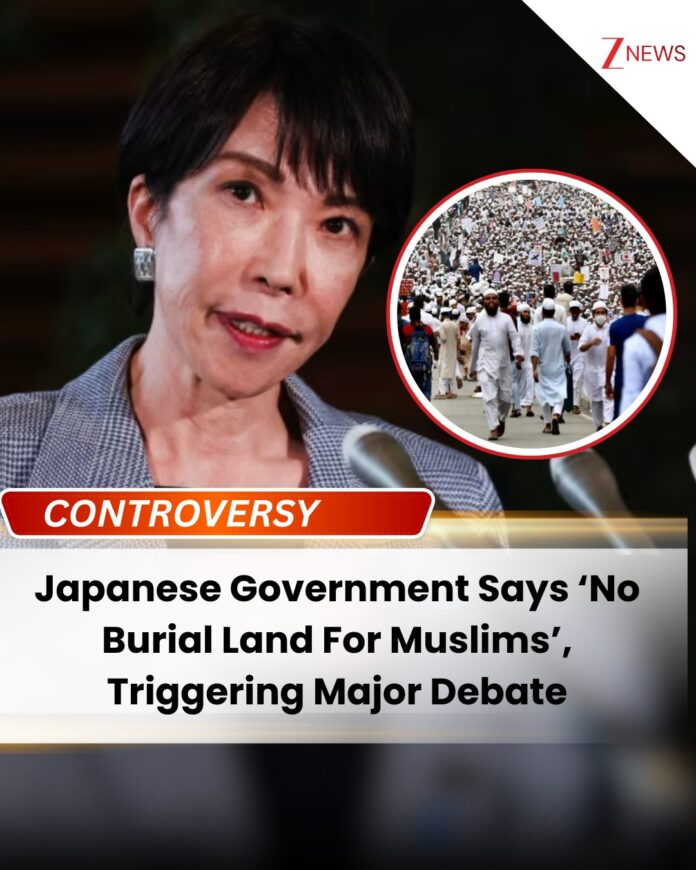


TOKYO, JAPAN — A fierce debate has erupted over religious freedom and cultural integration in Japan following blunt remarks by a lawmaker opposing the establishment of new Muslim cemeteries.
During a parliamentary committee session, Mizuho Umemura argued that Japan has no obligation to allocate land for Islamic earth burials, explicitly telling minority faith communities to repatriate their deceased loved ones if they refuse cremation.
The Lawmaker’s Stance
Umemura’s speech addressed growing demands from Japan’s expanding Muslim resident workforce for designated burial grounds, given that Islamic law strictly forbids cremation.
“Japan is a cremation country,” Umemura declared during the parliamentary debate. “Allocating land for Muslim burials is not appropriate. If they want burial, it should be done in their home countries at their own expense.”
The lawmaker cited geographic and environmental vulnerabilities to justify her position. She pointed out that Japan is a high-humidity nation with limited land mass that is highly prone to earthquakes, tsunamis, landslides, and soil liquefaction. She argued that natural disasters could rupture earth burial plots, exposing human remains and raising concerns among local populations regarding the potential contamination of local agricultural water supply and groundwater systems.
A Clash of Sacred Traditions
The standoff highlights intense cultural friction between Japan’s strict domestic traditions and the basic religious needs of its foreign workforce.
- The Domestic Standard: Over 99.9% of all funerals in Japan are carried out through cremation, deeply rooted in Buddhist traditions and tight municipal land-use ordinances.
- The Islamic Mandate: Observant Muslims require that the deceased be washed, wrapped in white shrouds, and buried intact in the ground facing Mecca. Cremation is viewed in Islam as a desecration of the human body.
Currently, across the entire nation of Japan, only around 10 to 13 small cemeteries permit Islamic earth burials. Space in these few locations is rapidly diminishing, forcing bereaved families to transport remains over vast distances at exorbitant costs.
The Migrant Dilemma
The controversy emerges as Japan expands its foreign workforce to combat a severe domestic demographic crisis, with the number of foreign workers recently surging past 2 million people—many arriving from Muslim-majority nations like Indonesia.
While the Health Ministry responded to the parliamentary debate by clarifying that earth burials do not violate national public hygiene laws and that cemetery permits remain under local municipal jurisdiction, local populations have successfully organized to block or cancel proposed Muslim burial sites in several prefectures due to cultural pushback.
Umemura’s warning—insisting that immigrants must adapt to the customs of their host country rather than demanding structural alterations—has gone viral globally. While right-wing groups have widely praised her firm stance, human rights watchdogs and migrant support groups warn that refusing basic burial rights will severely damage Japan’s ability to attract and retain the international labor it desperately needs to sustain its economy.