

.
.
Washington, D.C. — September 13, 2026
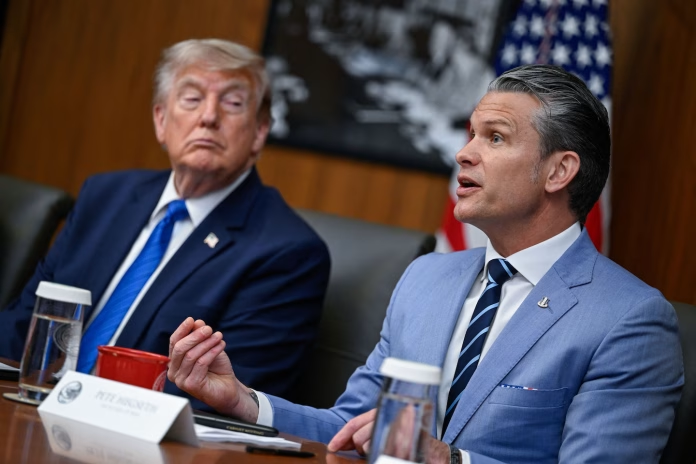
Defense Secretary Pete Hegseth and political appointees in his department pressured the two crew members of an F-15 shot down over Iran in April to participate in a “60 Minutes” segment about their rescue, according to a CNN investigation citing multiple sources familiar with the matter — a report the Pentagon has forcefully denied.
What CNN reported
Both airmen initially expressed reservations about appearing on the CBS program, with one raising concerns that he was effectively being ordered to take part. Military officials were separately wary of the interview revealing classified details of the rescue operation while U.S. forces remain in active combat with Iran, CNN reported. Political appointees in Hegseth’s office were said to be adamant that both crew members sit for interviews, prompting Hegseth to meet privately with the two men and ask whether they wanted to participate rather than compel them outright.
One airman — identified in reporting only by the callsign “Bravo” — agreed to appear; the other, “Alpha,” declined. Uniformed service members reportedly told CNN they were concerned the interview push amounted to using the crew’s heroism for political purposes, and said they had objected to the segment moving forward.
The program recounts the rescue of the F-15’s pilot, who was located within hours of the aircraft being downed by Iranian forces, and the weapons systems officer, who evaded capture for more than a day, at one point climbing to a 7,000-foot ridgeline with only a pistol, a communication device, and a tracking beacon before being extracted by U.S. commandos under air cover.
The Pentagon’s response
Chief Pentagon spokesman Sean Parnell called CNN’s report “a complete lie,” saying the decision to participate in the interview was “each pilot’s alone — because it is their story,” and noting that one airman participated while the other did not. Parnell said the department “took great care to ensure operational security, sources, and methods were protected,” and argued that CNN’s characterization “denigrate[s] every member of our military who participated in and supported the interview.”
Neither airman has been publicly identified by the Defense Department.
Context: A recurring pattern of disputed U.S. war reporting
The clash between Pentagon messaging and independent reporting is not new. Major U.S. military operations in Africa and the Middle East have repeatedly produced official accounts that were later revised, contradicted, or directly disputed by news organizations’ own investigations:
- The 2017 Niger ambush (Tongo Tongo). After a joint U.S.-Nigerien patrol was ambushed near the Mali border, killing four American soldiers and four Nigerien troops, initial Pentagon and U.S. Africa Command accounts described a routine, low-risk reconnaissance patrol. A subsequent New York Times investigation — drawing on internal Defense Department findings — reported that AFRICOM had poorly planned the mission and changed its objectives multiple times while it was underway, and that a lower-ranking officer had misrepresented the patrol’s actual purpose (a raid targeting an ISIS-linked commander) to superiors. Nigerien and American accounts of the battle itself also conflicted, including over whether U.S. forces had pursued militants before being ambushed. The mismatch between the Pentagon’s early narrative and the Times’ findings fueled congressional inquiries and two further internal reviews.
- Coalition airstrikes in Iraq and Syria. The Pentagon’s official data on the 2014–2018 air campaign against ISIS put the rate of airstrikes resulting in civilian deaths at roughly 1 in 157. A 2017 New York Times Magazine investigation, “The Uncounted,” based on on-the-ground surveys of more than 100 strike sites, found civilian deaths occurred in roughly 1 in 5 strikes examined — a rate reporters described as about 31 times higher than the military’s public figures. A follow-up Times investigation, “The Civilian Casualty Files,” obtained more than 1,300 confidential Pentagon casualty assessments through a multi-year legal battle and reported that flawed intelligence and rushed targeting had contributed to thousands of undisclosed civilian deaths, many of them children, across Iraq, Syria, and Afghanistan between 2014 and 2018. That series won the 2022 Pulitzer Prize for International Reporting.
- The Battle of Mogadishu, Somalia (1993). Initial U.S. military accounts of the “Black Hawk Down” operation emphasized a successful, if costly, mission; subsequent journalistic and historical accounts — most notably Mark Bowden’s reporting, later expanded into a book — reconstructed a chaotic engagement with far higher Somali civilian and combatant casualties than initially acknowledged, and raised questions about mission planning that echoed decades later in the Niger ambush reporting.
- The 2003 Iraq WMD reporting. While not solely a military-messaging dispute, pre-invasion U.S. government intelligence claims about Iraqi weapons of mass destruction — amplified in contemporaneous news coverage, including in The New York Times — were later found by the same news organizations, congressional inquiries, and the U.S. intelligence community’s own post-war assessments to have been unsupported by the underlying evidence, prompting formal editorial self-criticism from outlets that had relied heavily on official and defector sourcing.
In each case, the pattern CNN describes in its Hegseth reporting — official messaging emphasizing heroism or mission success, followed by independent reporting that surfaces a more contested or complicated internal picture — mirrors dynamics that have recurred across multiple administrations and conflicts over more than three decades.