
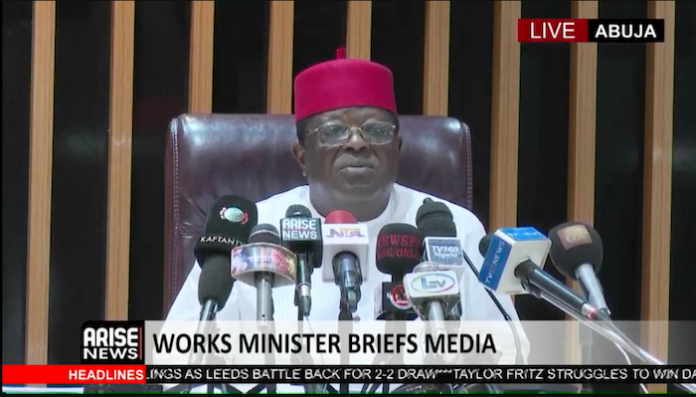

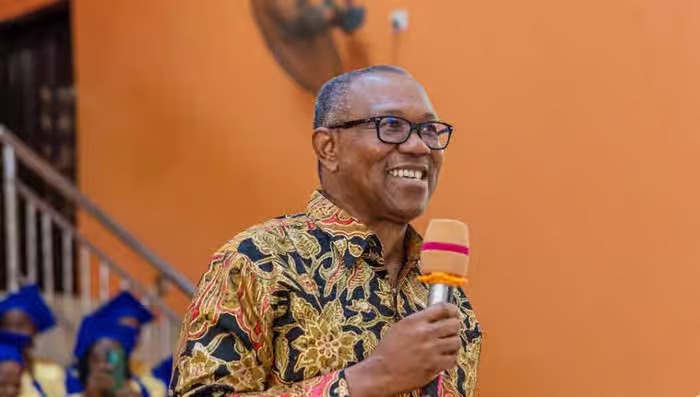
ABUJA — The political crossfire between the ruling All Progressives Congress (APC) and the opposition has intensified as the Minister of Works, Senator David Umahi, launched a scathing counter-attack against Nigeria Democratic Congress (NDC) presidential candidate, Mr. Peter Obi.
The minister’s fiery response came days after Obi publicly expressed deep concern over the decaying state of several federal expressways, questioning the administration’s infrastructural priorities. Taking off the gloves during a strategic briefing, Umahi dismissed Obi’s critique as a superficial stunt, mockingly asking, “When did governance reduce to comedy?”
“Deceit and Lack of Plan” — Umahi Dismantles Obi’s Record
Umahi, a seasoned engineer and former Ebonyi State Governor, did not hold back, framing the dispute as a fundamental clash between an “accountant” who hoards cash and an “engineer” who builds durable legacy assets. He accused the former Anambra State governor of weaponizing social media to mislead regular Nigerians who may not be fully informed about the technical details of national road development.
- The Accusation of Deceit: The minister asserted that Obi’s political narrative relies on public relations manipulation rather than structured data. He challenged Obi’s recent threats to halt major legacy infrastructure undertakings, calling the stance “very painful” and a disservice to national growth.
- The Anambra Legacy Debate: Turning the mirror back on the opposition leader, Umahi criticized Obi’s past tenure in Anambra State, claiming he left no sustainable infrastructure blueprint or master plan for regional connectivity. He argued that hoarding state funds while inflation erodes purchasing power—a jab at Obi’s fiscal philosophy—is a failed strategy for long-term development.
- The Concrete Shift: Defending the current administration’s record, Umahi noted that the shift toward concrete road technology has allowed critical federal highway projects to advance despite heavy seasonal rains.
By The Numbers: The Infrastructure Battle Lines
The verbal war highlights a deep ideological divide between how the opposition and the sitting administration view economic priorities during a time of extreme fiscal pressure.
| Leadership Perspective | Core Ideology | Infrastructure Stance | Strategic Criticism |
|---|---|---|---|
| Dave Umahi (The Engineer) | Aggressive capital expenditure on legacy mega-projects like the Lagos-Calabar Coastal Superhighway. | Long-term economic transformation requires massive foundational investments. | Focuses on multi-billion projects while existing arterial interstate roads suffer maintenance deficits. |
| Peter Obi (The Accountant) | Strict fiscal conservation and immediate human capital development. | Prioritize the intensive repair and maintenance of existing infrastructure to safeguard livelihoods. | Termed “not a priority” to build new superhighways when major commercial transit corridors are collapsing. |
Incitement Allegations and the 2027 Undercurrents
This latest verbal altercation is part of an ongoing, larger feud between both politicians. Earlier, Umahi had accused Obi of actively inciting indigenous populations against federal projects—a claim Obi firmly rejected through a series of public clarifications, stating his focus remains entirely on resource efficiency and protecting livelihoods.
The minister’s aggressive public pushback signals that the Tinubu administration has adopted a zero-tolerance policy for opposition narratives on state infrastructure. With the political alignments for the 2027 general elections quietly forming, the battle over Nigeria’s roads is no longer just about asphalt and concrete—it has become a primary campaign platform for administrative competence.