

ABUJA — A major budgeting scandal is rocking the heart of Nigeria’s federal administration, revealing a deep disconnect between public declarations and official financial records. The controversy centers on the existence of a high-profile body known as the Presidential Foreign Intervention Promotion Council (PFIPC).
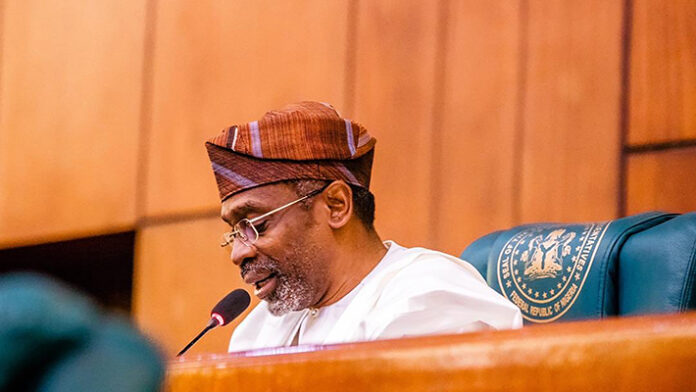
The Chief of Staff to the President, Rt. Hon. Femi Gbajabiamila, issued a definitive public disclaimer declaring that the council does not exist within the structure of President Bola Ahmed Tinubu’s administration. Warning international missions, financial bodies, and development partners to steer clear of the entity, the Chief of Staff asserted that no such office had been established or approved by the presidency.
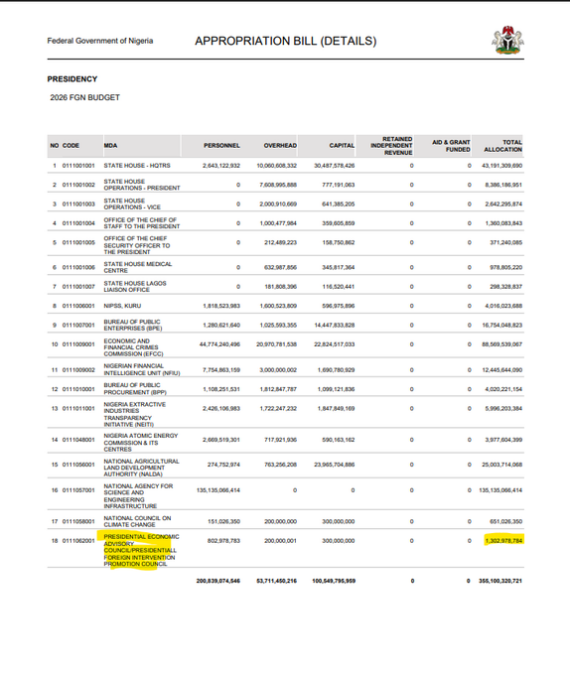
However, official records from the Budget Office of the Federation—visualized clearly in the approved federal financial blueprints under image_1af8ee.png—completely contradict the administration’s public posture.
What the 2026 Appropriation Act Reveals
Documents reviewed within the approved 2026 FGN Budget show that the “phantom” council is not hidden away in a distant ministry or vague agency; it is explicitly captured under the direct structure of the Presidency.
Listed as line item 18 under Code 0111062001, the entity is officially designated as the Presidential Economic Advisory Council/Presidential Foreign Intervention Promotion Council. The National Assembly voted on, and the President approved, a massive total allocation of ₦1,302,978,784 (N1.3 billion) specifically for this body.
According to the line-by-line budgetary breakdown in image_1af8ee.png, the ₦1.3 billion allocation is distributed across active operational parameters:
- Personnel Costs: ₦802,978,783 allocated for salaries and staff compensation.
- Overhead Expenses: ₦200,000,001 set aside for day-to-day administrative running costs.
- Capital Expenditure: ₦300,000,000 earmarked for foundational capital assets.

Two Troubling Possibilities for the Presidency
This stark contradiction between Gbajabiamila’s denial and the approved Appropriation Act leaves the public and policy analysts staring at two deeply concerning scenarios:
- Administrative Blindness: The executive branch, including the Office of the Chief of Staff, remains fundamentally unaware of the exact operational components, cost centers, and structural line items embedded within its own immediate presidential budget.
- Deliberate Misdirection: Senior leadership is fully aware of the entity’s financial provisions but is intentionally misleading the public, civil society, and international partners regarding its ongoing operations.
The situation has triggered an escalating war of words in Abuja. Prince Adeniyi Adeyemi, who claims to head the council as its Director-General, has openly challenged Gbajabiamila’s disclaimer. Adeyemi insists the council is fully legal, maintaining that it holds active accounts with the Central Bank of Nigeria (CBN), occupies dedicated office space at the Federal Secretariat, and has had over 300 personnel approved by the Office of the Head of the Civil Service of the Federation.
Growing Demands for Judicial and Legislative Scrutiny
As the crisis deepens, independent anti-corruption coalitions and legal observers are raising tough questions about how an entity publicly disowned by the presidency managed to wrangle its way into the nation’s supreme financial document.
“Public institutions are not created by press releases, but they also don’t just accidentally materialize with a ₦1.3 billion allocation without high-level administrative clearance,” noted a representative from the Coalition for Truth and Justice during a press briefing in Abuja. The group has formally called on the National Assembly and the Department of State Services (DSS) to launch an immediate oversight probe to determine who assigned the budget code and authorized the creation of the cost center.
With the fiscal records now laid bare in black and white via image_1af8ee.png, the ball rests entirely in President Bola Tinubu’s court. Civil society organizations and watchdogs will be closely observing whether the President moves to discipline those responsible for this severe budgetary contradiction, or if the administration will continue to ignore its own official gazetted reality.