

OWERRI, IMO STATE — In a dramatic legal development exposing grave judicial misconduct, the High Court of Imo State, sitting at the Orlu Judicial Division, has set aside a fake Certified True Copy (CTC) of a judgment that was altered to favor the Governor of Imo State after the original ruling was delivered in open court.
The case, suit number HOR/98/2019 (Hon. Chief Athanasius Uche Ogoh v. The Governor of Imo State & 2 Ors), has sent shockwaves through the legal community following revelations that court records were doctored after the bench ruling was delivered on June 24, 2025.
The Background
On June 24, 2025, Hon. Justice M.E. Nwagboso delivered a ruling in open court in favor of the Plaintiff, Hon. Chief Athanasius Uche Ogoh, against the Governor of Imo State, the Attorney General of Imo State, and the Commissioner for Land Survey and Urban Planning.
However, when the Certified True Copy of the judgment was subsequently issued on July 23, 2025, the Plaintiff discovered that the written document had been drastically altered to reverse the ruling in favor of the Imo State Government. Furthermore, the original bench notes recorded during the proceedings were found to have been concealed and doctored.
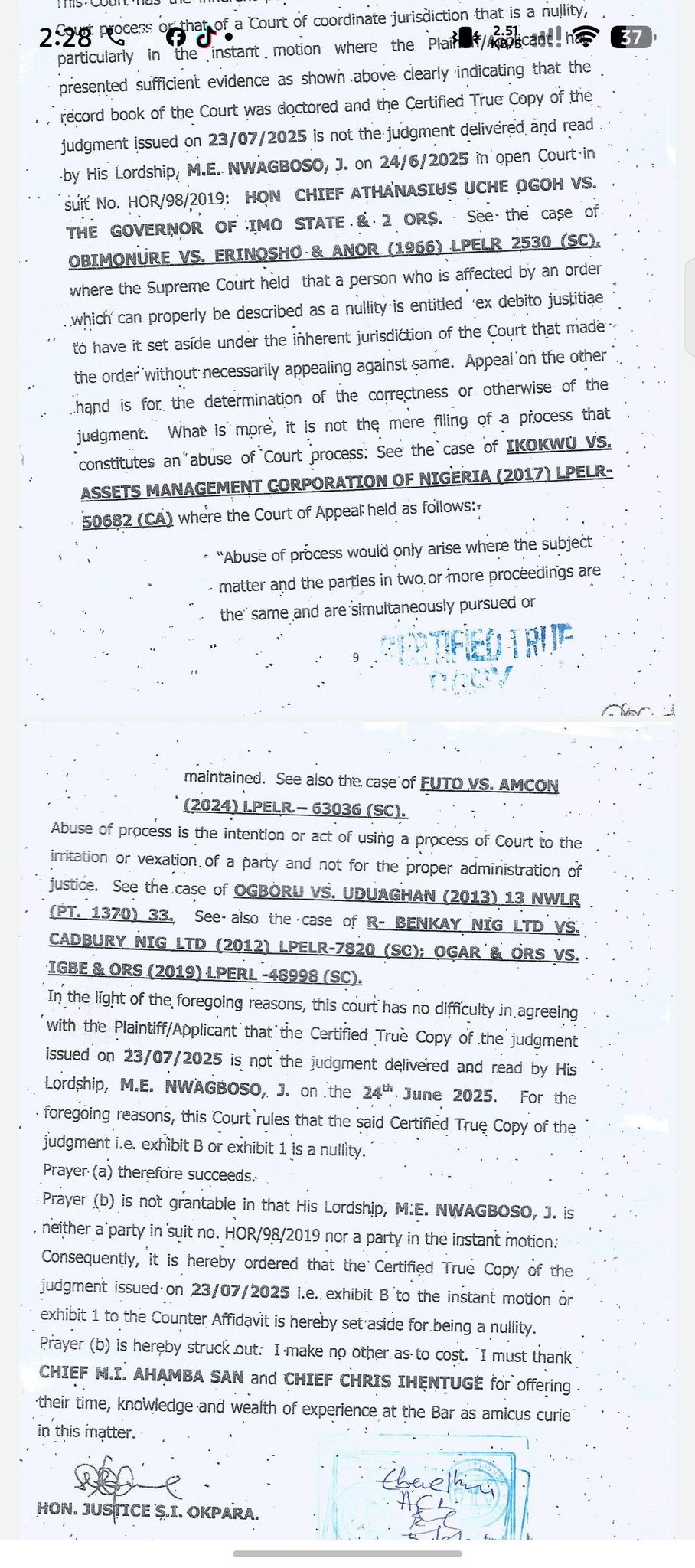
The Landmark Ruling
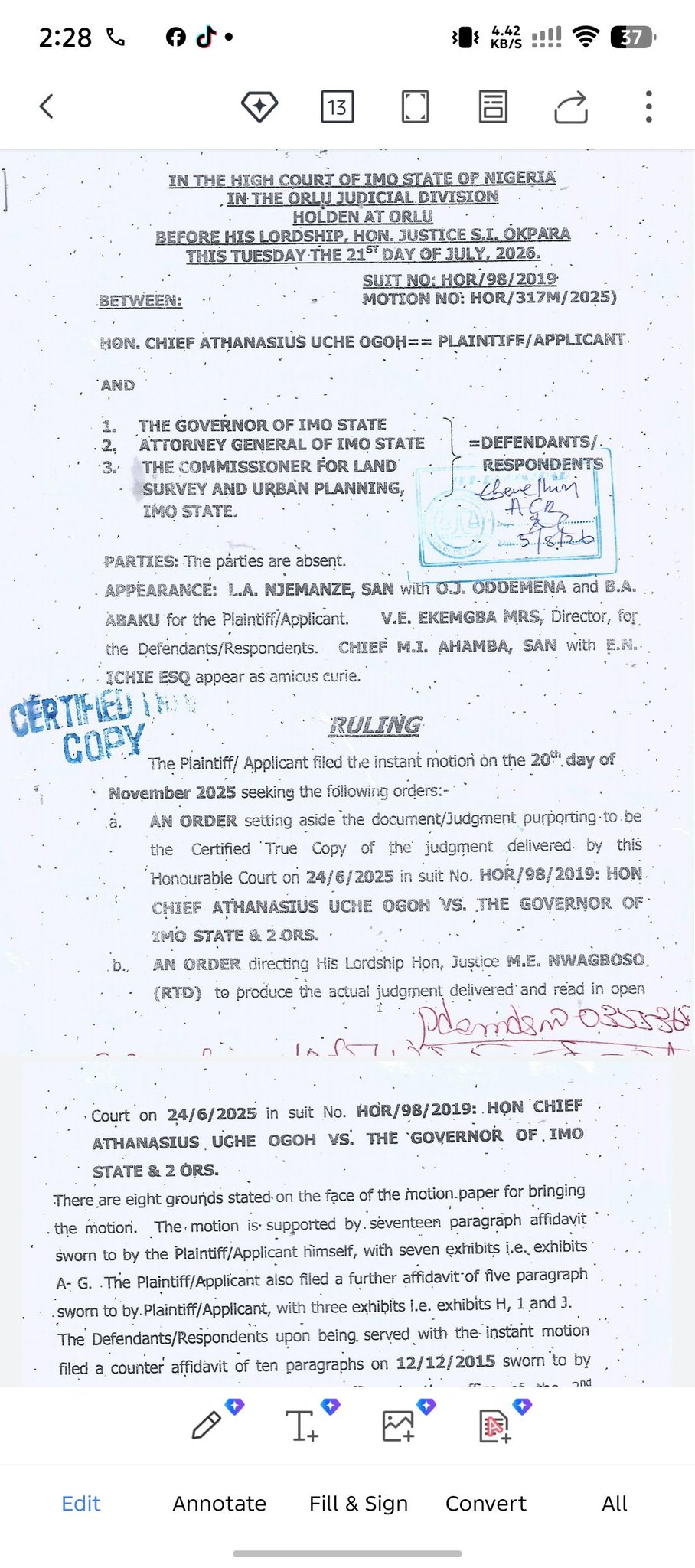
In response to an application filed on November 20, 2025, by Senior Advocate of Nigeria I.A. Njemanze on behalf of the Plaintiff, Hon. Justice S.I. Okpara delivered a decisive ruling on Tuesday, July 21, 2026.
Relying on established Supreme Court precedents—including Obimonure v. Erinosho (1966) and FUTO v. AMCON (2024)—Justice Okpara declared the fraudulent CTC a complete nullity under the inherent jurisdiction of the court. He noted that the court had no difficulty agreeing that the document issued in July was not the judgment actually read in open court a month earlier.
While the court granted the prayer to void the falsified document, it struck out the request seeking an order to compel Justice Nwagboso to produce his original notes, as the retired judge is not a named party to the instant motion. Senior advocates Chief M.I. Ahamba and Chief Chris Ihentuge appeared as amici curiae during the proceedings.
Legal Fallout for Justice Nwagboso
Although Justice Nwagboso has since retired from the bench, legal experts emphasize that retirement does not grant immunity from accountability for acts of judicial corruption and falsification of public records. He now faces potential consequences across three distinct legal fronts.
Under Regulation 19(2) of the NJC Judicial Discipline Regulations, the National Judicial Council retains jurisdiction to investigate former judges for acts of gross misconduct committed while on the bench. If found guilty of doctoring court records, the Council can officially alter his record of service to reflect dismissal and recommend the forfeiture of his post-retirement pensions, gratuities, and judicial benefits.
Furthermore, while the landmark Supreme Court decision in Nganjiwa v. Federal Republic of Nigeria (2017) restricts law enforcement from prosecuting sitting judges without prior NJC clearance, that protection ceases once a judge leaves office. Justice Nwagboso is now exposed to investigation and criminal prosecution by the Nigeria Police Force or anti-graft agencies like the ICPC for severe offenses, including forgery, falsification of public documents, perversion of the course of justice, and abuse of office.
Finally, as a qualified legal practitioner, he remains subject to the Rules of Professional Conduct. The Body of Benchers and the Legal Practitioners Disciplinary Committee can initiate disciplinary proceedings against him for conduct unbefitting a legal officer, which could ultimately result in his name being struck off the Roll of Legal Practitioners in Nigeria.
The setting aside of the fraudulent CTC restores the integrity of the original bench ruling in favor of Hon. Chief Athanasius Uche Ogoh, while putting the spotlight on regulatory bodies to take swift action regarding the alleged tampering.