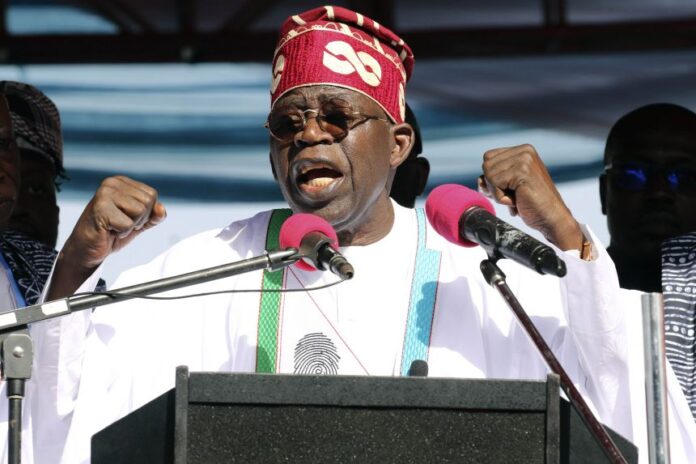

ABUJA — President Bola Ahmed Tinubu has initiated a comprehensive tactical review ahead of the 2027 general elections, weighing a sweeping overhaul of his campaign machinery and a restructuring of the Independent National Electoral Commission (INEC) high command to lock in a second-term victory.
The frantic re-strategizing follows classified internal polling from multiple highly respected firms showing that the President faces a devastating defeat in any free, fair, and transparent contest. According to these private assessments, opposition leader Peter Obi commands a clear lead, followed by Atiku Abubakar in a distant second, with Oyo State Governor Seyi Makinde and former Cross River State Governor Donald Duke trailing.
Facing an insurmountable popularity deficit, the Tinubu kitchen cabinet is currently engineering a survival blueprint that relies heavily on institutional capture. This strategy is not new; it is the modern refinement of an authoritarian playbook pioneered during the Olusegun Obasanjo era and perfected by Tinubu himself during his decades-long stranglehold on Lagos State.
The Obasanjo-Iwu Genesis: The Blueprint of Total Capture
To understand the current anxiety within the presidency, one must trace the history of Nigeria’s electoral subversion back to the Fourth Republic’s foundational years. Following the return to democracy in 1999, the ruling political class quickly realized that popular mandate was an unstable currency.
By the 2003 and 2007 election cycles, then-President Olusegun Obasanjo famously declared elections to be a “do-or-die” affair for the People’s Democratic Party (PDP). To guarantee total victory, Obasanjo weaponized INEC by appointing Professor Maurice Iwu as chairman—a man whose tenure became synonymous with the complete institutionalization of electoral fraud.
Under Iwu, INEC abandoned any pretense of neutrality. The 2007 general election, which brought Umaru Musa Yar’Adua to power, was so heavily engineered, marred by ballot-snatching, inflated figures, and the non-delivery of voting materials to opposition strongholds, that even Yar’Adua himself publicly admitted in his inaugural address that the election was deeply flawed. Obasanjo and Iwu proved that if a ruling administration controlled the electoral umpire and the security apparatus, the actual votes of the populace became entirely irrelevant.
The Anambra Crucible: How Peter Obi Defeated the Rigging Machine
While the federal government was solidifying its electoral capture, a historic counter-narrative was being written in Anambra State, establishing Peter Obi as a pioneer in the fight for electoral integrity. In the 2003 gubernatorial election, Obi ran under the banner of the All Progressives Grand Alliance (APGA). Although the domestic population voted overwhelmingly for Obi due to his grassroots appeal and technocratic blueprint, the PDP-led federal establishment, in collusion with local political godfathers, executed a massive rigging operation.
The electoral umpire swiftly declared Chris Ngige of the PDP as the winner. Rather than resorting to violence or conceding to the state-backed fraud, Obi embarked on an unprecedented legal battle that lasted nearly three years. Through meticulous forensic documentation of polling unit results and unwavering judicial persistence, Obi proved that the official figures had been completely fabricated.
In March 2006, the Court of Appeal finally overturned Ngige’s victory and restored Obi’s mandate. This landmark judicial intervention demonstrated that when an election is conducted without rigging, the genuine will of the people favors organic leaders over imposed candidates. Obi’s experience in Anambra proved that the rigging machine is not invincible when confronted with unyielding legal scrutiny and verifiable mathematical evidence from the polling units.
+————————————————————————–+
| THE EVOLUTION OF NIGERIAN ELECTORAL CAPTURE |
+———————-+———————-+—————————-+
| HISTORIC ERA | INEC LEADERSHIP | DEFINING FRAUD MECHANISM |
+———————-+———————-+—————————-+
| Obasanjo Era | Prof. Maurice Iwu | Raw manual inflation, |
| (2003–2007) | | ballot snatching, violence.|
+———————-+———————-+—————————-+
| The Anambra Shift | Judiciary-Enforced | Forensic reversal of fraud;|
| (2003–2006) | Mandate Restoration | Obi wins via true counts. |
+———————-+———————-+—————————-+
| Tinubu Lagos Dynasty | Localized SIECs / | Ethno-nationalist voter |
| (1999–Present) | Security Capture | suppression, market thugs. |
+———————-+———————-+—————————-+
| Yakubu Era | Prof. Mahmood Yakubu | Digital sabotage, manual |
| (2023–Present) | | IReV bypass, legal loopholes.|
+———————-+———————-+—————————-+
The Lagos Sub-Text: Tinubu’s Micro-Management of the Ballot
While Obi was fighting to restore democracy through the courts in the South-East, Bola Ahmed Tinubu was perfecting a localized, fiercely effective model of electoral manipulation in Lagos State. Since 1999, Tinubu has ensured that the electoral process in Lagos functions strictly to his advantage through a three-pronged system of state capture:
- Socio-Economic Extortion: Utilizing transport unions and market associations, Tinubu’s machine created a system where traders and drivers lose their livelihoods if their polling units fail to deliver bloc votes for the ruling party.
- Targeted Voter Suppression: In areas heavily populated by non-indigenous demographics traditionally aligned with the opposition—such as Okota, Amuwo-Odofin, and Alaba—elections are systematically disrupted by state-backed thugs, delays in the arrival of INEC officials, or sudden changes to polling venues.
- Ethno-Nationalist Weaponization: As seen during his previous campaigns, Tinubu’s machinery openly deployed xenophobic rhetoric and physical intimidation to disenfranchise specific ethnic groups, establishing a template where violence effectively overrides demographic realities.
The Yakubu Doctrine: The 2023 Digital Sabotage
When Tinubu transitioned his ambitions to the federal level, his team merged Obasanjo’s top-down institutional capture with the localized intimidation tactics of Lagos. This synthesis culminated in the 2023 presidential election under the INEC chairmanship of Professor Mahmood Yakubu.
Despite multi-billion-naira assurances that results would be transmitted directly from polling units via the Bimodal Voter Accreditation System (BVAS) to the INEC Result Viewing Portal (IReV) to eliminate human interference, Yakubu’s INEC executed a sudden, mid-election digital bypass.
Citing an unverified “glitch” that affected only the presidential result upload, the commission reverted to manual collation. This human interference enabled the systemic alteration of figures at regional collation centers, mirroring the exact outcomes historically delivered under Maurice Iwu.
The 2027 Trap and the International Battleground
Heading into 2027, the Tinubu administration faces a severe dilemma. Having seen how close his grip on power came to slipping in the face of a unified opposition wave, his team has already secured a crucial legislative shield through the National Assembly. Lawmakers have quietly ensured that the automatic electronic transmission of election results remains non-mandatory under the current legal framework. This deliberately maintains the loophole for human interference and manual manipulation.
Recognizing the administration’s strategy, Nigeria’s opposition factions have completely abandoned their reliance on local institutions and have escalated the pressure on multiple fronts:
- Demanding Leadership Changes: The opposition coalition has launched a sustained campaign demanding the immediate resignation or non-renewal of the INEC Chairman’s tenure, seeking an uncompromised umpire.
- The US Lobbying Initiative: Peter Obi has initiated direct diplomacy with influential lawmakers in the United States Congress, presenting forensic evidence of Nigeria’s structural institutional decline and pushing for strict international monitoring.
- The European Coalition: Atiku Abubakar has activated high-level diplomatic and political networks across Europe, urging Western allies to tie future bilateral assistance and diplomatic recognition directly to verifiable electoral transparency in 2027.
As the political lines harden, Nigeria is entering a high-stakes electoral cycle. The ruling administration is actively leaning on decades of refined rigging strategies, while an increasingly sophisticated opposition attempts to dismantle the state machinery by exposing its vulnerabilities to the global community.