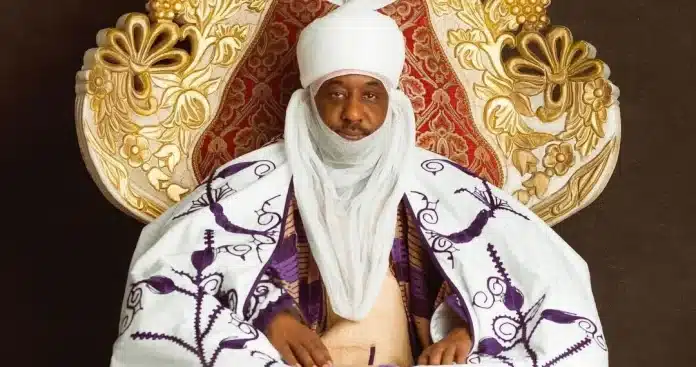


ABUJA – The former Governor of the Central Bank of Nigeria (CBN) and current Emir of Kano, Sanusi Lamido Sanusi, has issued a scathing critique of the President Bola Ahmed Tinubu administration’s economic management, specifically targeting the contradiction between the reported removal of fuel subsidies and the nation’s rising debt profile.
The Emir’s remarks, which have sent ripples through the nation’s capital, challenge the fundamental narrative that the government has successfully “saved” trillions of naira by ending the subsidy regime.
The $100 Billion Paradox
Emir Sanusi’s central argument hinges on a simple yet devastating mathematical question: If the government is no longer spending billions of dollars on fuel subsidies, and if revenue is allegedly increasing, why is Nigeria still aggressively borrowing from domestic and international markets?
“If you are not paying subsidy and you have the money, why are we still borrowing?” Sanusi asked during a high-profile economic summit. “The math doesn’t add up. If you save $10 billion in a year, that $10 billion should show in your reserves or in a reduction of your debt. Instead, we see the debt increasing and the reserves under pressure.”
The “Hidden Subsidy” Allegation
The Emir’s critique aligns with growing concerns among economic analysts that the government may be operating a “shadow subsidy.” While the official pump price of petrol has tripled since May 2023, the landing cost of fuel has continued to climb due to the depreciation of the Naira.
Analysts suggest that if the government were truly operating a 100% market-driven system, fuel prices would likely be even higher than current rates. Sanusi’s questioning implies that the “savings” from subsidy removal are either being neutralized by debt service or are being funneled back into the petroleum sector through non-transparent channels.
Key Points of the Emir’s “Blast”
| Issue | Sanusi’s Argument |
| Fiscal Transparency | The government must explain where the “saved” subsidy trillions are actually going. |
| Debt Accumulation | Borrowing while claiming to have increased revenue suggests a failure in fiscal discipline. |
| Cost of Governance | The administration is “spending too much on government”—officials, appointees, and overheads—at the expense of the public. |
| Institutional Pedigree | Sanusi previously stated the administration lacks people with the “pedigree” to articulate complex economic policies to a suffering populace. |
The “Terrible Confusion”
Sanusi’s latest intervention reinforces his description of the current economic climate as a state of “terrible confusion.” He warned that while he supports the intent of reforms (supporting roughly 80% of the policy direction in principle), the implementation is flawed by a lack of transparency and a refusal to cut the cost of governance.
“You cannot ask the common man to tighten his belt while the government is buying new jets and expanding the size of the cabinet,” Sanusi noted.
Presidential Response
The Presidency has previously reacted to Sanusi’s criticisms by urging him to “rise above personal interests.” However, with inflation currently hovering at record highs and the debt-to-revenue ratio remaining a critical concern, the Emir’s questions are being echoed by organized labor and civil society groups across the country.
As at press time, the Ministry of Finance has not provided a direct breakdown of the subsidy savings versus the new borrowing requirements, leaving the Emir’s “math” as the primary challenge to the administration’s economic narrative.
Sanusi blames delayed fuel subsidy removal
This video provides the necessary context on Emir Sanusi’s long-standing position that while subsidy removal was a “necessary pain,” the delay in doing so and the current lack of fiscal discipline have created an avoidable crisis for the average Nigerian.