


247ureports
A 2003 letter from the American Consulate in Lagos is being recirculated by allies of President Bola Ahmed Tinubu as definitive proof he has no criminal history in the United States — but a close reading shows the letter answers a much narrower question than the one it is now being deployed to settle. The renewed push comes just as a separate, more recent federal court case reveals the FBI and DEA are sitting on hundreds of pages of records connected to Tinubu’s name, records the 2003 letter could never have addressed.
The two documents are frequently conflated online, in a way that overstates what the older letter actually proves. 247ureports examined both threads of the story.
THE 2003 LETTER
The document in circulation is dated February 4, 2003, and addressed to Mr. Tafa Balogun, who was then Inspector-General of the Nigeria Police Force. It is signed by Michael H. Bonner, identified as Legal Attaché at the American Consulate in Lagos.
According to the letter, it was written in response to a police inquiry dated February 3, 2003, which had sought a records check on then-Lagos State Governor Bola Ahmed Tinubu through the FBI’s National Crime Information Center (NCIC). Bonner’s reply stated that the check “were negative for any criminal arrest records, wants, or warrants” for Tinubu, whose date of birth is listed in the letter as March 29, 1952. The letter describes the NCIC as a centralized database maintaining arrest and conviction records across the United States and its territories.
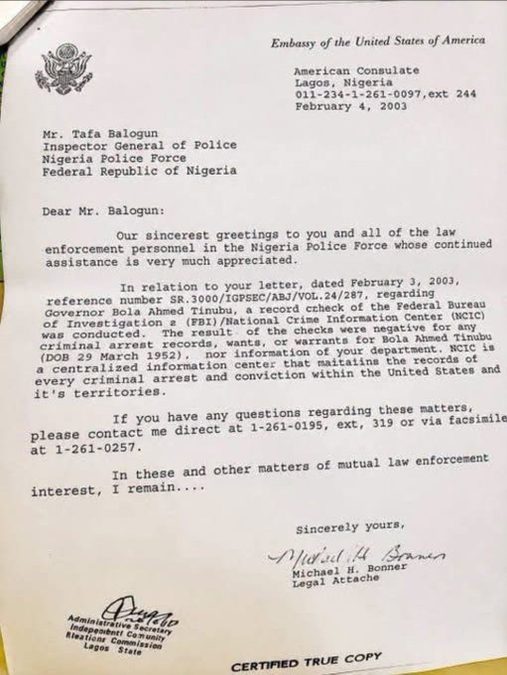
This is not a new document. Nigerian outlets reported its contents contemporaneously in February 2003, shortly after it was issued, in the context of allegations of drug trafficking and money laundering that had been raised against Tinubu by a rival within his own party ahead of his re-election bid as governor. The letter has recently recirculated online, including a version bearing a certified true copy stamp from Lagos State’s Independent Corrupt Practices and Other Related Offences Commission (ICPC), shared by activist and former presidential aide Reno Omokri.
Some social media users have questioned the letter’s authenticity, pointing to typographical errors in the circulated scans, such as “maitatins” for “maintains” and awkward phrasing including “nor information of your department.” These errors do not, on their own, establish that the letter is fabricated — the substance of the letter matches what independent Nigerian press reported in 2003, well before it became a subject of online dispute, and typographical inconsistencies are common artifacts of repeated photocopying, faxing and rescanning of two-decade-old documents.
What the letter’s content does establish, based strictly on its own text, is narrower than how it is sometimes represented. An NCIC check searches for arrest records, active warrants and “wanted” notices within the United States. It does not, by its nature, cover ongoing federal investigations that have not resulted in an arrest, matters handled by other federal agencies, financial or tax investigations, or proceedings outside the NCIC’s arrest-and-conviction database.
THE SEPARATE, ONGOING FOIA LITIGATION
Distinct from the 2003 letter is a federal court case in Washington, DC, that has drawn fresh attention to older FBI and DEA files.
According to court filings, American researcher and transparency activist Aaron Greenspan, who runs the platform PlainSite, filed twelve Freedom of Information Act (FOIA) requests between 2022 and 2023 to several US agencies, including the FBI, DEA, IRS, State Department and US Attorneys’ offices in Illinois and Indiana. The requests sought records concerning a Chicago-based narcotics investigation from the early 1990s involving four individuals: Tinubu, Lee Andrew Edwards, Mueez Akande and Abiodun Agbele.
For a period, the FBI and DEA responded to the requests with so-called “Glomar” responses — neither confirming nor denying that responsive records existed. In an order issued April 8, 2025, presiding judge Beryl Howell ruled that the agencies had, in practice, already confirmed the existence of investigative records involving Tinubu in other contexts, and that such non-denial responses were no longer justified. The court directed the FBI and DEA to search for and process any responsive, non-exempt records under FOIA.
In subsequent filings, the FBI reportedly told the court that agents and informants named in the material could face safety risks if identifying details were released, and asked for additional time to complete the review. Separately, a US lobbyist identified as Von Batten-Montague-York has claimed in social media posts that the two agencies’ search returned 399 pages of responsive records. That specific figure originates from the lobbyist’s public statements rather than from a document independently verified by this newsroom, and readers should treat it with appropriate caution pending confirmation from the court record itself.
THE PRESIDENCY’S RESPONSE
Nigeria’s presidency has pushed back on characterizations that the litigation represents a new revelation. Presidential Special Adviser on Information and Strategy, Bayo Onanuga, has said the underlying investigative material — associated with a 1993 report by an FBI agent — has circulated publicly for more than three decades and did not result in an indictment of Tinubu. Government lawyers, he said, were reviewing the US court’s April ruling.
WHY BOTH THINGS CAN BE TRUE AT ONCE
The two documents are not contradictory, but they answer different questions. The 2003 NCIC letter confirms that, as of that date, no US arrest record, warrant or “wanted” notice existed for Tinubu in the specific database the FBI’s Legal Attaché consulted. The ongoing FOIA case concerns a separate category of material — investigative files, potentially including surveillance, informant and grand jury-related records — that predate the 2003 letter and were never resolved through an arrest or conviction, and therefore would not have appeared in an NCIC arrest-records search in the first place.
Whether the older investigative files, once released, contain anything materially different from what has already circulated publicly for decades is a question the litigation itself has not yet resolved. The FBI and DEA’s document review, ordered by the court in April 2025, remains ongoing.
247ureports will continue to follow this story as the FOIA litigation proceeds in US federal court.