

.
.
By 247ureports.com
Onitsha and Aba are, by any economic measure, among the beating commercial hearts of West Africa. Onitsha’s main market is regularly cited as one of the largest in the region, moving goods across state and national borders daily. Aba’s sprawling informal manufacturing sector — leather, textiles, footwear — has earned it the nickname “Japan of Africa” for its improvised industrial ingenuity. And yet, more than six decades after independence, neither city sits on a single functioning rail line. This report examines how that came to be, and why it has persisted.
A Region Once Connected
The South East was not always a rail desert. The colonial-era Eastern Line, built beginning in 1916, linked Port Harcourt to Enugu specifically to move coal — one of the earliest and most strategically important rail corridors in the country. That line was later extended toward Kafanchan, Makurdi and eventually Maiduguri, and by the 1960s, Nigeria’s railway carried an average of 12 million passengers a year, with towns across the East growing up around railway stations much as Lagos, Ibadan and Kano did in the West and North.
Residents of Enugu recall a popular reason behind the old “PHCN”-style acronym once used for the railway network stretching across the region: “with the trains, you could reach every corner of the East at an affordable rate,” in the words of one longtime Enugu resident. Cattle traders moved stock from as far as Potiskum and Nguru in Yobe State down to Enugu and onward to Anambra and Nnewi. Petroleum products moved by rail from Calabar toward the North. A functioning rail economy once stitched the region into the rest of the country.
The Long Decline
That began to unravel after the Nigerian Civil War (1967–1970), and has never meaningfully recovered. Successive administrations — military and civilian alike — allowed the Eastern network to fall into what industry observers now routinely describe as a “moribund” state. A 2020 Port Harcourt–Aba test run under then-Vice President Namadi Sambo generated hope that briefly flickered and died; today, the corridor remains non-functional for regular passenger or freight service.
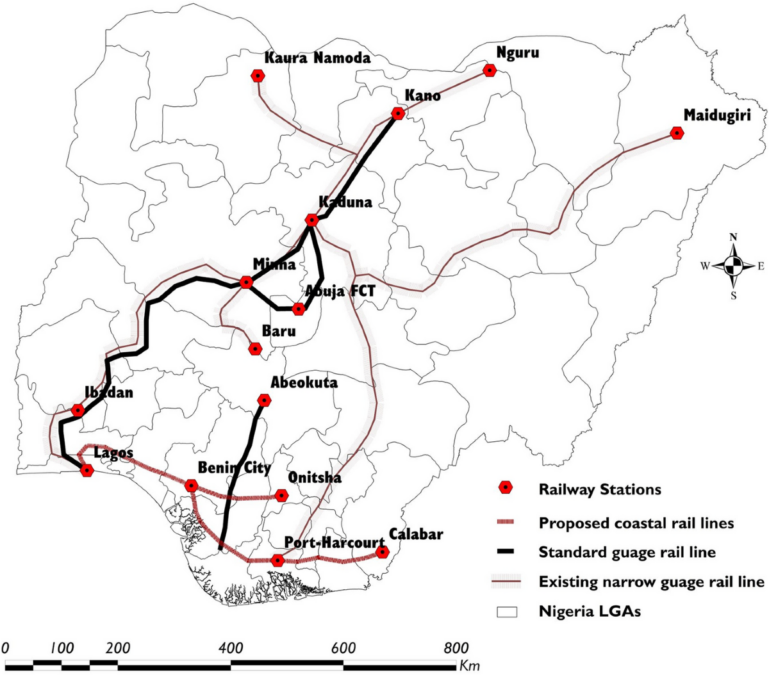
The pattern has continued into the era of large-scale rail investment. While the Lagos–Ibadan, Abuja–Kaduna and Itakpe–Warri standard-gauge lines were completed and commissioned over the past decade, no comparable standard-gauge project has been completed anywhere in the South East. The long-promised Port Harcourt–Maiduguri line, launched with fanfare in 2021, has seen what one analysis bluntly called “minimal progress.” The Coastal Railway project — first proposed in 2014 to connect Lagos to Calabar through Owerri, Onitsha and Asaba, precisely the corridor that would have linked the South East’s commercial centers to the national grid — was shelved indefinitely for years before resurfacing in a different form.
2025: A Budget That Crystallized the Grievance
The frustration reached a new pitch with Nigeria’s 2025 national budget, which allocated approximately N400 billion for light rail projects specifically in Lagos, Ogun, Kaduna and Kano states — all outside the South East and South South. Critics did not mince words. One widely circulated critique described the allocation as “not merely an oversight” but “a glaring, deliberate act of exclusion that reinforces decades of systemic marginalization,” and called for redirecting funds toward an Enugu–Onitsha–Port Harcourt line and a Calabar–Uyo–Aba line.
The pattern recurred in 2026: the Federal Executive Council approved roughly $2.99 billion for three rail projects — the Lagos Green Line, the Kano Metro Rail, and the Kaduna Light Rail. Once again, no South East project featured among them. Commentators noted that trillions of naira have flowed into major rail and highway megaprojects nationwide since 2015, while the South East has received what many describe as comparatively marginal, if any, transformative federal infrastructure investment.
What Onitsha and Aba Are Missing
The economic cost of this exclusion is not abstract. Academic research into the region’s post-war rail decline has argued that the absence of railway services has profoundly hampered the South East’s economic growth, limiting industrial development, agricultural export capacity and overall economic diversification, while raising the cost of goods and reducing the competitiveness of local trade. For Onitsha traders moving goods to and from the rest of the country, and for Aba’s manufacturers competing for national and regional markets, the reliance on Nigeria’s famously deteriorated road network — including the perpetually failing Enugu–Onitsha and Enugu–Port Harcourt expressways — means higher transport costs, slower delivery times and reduced competitiveness compared to counterparts in rail-connected regions.
Why Has This Happened? Competing Explanations
Several explanations are commonly advanced for the pattern, though they carry different weight and different degrees of evidence:
Post-war political marginalization. The most frequently cited explanation, especially within the region itself, ties the South East’s infrastructural exclusion directly to lingering political consequences of the Civil War, in which the former Biafra region fought for secession. Proponents of this view point to a broader pattern beyond rail — including a widely repeated claim, cited by regional commentators, that plans to site the Ajaokuta Steel Plant in Onitsha were shifted to Kogi State — as evidence of a decades-long pattern in which the region is systematically bypassed for landmark federal projects, regardless of its economic weight.
General national infrastructural decay, unevenly distributed. A separate, less politically charged explanation notes that Nigeria’s entire colonial-era railway system fell into disrepair after independence due to aging infrastructure, poor funding and general mismanagement — a decline that affected the Western and Northern lines as well, not only the East. Under this view, the South East’s exclusion from the newer standard-gauge revival is less a targeted decision than a continuation of whichever routes happened to attract political priority and financing at each stage — priorities that have, as a matter of pattern rather than explicit policy, repeatedly bypassed the region.
Security and terrain considerations. Government officials have at various points cited the security situation in parts of the Southeast — including sporadic attacks linked to secessionist agitation and the broader “unknown gunmen” crisis since 2021 — as a complicating factor for large infrastructure investment, though critics argue this explanation does not account for the years of neglect that preceded the current security crisis, nor for continued investment in other regions facing comparable or worse security challenges.
Federal budgeting and political bargaining power. Some analysts point to a more structural, less conspiratorial explanation: infrastructure allocation in Nigeria’s federal system tends to track political bargaining power and coalition-building needs at the center, and the South East’s relatively fragmented political representation compared to blocs like the Northwest or Southwest may leave it with less leverage in budget negotiations, independent of any specific animus toward the region.
Where Things Stand
As of this report, the Lagos–Calabar coastal rail line — the project most directly relevant to finally connecting Onitsha, Aba and the wider South East to the national standard-gauge network — remains listed as “under construction,” with a 1,402-kilometre route and 22 stations planned, backed by a $11 billion financing arrangement with Standard Chartered Bank as part of a larger $14.4 billion project. Whether and when that line will actually reach the South East’s commercial centers remains, based on the region’s rail history, an open question rather than a settled promise.
247ureports.com will continue to track developments on the Lagos–Calabar coastal rail project and any future federal rail allocations affecting the South East.