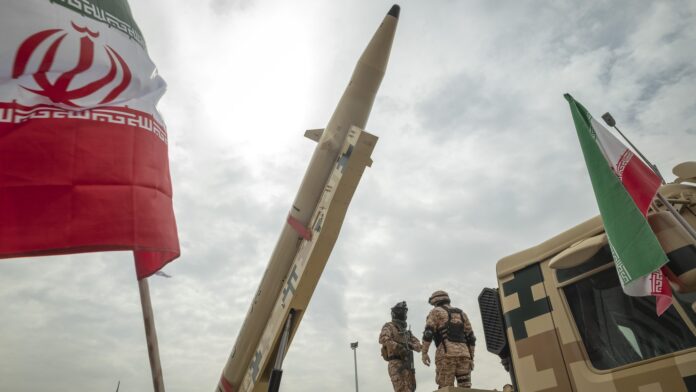


TEHRAN, IRAN — In a development that could alter maritime and regional defense dynamics, the Islamic Revolutionary Guard Corps (IRGC) Aerospace Force has announced that Iran successfully achieved the technical capability to strike moving targets using long-range ballistic missiles.
Speaking to Iranian state media, Brig. Gen. Ali Balali, a senior adviser to the commander of the IRGC Aerospace Force, characterized the milestone as a long-sought technical hurdle that was overcome through practical tactical adaptations on the battlefield.
“One of our challenges was developing a long-range ballistic missile capable of hitting a moving target. That was achieved in recent days, and more successes are on the way,” Balali stated, adding that weapon accuracy and operational efficacy have consistently improved across successive engagements.
Tactical Significance for Naval Warfare
Striking a moving target—such as a maneuvering warship or aircraft carrier at extended ranges—presents immense technical hurdles for ballistic missiles. Unlike fixed land targets, mobile maritime targets require:
- Real-Time Guidance and Data Link Updates: MidThe ability to target moving assets—specifically naval battle groups like aircraft carriers—at long ranges using ballistic missiles (ASBMs) represents one of the most technically challenging thresholds in modern missile engineering.
To achieve terminal guidance against a moving target over long distances, a missile system relies on a complex kill chain that goes beyond the missile itself:
- Real-Time Reconnaissance: Continuous tracking via satellite constellations, over-the-horizon (OTH) radar, or high-altitude long-endurance drones to feed initial target coordinates.
- Mid-Course Updates: A mid-course data link to adjust the missile’s trajectory while in high-altitude exoatmospheric or upper-atmospheric flight.
- Terminal Seeker Technology: Re-entry vehicles (RVs) equipped with radar (SAR), optical, or infrared sensors capable of locking onto a ship’s signature despite intense friction heat and plasma shielding during re-entry.
- Maneuverability: Maneuvering re-entry vehicles (MaRVs) fitted with aerodynamic control surfaces or thrusters to adjust vector in the final seconds of flight.
Iran has previously demonstrated terminal guidance on short-to-medium-range missiles—such as the Khalij Fars (anti-ship ballistic missile) and Fateh-110 variants—but scaling this technology to long-range systems increases complexity exponentially due to higher re-entry speeds and communication blackouts caused by atmospheric friction.
If operationalized, a long-range ASBM capability aims to enforce an Anti-Access/Area Denial (A2/AD) envelope, attempting to push hostile naval forces and carrier strike groups further off shore in the Persian Gulf, Gulf of Oman, and northern Indian Ocean.