

Group Seeks Forensic Review, Physical Verification of Projects Across Bauchi South
By: Hauwa Gambo
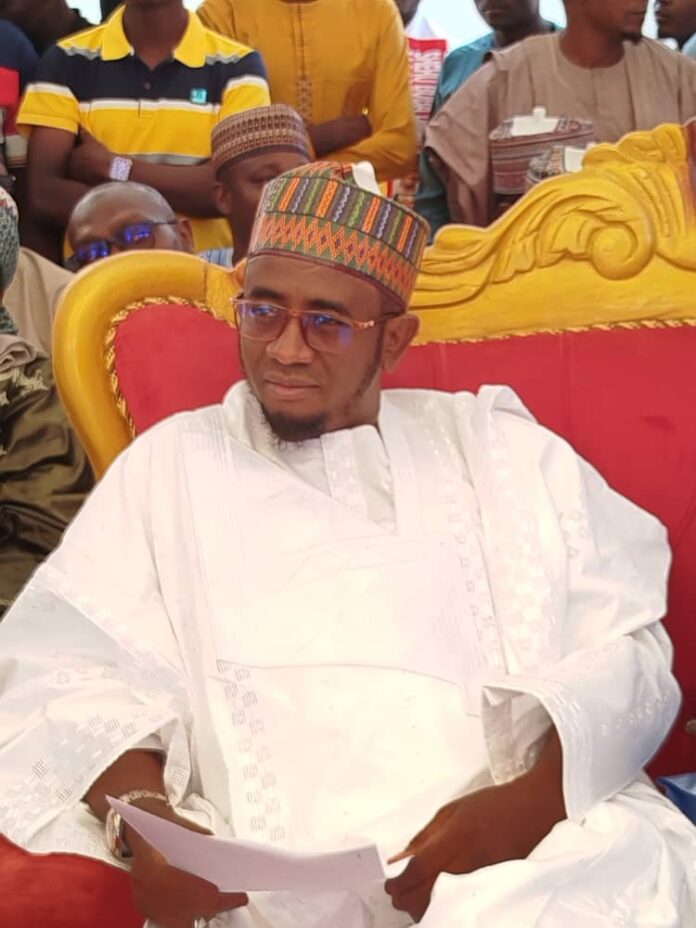
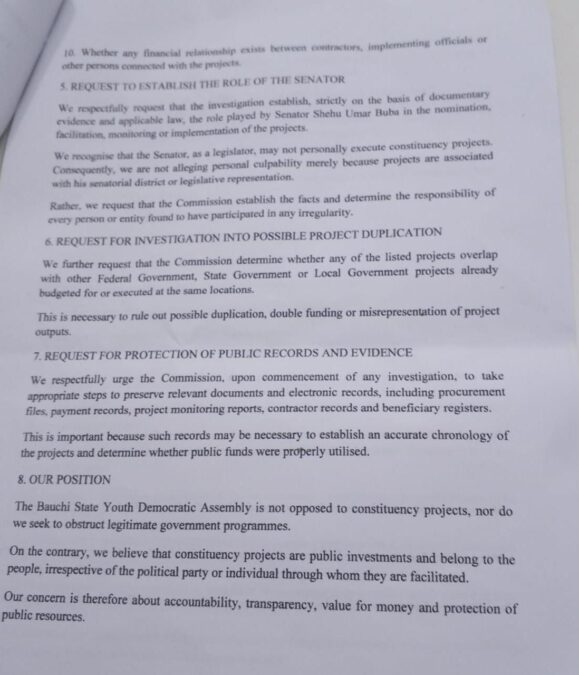
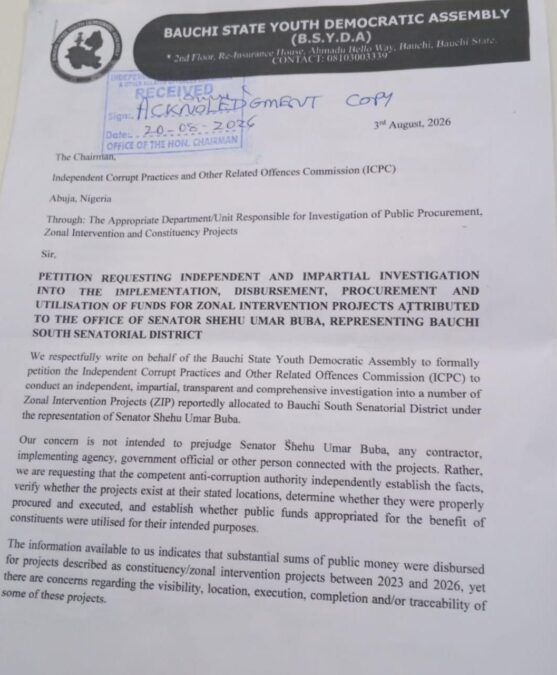
A Bauchi-based youth organisation, the Bauchi State Youth Democratic Assembly (BSYDA), has petitioned the Independent Corrupt Practices and Other Related Offences Commission (ICPC), calling for an independent, impartial and comprehensive investigation into the implementation, procurement, funding and utilisation of constituency and Zonal Intervention Projects (ZIP) reportedly linked to the office of Senator Shehu Umar Buba, representing Bauchi South Senatorial District.
The petition, dated August 3, 2026, and reportedly acknowledged by the Office of the ICPC Chairman on August 20, 2026, urged the anti-corruption commission to examine projects said to have been allocated or funded within Bauchi South between 2023 and 2026.
The group is specifically asking the commission to establish the actual number of projects involved, their locations, approved contract sums, amounts released and paid, contractors engaged, implementing agencies, level of completion and the extent to which the projects have delivered value to the communities for which they were intended.
BSYDA said its intervention was motivated by the need to protect public resources and ensure that government-funded constituency projects produce the tangible benefits for which they were appropriated.
Group Seeks Independent Verification
In the petition addressed to the ICPC Chairman through the department responsible for investigations involving public procurement, Zonal Intervention Projects and Constituency Projects, the organisation urged the commission to conduct a comprehensive examination of the projects rather than relying solely on official paperwork.
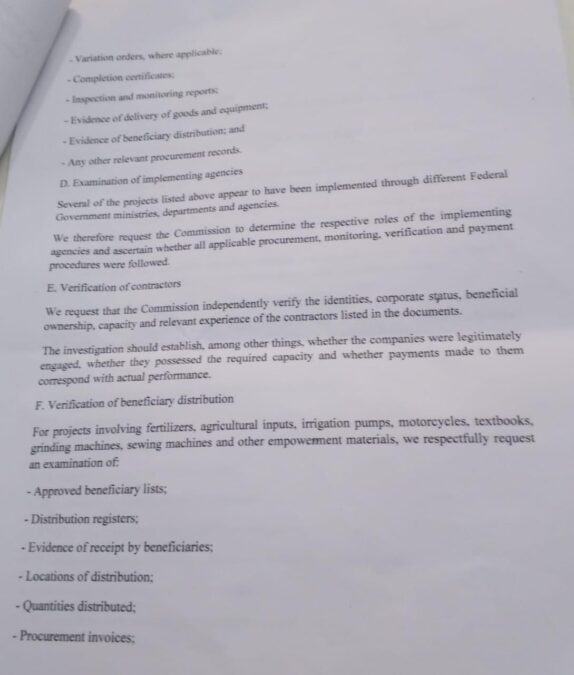
It called for physical inspection of project sites, examination of procurement and payment records, verification of contractors and implementing agencies, and assessment of the actual work delivered against the amounts reportedly allocated or disbursed.
The group also wants investigators to determine whether the projects were procured and implemented in accordance with applicable public procurement, financial and administrative regulations.
According to the petitioners, the central question is whether public funds appropriated for the benefit of constituents have been translated into completed and functional projects on the ground.
Projects and Amounts Listed
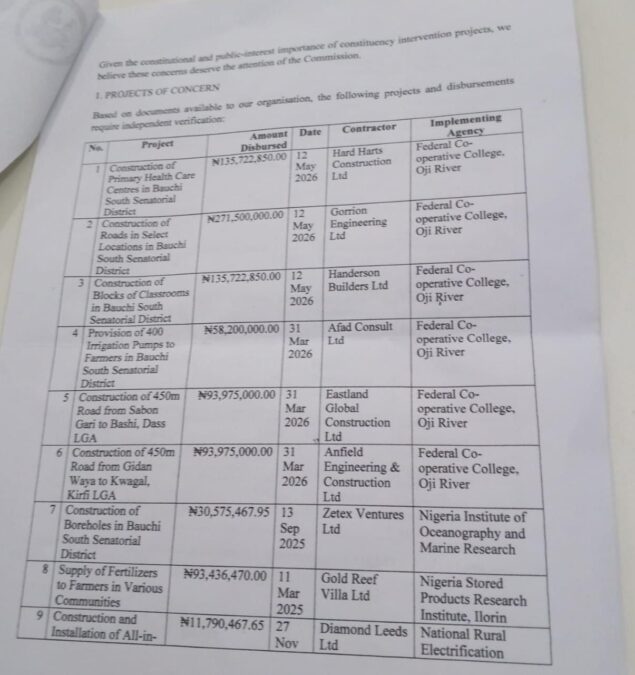
Documents attached to the petition reportedly contain a list of projects and financial figures which BSYDA wants subjected to independent verification.
Among the projects listed is the construction of Primary Health Care Centres in Bauchi South Senatorial District, for which the petition cites an amount of ₦135,722,850, reportedly disbursed on May 12, 2026.
Hard Harts Construction Ltd is identified in the petition as the contractor, while the Federal Cooperative College, Oji River, is listed as the implementing agency.
Another project cited is the construction of roads in selected locations in Bauchi South Senatorial District, with ₦271.5 million listed as disbursed on May 12, 2026.
The petition identifies Gornion Engineering Ltd as the contractor and again lists the Federal Cooperative College, Oji River, as the implementing agency.
The group also listed ₦135,722,850 for the construction of blocks of classrooms in Bauchi South Senatorial District, with Handerson Builders Ltd named as contractor.
Other projects contained in the petition include the provision of 400 irrigation pumps to farmers, reportedly valued at ₦58.2 million, as well as two separate road projects involving the construction of approximately 450-metre roads.
One of the roads is identified as the Sabon Gari–Bashi road in Dass Local Government Area, while the other is the Gidan Waya–Kwagazal road in Kirfi Local Government Area, with each project listed at approximately ₦93.975 million.
The petition further cites a ₦30.575 million borehole project, a ₦93.436 million fertiliser supply programme for farmers in various communities and an ₦11.79 million rural electrification-related project, among other interventions.
The figures cited in the petition represent projects requiring verification by the appropriate authorities, rather than independently established evidence of wrongdoing.
Request for Forensic Examination
Beyond physical inspection, BSYDA wants the ICPC to conduct a forensic examination of the financial and procurement trail associated with the projects.
The group has requested scrutiny of budgetary provisions, releases, payment records, contract documents, procurement processes, certificates, project supervision reports and completion documentation.
It also wants investigators to establish whether the amounts reportedly paid to contractors correspond with the level and quality of work executed.
Where projects are incomplete or allegedly abandoned, the petitioners want the authorities to determine the reasons for the delays and establish whether payments were made for work that was not executed or was substantially incomplete.
The group further called for verification of whether project variations, extensions or changes in scope, where applicable, received the required approvals.
Physical Verification of Projects
One of the strongest demands contained in the petition is for physical verification.
BSYDA argued that documentary records alone may not provide a complete picture of project implementation and therefore urged the ICPC to physically inspect the listed projects across Bauchi South.
Such verification, according to the group, should establish the exact location of each project, its current condition, level of completion, functionality and conformity with the specifications contained in the relevant contract documents.
The organisation also wants communities benefiting from the projects to be engaged where necessary to provide information concerning the existence, utilisation and history of the interventions.
Accountability and Value for Money
The petitioners maintained that constituency and Zonal Intervention Projects represent public investments intended to address specific developmental challenges in local communities.
They therefore argued that citizens have a legitimate interest in knowing whether projects appropriated for their communities have been delivered and whether the public has received value for money.
According to the group, accountability should not be viewed through a partisan lens, but as an essential component of responsible management of public resources.
It urged the ICPC to follow the evidence wherever it leads and to investigate all relevant actors and institutions where necessary, including contractors, implementing agencies, government officials and other persons connected to the projects.
No Presumption of Guilt
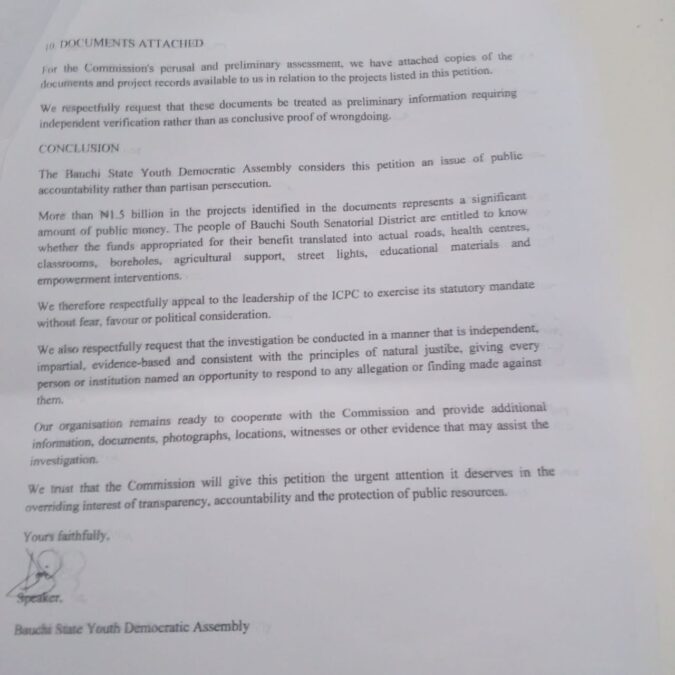
Importantly, BSYDA stated that its petition should not be interpreted as a declaration that Senator Shehu Umar Buba, the contractors named in the petition or any government institution has committed an offence.
The group said the matters raised constitute allegations and concerns requiring independent verification by competent authorities.
It called for every person or organisation mentioned in connection with the projects to be given an opportunity to respond to any adverse finding that may emerge during the investigation.
The petitioners also stressed that their objective is not to convict anyone through the media but to encourage the appropriate institutions to establish the facts through lawful investigative procedures.
Broader Public Interest
The petition comes against the backdrop of continuing public interest in the implementation of constituency and Zonal Intervention Projects across Nigeria.
Such projects have increasingly attracted public attention because they involve government funds allocated to address local development needs, ranging from roads and healthcare facilities to schools, water supply, agriculture, electricity and other community infrastructure.
For constituents, the effectiveness of these interventions is ultimately measured not merely by budgetary entries or contract awards, but by whether projects are physically delivered, functional and beneficial to the communities concerned.
BSYDA’s petition therefore places emphasis on the need to connect financial records with physical outcomes.
What an Investigation Could Establish
If the requested investigation is undertaken, it could potentially clarify several outstanding questions, including whether the projects listed in the petition were actually approved and funded, whether procurement procedures were followed, whether contractors received the amounts indicated, whether projects exist at their reported locations and whether the quality and extent of work correspond with the funds expended.
It could also establish whether there were legitimate reasons for delays or incomplete projects and whether any financial or administrative irregularities occurred.
Should the investigation find no wrongdoing, such findings would equally provide an opportunity to clarify the status of the projects and address public concerns.
Conversely, if competent authorities establish evidence of financial misconduct, procurement violations, diversion of public funds, payment for unexecuted work or other breaches of the law, appropriate action would be expected in accordance with due process.
Call for Transparency
BSYDA has consequently urged the ICPC to approach the petition professionally, independently and without political interference.
The group said it is prepared to provide information and supporting documents available to it that could assist investigators in establishing the facts.
For the people of Bauchi South, the significance of the matter extends beyond political affiliations. The central issue is whether public resources appropriated for development are reaching the communities for which they were intended.
As the petition awaits consideration by the relevant authorities, the outcome of any investigation would be expected to provide greater clarity on the projects, their funding, implementation and value to constituents.
Until such an investigation is completed, however, the allegations contained in the petition remain unproven claims requiring verification, and no person or organisation should be presumed guilty solely on the basis of the petition.
The broader public interest, ultimately, lies in ensuring that every public naira allocated for constituency development is properly accounted for and translated into measurable benefits for the people.