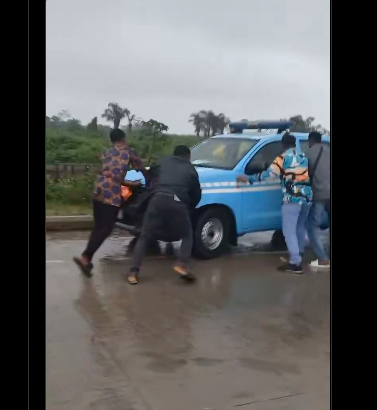


ASABA, NIGERIA — Commuters and motorists along the busy Asaba-Ogwashi-Ukwu commercial corridor in Delta State witnessed a chaotic breakdown of order following a direct physical confrontation between commercial transport passengers and operatives of the Federal Road Safety Corps (FRSC).
The violent altercation, which was captured in a viral video circulating heavily across socio-political social media channels, has forced the FRSC National Headquarters to launch an emergency investigation into the conduct of its field patrol officers.
Fight Over the Steering Wheel
According to preliminary field reports from the Delta State Sector Command, the near-fatal crisis began when an enforcement team flagged down a commercial Toyota Sienna bus for routine document tracking and a mechanical compliance audit. Upon inspection, the patrol officers discovered that the commercial operator was operating the transit unit without a legally mandated speed-limiting device, a critical violation that requires immediate vehicle impoundment under existing highway safety codes.
The enforcement procedure took a violent turn when an FRSC marshal attempted to take physical control of the vehicle’s cockpit to drive it to the zonal command base. Angered by the sudden delay and potential disruption to their journeys, passengers vehemently revolted.
“A female passenger aggressively grabbed the steering wheel, physically wrestling control away from the FRSC marshal to block the standard impoundment protocol,” a local transport source revealed.
The situation rapidly dissolved into a physical shouting and shoving match right on the asphalt, bringing mid-day traffic along the highway to a complete standstill as other commuters rushed to separate the fighters.
Abuja Headquarters Orders Rapid Sanctions
Reacting to the viral footage, which has drawn intense public criticism regarding the tactical restraint of paramilitary personnel, the Corps Marshal of the FRSC, Malam Shehu Mohammed, expressed deep concern over the visible lack of professional operational control.
| Operational Audit | Chronology of the Asaba Corridor Enforcement Crisis |
| The Trigger | Toyota Sienna commercial bus intercepted for lacking a speed-limiting device. |
| The Violation | Automatic impoundment order triggered under federal road safety guidelines. |
| The Flashpoint | Passengers refuse to disembark; a commuter physically grabs the steering wheel. |
| The Command Action | Sector Commander given a strict 48-hour deadline to submit an extensive incident report. |
The FRSC high command has officially ordered the Delta State Sector Commander to conduct a comprehensive inquiry and forward an exhaustive behavioral blueprint to the national headquarters within 48 hours to identify all culpable actors.
Balancing Road Enforcement and Public Temperament
The violent highway incident highlights a growing friction between Nigerian transport safety agents and a commuting public increasingly frustrated by unexpected transit delays and heavy-handed enforcement routines.
While the FRSC maintains that enforcing the installation of speed-limiting devices is non-negotiable for curbing fatal crashes, passenger unions argue that marshals frequently execute impoundments in an aggressive manner that leaves travelers stranded in insecure border zones.
The Corps Marshal has reassured the public that if the marshals involved are found to have breached standard rules of engagement, they will face swift orderly room trials and disciplinary dismissals to preserve institutional integrity.