
By Michael Olukayode
For thousands of young Nigerians, the dream is familiar: leave home, find work abroad and build a better life.
But for many who set out on the perilous migration route through North Africa, the dream often ends in exploitation, violence and years of uncertainty.
Among a recent group of Nigerians evacuated from Libya was a young woman who believed she was travelling to Egypt to work as a hairdresser and makeup artist. Instead, she found herself trapped in Libya’s shadowy migrant economy.
“We were told that we were going to Cairo,” she said quietly. “Unfortunately, we found ourselves in Libya.”
Her testimony is one of several harrowing accounts from returnees whose stories expose the realities behind the promises made by traffickers, agents and migration middlemen.
She had travelled alongside her sister after being offered what appeared to be a legitimate overseas job opportunity. Upon arrival, however, she discovered that the work awaiting her had little to do with the profession she knew.
Rather than working as a beautician, she was forced into domestic labour.
“We entered Shagala,” she explained, using the term commonly employed by migrants to describe domestic housework. “I worked as a housemaid there.”
Like many migrants arriving in Libya, she became indebted to sponsors who financed the journey and expected repayment through labour. For months she worked under difficult conditions, believing that once the debt was cleared she would finally regain control of her life.
“After I paid for about 10 months, only two months remained before I completed the money,” she recalled.
Then she overheard a conversation that changed everything.
“I heard my madam and her husband discussing with someone who wanted to come and pick me up. They said they would collect 9,000 dinars.”
The implication was devastating. Despite nearly completing her debt repayment, she was about to be sold or transferred to another employer.
When she resisted, she said she was brutally assaulted.
“Nine people beat me,” she recounted. “They used a stick and shot me in my eye.”
The injuries were severe. Photographs of her condition were eventually sent to relatives in Nigeria.
For six years she remained trapped in Libya, separated from her family and unsure whether she would ever return home.
Her sister was luckier.
“My sister came back to Nigeria after one year and six months,” she said. “But I stayed six years.”
Her story reflects the darker realities faced by many migrants who fall victim to trafficking networks, debt bondage and abuse in a country that has remained unstable since the 2011 overthrow of former Libyan leader Muammar Gaddafi.
Yet not every returnee described the same experience.
Another migrant, a young man who left Nigeria shortly after completing secondary school, said economic hardship and limited educational opportunities pushed him to seek work abroad.
“My father was already old and I didn’t have anybody to sponsor me in school,” he explained. “So I went there to work.”
He spent nine years in Libya and eventually secured employment at a car wash.
“The job really paid me,” he said.
Unlike many others, he was able to repay his sponsor, establish himself and earn enough to survive.
But even he warned against viewing Libya as a land of opportunity.
“Libya is not easy,” he said. “It depends on who carries you there.”
According to him, many young Nigerians are lured by exaggerated promises that rarely match reality.
“Some people lie to you that there is plenty of work in Libya,” he said. “At the end of the day, you get there and discover something else.”
His partner, who joined him in Libya and gave birth there, described a life marked by constant uncertainty despite their ability to find employment.
“We faced a lot of challenges,” she said.
At various times, the family found themselves homeless.
“Sometimes we slept on the street. Sometimes we slept inside our car with our child.”
She also spoke about the vulnerability migrants face during raids and security operations.
“They just enter your house, break the door and carry your properties,” she said. “There is nothing you can do.”
The experiences of the returnees underscore the complexity of migration through Libya.
For some, the country provides jobs and an income that may be difficult to secure at home. For others, it becomes a place of exploitation, violence and shattered expectations.
What unites both experiences is the determination to pursue a better future despite overwhelming risks.
One migrant spent six years struggling to escape exploitation. Another worked for nearly a decade and managed to save enough money to rebuild his life back home.
Yet both arrived at the same conclusion.
“Libya is not easy.”
Their warning comes not from speculation or hearsay, but from years spent navigating one of the world’s most dangerous migration corridors.
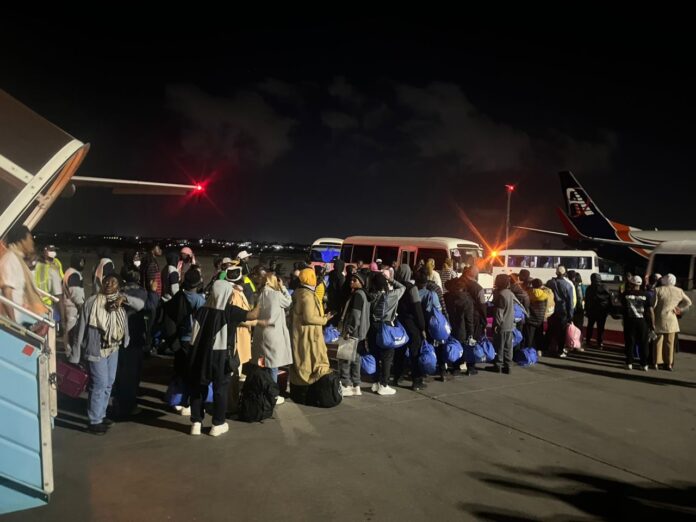
As Nigeria continues to receive returnees from Libya through assisted voluntary return and evacuation programmes, their stories serve as a sobering reminder that behind every migration statistic is a human being carrying dreams, disappointments and extraordinary resilience.
For many of those now back on Nigerian soil, the journey has finally ended.
But the memories of what they endured in pursuit of a better life may remain with them forever.
Beyond facilitating the safe return of stranded migrants, the International Organization for Migration (IOM) has continued to provide reintegration support aimed at helping returnees rebuild their lives and reduce the likelihood of re-migration through irregular routes.
Under its Assisted Voluntary Return and Reintegration (AVRR) programme, returnees receive varying forms of support, including temporary accommodation, psychosocial counselling, medical assistance, vocational training, education support and small business grants tailored to individual needs.
Many returnees are assisted in acquiring skills in trades such as tailoring, catering, information technology, welding, agriculture and other income-generating ventures. Others receive start-up equipment and business support designed to help them establish sustainable livelihoods in their communities.
Officials say the programme is intended not only to help migrants recover from often traumatic experiences abroad but also to address some of the economic pressures that drive irregular migration.
For many of the returnees arriving from Libya, the support represents an opportunity to begin again after years marked by uncertainty, exploitation and hardship.
As they step off evacuation flights and reunite with families, they face the challenge of rebuilding their lives. But with reintegration assistance and renewed opportunities at home, many hope their next chapter will be defined not by survival, but by stability and progress.