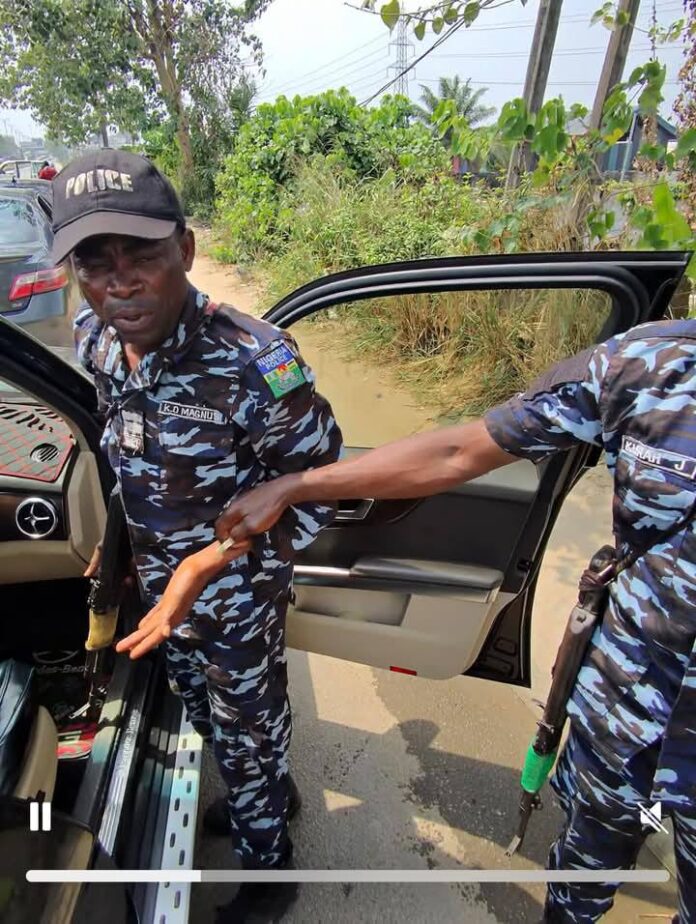


LAGOS — A viral incident where a crowd of northern youths aggressively confronted an armed police officer accused of stealing a mobile phone has ignited a fierce national debate over how Nigerians across different geopolitical zones respond to law enforcement misconduct.
The confrontation, which saw civilians refuse to back down despite the officer wielding a service rifle, has spotlighted a deep cultural and sociological divide in the fight against police brutality.
While some praise the raw courage of the northern youths for executing immediate accountability, others warn that such volatile standoffs highlight a complete collapse of institutional trust and risk turning everyday streets into bloody execution grounds.
The Northern Response: Community Solidarity and Immediate Pushback
Socio-political analysts observe that in many urban centers across the North, a deeply entrenched culture of immediate community solidarity often overrides the fear of state authority.
When a law enforcement agent is perceived to have crossed the line into outright criminality—such as extortion or theft—the public reaction is frequently swift, collective, and physically assertive. In these high-tension moments, the sheer volume of the crowd acts as a human shield, effectively neutralizing the intimidation factor of a firearm.
“In the North, there is an unspoken rule of collective defense when an injustice occurs in the marketplace or on the street,” said a sociologist at the Ahmadu Bello University. “The crowd does not see a representative of the state; they see a criminal in uniform, and the response is immediate frustration boiled over.”
The Southern Approach: The Post-EndSARS Trauma and Digital Weaponry
In sharp contrast, street interactions with corrupt officers in southern Nigeria are often characterized by a more cautious, defensive posture from bystanders. Critics frequently complain that onlookers in the South resort to filming abuses on their smartphones rather than physically intervening to rescue victims of harassment.
However, human rights advocates argue that this behavior is not driven by cowardice, but by a calculated survival instinct shaped by history. Following the heavy-handed state crackdowns during the 2020 EndSARS protests, citizens in the South are acutely aware of how quickly a physical confrontation with a nervous or compromised officer can escalate into a fatal shooting.
For many in the South, the smartphone camera has replaced physical force as the primary weapon of resistance. Filming is deployed as a strategic tool to gather undeniable digital evidence, relying on the power of social media outrage to force the police high command into issuing internal disciplinary actions and dismissals.
The Fatal Risk of Uniformed Confrontations
While the viral video of the northern youths has been celebrated by some as a triumph of civilian pushback, national security experts are warning against the normalization of physical resistance against armed personnel.
The primary danger remains the unpredictable nature of an armed standoff. Security analysts emphasize that physically assaulting or cornering an officer carrying a loaded weapon creates a high-probability scenario for accidental discharges or panic-driven mass shootings.
The fact that citizens feel compelled to risk their lives on the pavement just to recover a stolen phone or halt a bribe underscores a tragic reality: the public completely lacks faith in internal police complaint bureaus, anti-cultism units, and regional commands to police themselves. [1]
The Path to Institutional Sanity
The growing divergence in how Nigerians tackle street-level extortion highlights an urgent need for the Police Service Commission to accelerate real structural reforms.
Stakeholders insist that true civilian safety will not be achieved through dangerous street brawls or viral videos, but through the mandatory enforcement of body cameras, the elimination of illegal roadblocks, and the swift, public prosecution of uniform-wearing criminals in conventional courts of law.