
ABUJA, Nigeria — A comparative analysis detailing the contrast between the diplomatic entourages of the United States and Nigerian governments has triggered widespread discussion regarding economic strategy and the cost of public administration.
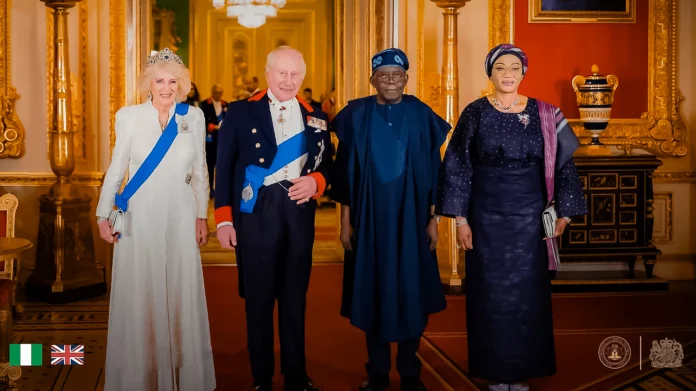
Originally compiled and distributed by social commentator Teju Olaoye, the document contrasts the corporate-heavy team accompanying U.S. President Donald Trump on his trade mission to China against the heavily political delegation of praise singers and hangers-on that followed President Bola Tinubu to his United Kingdom State Visit.
The U.S. Approach: Corporate Diplomacy to China
According to the published lists, President Trump’s entourage aboard Air Force One for his mid-May summit with Chinese President Xi Jinping was structured for economic negotiation. Outside of core cabinet members like Secretary of State Marco Rubio and Secretary of Defense Pete Hegseth, the 20-man delegation consisted of prominent business leaders.
The manifestation featured some of the world’s most powerful corporate executives, including Elon Musk (Tesla/SpaceX), Jensen Huang (Nvidia), Tim Cook (Apple), and Larry Fink (BlackRock). Financial analysts note that the composition targeted direct marketplace negotiations aimed at resolving market access, technological standards, and tech-sector trade barriers.
The Nigerian Approach: Political Heavyweights and Supporters to the UK
In contrast, President Bola Tinubu’s delegation for Nigeria’s UK State Visit focused heavily on political representation, domestic staff, and non-essential attendees. While the official core list was designated as a 17-member ministerial and security council, the broader accompanying logistical framework painted a different picture.
The extended presidential apparatus featured:
- 12 State Governors and 9 Cabinet Ministers
- 7 National Assembly Members
- 28 State House Senior Staff and 37 Security Personnel
- 12 Domestic Staff members dedicated to the President and First Lady
- Several hundred external supporters who traveled to London independently to welcome the administration
Public Reaction and Strategic Divergence
The structural differences between the two lists have generated scrutiny among Nigerian civil society groups and economic analysts. Critics note that while the American delegation utilized the state visit to advance industrial leverage by bringing corporate leaders directly into the room, the Nigerian delegation leaned heavily on public sector officials and a crowd of hangers-on whose travel is funded by taxpayers.
“The juxtaposition highlights differing approaches to diplomatic architecture,” stated an Abuja-based international relations analyst. “Washington uses diplomacy to create openings for its corporations. Abuja uses diplomacy to accommodate political stakeholders and praise singers.”
Spokespersons for the Nigerian State House have previously defended the inclusion of state governors and legislators on international missions, arguing that federal bilateral agreements cannot be implemented back home without direct alignment and buy-in from sub-national leaders.