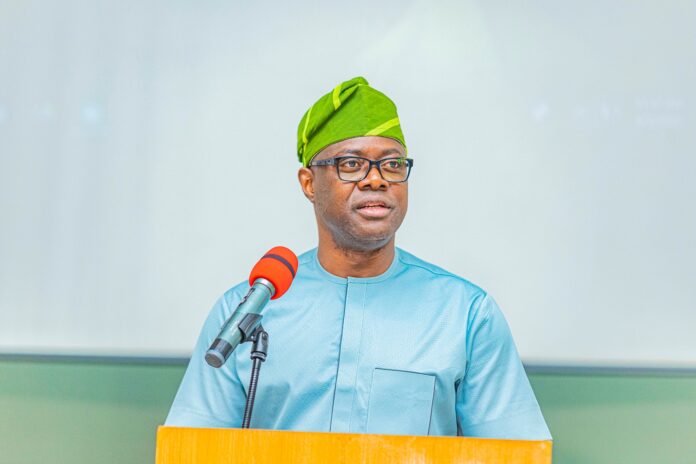

IBADAN — A new financial report has exposed a staggering surge in borrowing by the Oyo State government, revealing that Governor Seyi Makinde’s administration accumulated ₦164.8 billion in new debt over just three months. This figure is approximately six times the state’s total revenue for the same period, raising urgent alarms over the fiscal health of the “Pacesetter State.”
The Debt-to-Revenue Gap
The data highlights a deepening reliance on credit to fund government operations. While Oyo has made efforts to grow its Internally Generated Revenue (IGR)—which averaged between ₦7.5 billion and ₦8.5 billion monthly—the ₦164.8 billion quarterly debt spike far outpaces these earnings.
The data highlights a deepening reliance on credit to fund government operations. While Oyo has made efforts to grow its Internally Generated Revenue (IGR)—which averaged between ₦7.5 billion and ₦8.5 billion monthly—the ₦164.8 billion quarterly debt spike far outpaces these earnings.
Financial analysts note that this trend is a significant escalation. For comparison, the state borrowed ₦62 billion during the first nine months of 2024. The current trajectory suggests that for every naira the state earns, it is taking on several times that amount in fresh liabilities.
Debt Servicing Pressure
The rapid borrowing is already eating into the state’s budget. Previous records show that Oyo was spending roughly ₦4.70 out of every ₦10.00 collected from taxpayers just to service existing debts. With this latest influx of loans, there are concerns that debt repayment will eventually swallow funds meant for essential public services.
The rapid borrowing is already eating into the state’s budget. Previous records show that Oyo was spending roughly ₦4.70 out of every ₦10.00 collected from taxpayers just to service existing debts. With this latest influx of loans, there are concerns that debt repayment will eventually swallow funds meant for essential public services.
In past fiscal cycles, debt servicing costs have reportedly overshadowed capital spending in critical sectors such as healthcare, education, and water sanitation.
Government Response and Criticism
The administration has faced sharp rebukes from opposition leaders and civil society groups, who accuse the government of “mortgaging the future” of Oyo’s citizens. Critics point out that despite the heavy borrowing, many residents have yet to see a proportional improvement in their daily economic conditions.
The administration has faced sharp rebukes from opposition leaders and civil society groups, who accuse the government of “mortgaging the future” of Oyo’s citizens. Critics point out that despite the heavy borrowing, many residents have yet to see a proportional improvement in their daily economic conditions.
In its defense, the state government has previously labelled reports of excessive borrowing as “mischievous.” Officials argue that much of the approved credit is intended for “refinancing”—replacing older, high-interest loans with more manageable debt—and for “contractor financing” to ensure that massive infrastructure projects across the state do not stall.
Economic Outlook
Governor Makinde’s 2026 “Budget of Economic Expansion,” set at ₦891 billion, relies heavily on the hope that infrastructure investments will eventually stimulate enough economic activity to pay off these liabilities. However, with the debt-to-revenue ratio widening so drastically, the state faces a precarious balancing act to avoid a full-blown fiscal crisis.
Governor Makinde’s 2026 “Budget of Economic Expansion,” set at ₦891 billion, relies heavily on the hope that infrastructure investments will eventually stimulate enough economic activity to pay off these liabilities. However, with the debt-to-revenue ratio widening so drastically, the state faces a precarious balancing act to avoid a full-blown fiscal crisis.