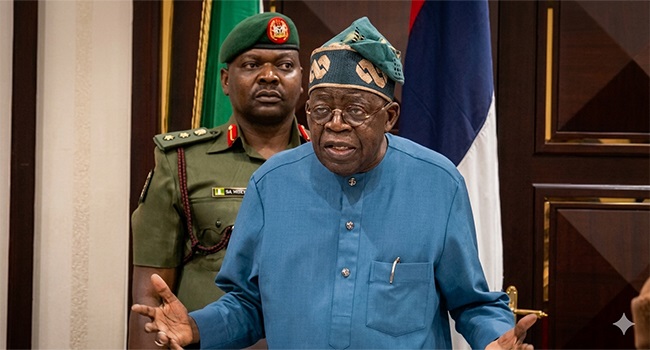

ABUJA — President Bola Tinubu has officially declared insecurity and poverty as national emergencies, describing them as existential threats to Nigeria’s stability. However, the announcement has been met with a wave of public backlash, as citizens accuse the administration of paying lip service to the nation’s suffering while sinking the country further into a “debt trap.”
The Presidential Directive
Speaking at the 2026 Workers’ Day celebrations through the Secretary to the Government of the Federation, George Akume, the President insisted that his administration is taking drastic measures to secure the country and reboot the economy. He highlighted the planned recruitment of 50,000 new police officers and the deployment of forest guards to reclaim bandit-controlled areas.
Speaking at the 2026 Workers’ Day celebrations through the Secretary to the Government of the Federation, George Akume, the President insisted that his administration is taking drastic measures to secure the country and reboot the economy. He highlighted the planned recruitment of 50,000 new police officers and the deployment of forest guards to reclaim bandit-controlled areas.
On the economic front, the President claimed that his social intervention programs are already reaching millions of households, promising that 2026 would be a “Year of Families” focused on social development.
“Nothing to Show for the Borrowing”
Despite the high-level declarations, the mood across the country remains bitter. Many Nigerians have dismissed the speech as a distraction from the government’s aggressive borrowing spree. Just this week, the Senate approved a fresh $6 billion loan request, bringing Nigeria’s total public debt to a staggering ₦159.28 trillion.
Despite the high-level declarations, the mood across the country remains bitter. Many Nigerians have dismissed the speech as a distraction from the government’s aggressive borrowing spree. Just this week, the Senate approved a fresh $6 billion loan request, bringing Nigeria’s total public debt to a staggering ₦159.28 trillion.
Critics and labor leaders argue that while the government continues to take out massive loans, there is no visible impact on the ground. “He just borrows and nobody knows where the money goes,” complained one Abuja-based analyst, reflecting a sentiment shared by millions who face record-high food prices and frequent power outages.
A Nation in Distress
The skepticism is backed by grim statistics. Recent reports indicate that the number of Nigerians living in extreme poverty has ballooned to 139 million. While the President speaks of “national emergencies,” the average worker sees only a decimated naira and a rising cost of living that has far outstripped the new minimum wage.
The skepticism is backed by grim statistics. Recent reports indicate that the number of Nigerians living in extreme poverty has ballooned to 139 million. While the President speaks of “national emergencies,” the average worker sees only a decimated naira and a rising cost of living that has far outstripped the new minimum wage.
Opponents like Peter Obi and Atiku Abubakar have characterized the administration’s policies as “hit-and-miss,” noting that declaring an emergency is meaningless if the borrowed funds are not transparently used to create jobs or secure farms.
As debt servicing now consumes nearly a third of the national budget, the gap between the government’s promises and the reality of Nigerian streets continues to widen, leaving many to wonder if these latest “emergencies” will result in actual relief or just more paperwork.