
ENUGU — Behind the glossy billboards and digital mockups of Governor Peter Mbah’s “New Enugu Smart City” lies a growing trail of tears, demolished homes, and allegations of a state-sponsored land grab. From Nchatancha Nike to Umuigbo Amurri, indigenous communities are sounding the alarm, accusing the state government of forcefully seizing ancestral lands without compensation to sell them at premium rates to the wealthy.
“Homeless on Our Own Land”
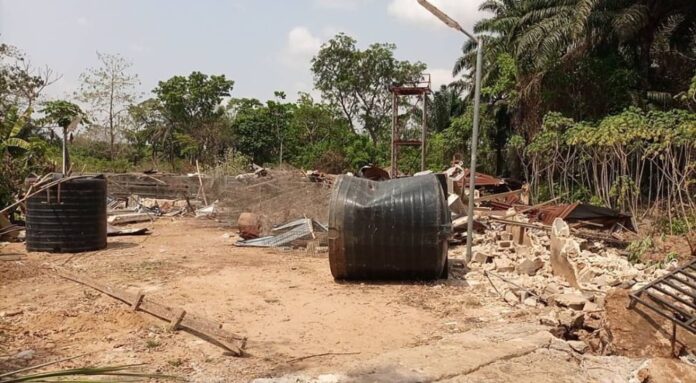
The dream of a 10,000-acre urban paradise has become a nightmare for the people of Nchatancha Nike in Enugu East. Residents watched in horror as bulldozers—backed by heavily armed security forces—leveled ancestral homes and farmlands to make way for the “Smart City” infrastructure.
“They didn’t come to negotiate; they came to destroy,” said one community elder who lost his family house in the exercise. “Our ancestors were buried here. Now, the government is clearing our history to sell plots for millions of naira. Where is the compensation? Where are we supposed to go?”
The anger is not limited to residential areas. In Umuigbo Amurri, Nkanu West, farmers have been blocked from their ancestral fields to accommodate the “Smart Farm” initiative. Protesters have flooded the streets, carrying placards that read: “Mbah, Don’t Kill Us to Feed Others” and “Smart City is a Land Scam.”
The Multi-Million Naira Markup
While the government pitches the Smart City as a developmental necessity, critics point to the massive profit margins as evidence of exploitation. Reports indicate that while indigenous owners are displaced without a kobo in compensation, plots in the new layout are being priced as high as ₦162 million for residential development.
In the Olympic Layout of Enugu South, existing landholders are facing what they describe as “extortionate” levies. Owners have been ordered to pay an ₦8 million infrastructure levy per plot to retain their properties—a sum many residents say is designed to force them out so the land can be resold to elite buyers.
The Political Undercurrent
The optics of the project have fueled deep political resentment. Though Governor Peter Mbah was elected under the People’s Democratic Party (PDP), his policies have led to widespread accusations of an “anti-people” agenda.
Many residents have noted the irony of a government that promised to “disrupt the status quo” now reportedly acting as a real estate agent for the rich. “The government is treating us like tenants in our own state,” said a youth leader in Enugu. “They use the law to take it from the poor for free and use the ‘Smart City’ tag to sell it to the rich for hundreds of millions.”
No Compensation, No Peace
The displacement extends beyond residential land. Small business owners at the recently demolished Ogige Market in Nsukka are still waiting for the compensation promised by the state. Without these funds, thousands of traders have been left without a livelihood, adding to the growing sense of economic betrayal in the state.
Despite the protests, the Mbah administration maintains that the Smart City is essential for Enugu’s ₦1.62 trillion budget goals and urban renewal strategy. The government insists that all land acquisitions follow the Land Use Act, but for the people of Ezioha Mgbowo and Enuagu Akpugo, who are currently fighting illegal leasing claims in court, the “law” feels like a weapon rather than a shield.
As the bulldozers continue to roar, the gap between Mbah’s “Smart City” and the survival of the common Enugu indigene is widening into a chasm that no amount of digital infrastructure can bridge.