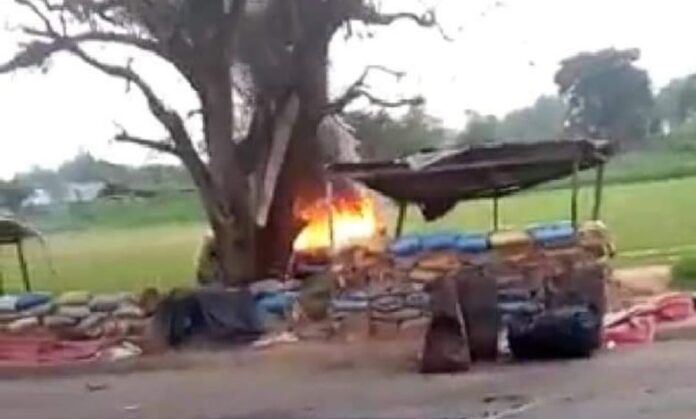


BARKIN LADI — The fragile peace in Plateau State shattered this week as years of religious tension and accusations of military bias boiled over into a violent confrontation. In the Kassa community of Barkin Ladi, the burial of a resident became the spark for an uprising that saw a military checkpoint reduced to ashes.
“They Watch While We Die”
The riot began late Sunday night following the funeral of Gyang Nuhu Choji, a Christian resident murdered by suspected bandits on April 16. For the mourners, Choji’s death was not just another statistic; it was proof of what they call a “calculated agenda” to wipe out indigenous farming communities.
As the body was lowered into the grave, the grief turned to fury. Hundreds of youths and women marched on the Rapung Kassa military post, accusing the soldiers of standing idly by while “foreign” gunmen terrorised the area.
“The soldiers are only here to protect one side,” shouted one protester as the checkpoint was set ablaze. “When the attackers come with their cows and guns, the military looks away. But when we try to defend our ancestral lands, they turn their guns on us.”
The Accusations: Bias and Religious Cleansing
The fire in Kassa is part of a dangerous narrative taking hold across the Middle Belt. Community leaders in Barkin Ladi and Riyom LGAs have grown increasingly vocal about what they perceive as the pro-caliphate bias of the federal security forces.
The grievances are specific and stinging:
- Selective Protection: Residents allege that military response is lightning-fast when nomadic herders report cattle rustling, but “agonisingly slow” when Christian farming villages are under siege.
- The Proximity Factor: In Kassa, protesters pointed out that Choji was killed just a few hundred meters from the military post. “How can a man be slaughtered in the shadow of a government gun, and the soldiers say they heard nothing?” asked a community elder.
- Disarmament of Victims: There is a deep-seated anger over security operations that focus on disarming local “vigilantes” while the sophisticated weapons used by invading groups remain in circulation.
Women Take a Stand in Gashish
The unrest spread to the Gashish community, where a group of women took matters into their own hands, physically dismantling a military checkpoint. For these women, the checkpoint had become a symbol of occupation rather than protection.
“We don’t want them here anymore,” a spokesperson for the women stated. “Their presence gives us a false sense of security while our husbands and sons are picked off one by one. We would rather face our enemies alone than trust a force that is biased against our faith and our people.”
A Region on the Brink
The military has denied these allegations, insisting they remain neutral and are working to restore order. However, the numbers tell a grim story. In the last 48 hours, six more residents were killed in coordinated raids across Barkin Ladi and Riyom.
As the smoke clears from the burned checkpoint in Kassa, the underlying religious and ethnic divisions remain raw. The people of the Plateau are sending a clear message to Abuja: the era of “enforced silence” under the watch of biased security forces is over.