

By News Desk
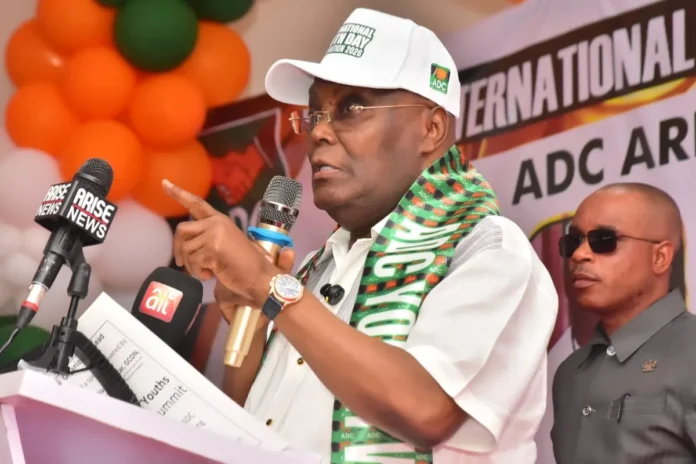
ABUJA, Nigeria — Former Vice President and African Democratic Congress (ADC) presidential candidate, Alhaji Atiku Abubakar, has fired back at President Bola Ahmed Tinubu over the ongoing debate surrounding fuel subsidy removal.
Atiku rejected the administration’s claim that higher state revenue allocations represent economic progress, asserting that the policy has instead inflicted severe financial hardship on ordinary households.
“Economic Vandalism by Presidential Fiat”
Reacting to remarks by President Tinubu—who described Atiku’s proposal to intervene in fuel pricing as “serious ignorance on governance and economy”—Atiku characterized the president’s stance as an attempt to label citizen suffering as successful economic policy:
- Direct Economic Impact: Atiku stated that the abrupt “subsidy is gone” announcement at Tinubu’s inauguration was executed without a transition framework, triggering immediate spikes in transportation, food costs, and general inflation.
- Shift to Production Subsidies: Clarifying his campaign vision, Atiku explained that he does not advocate returning to the former import-subsidy model. Instead, his policy proposes a capped, transparent production-side intervention directly linked to domestic refining and verifiable barrels.
- “Robbing Households to Subsidize Governments”: Responding to arguments that state governments now receive larger Federation Account Allocation Committee (FAAC) payouts, Atiku noted that impoverishing citizens to send bigger checks to governors is an admission of failure rather than an achievement.
Demands for Fiscal Transparency
Beyond energy policy, Atiku challenged the Presidency to provide a transparent accounting of government revenues following the economic reforms:
- Accounting for Federation Revenues: Atiku reiterated calls for the Federal Government to account for roughly ₦30 trillion in Federation Account revenues, transfers, and deductions, alongside the ₦12.8 trillion allocated to the Service-Wide Vote in the 2026 budget.
- Persistent Under-Recoveries: He questioned why opacity and non-transparent costs persist within the energy sector if the subsidy regime was fully eliminated.
The exchange signals an intensifying debate over energy pricing, inflation, and public fiscal management as political figures position their economic platforms ahead of the 2027 presidential election.