
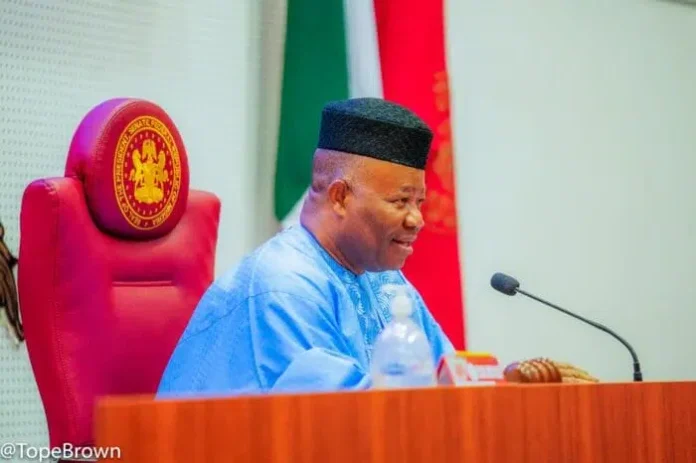


ABUJA — The 10th National Assembly, under the leadership of Senate President Godswill Akpabio, is facing a severe crisis of institutional credibility as civic watchdogs, anti-corruption advocates, and public finance analysts demand independent probes into massive insertions embedded within the approved federal budget.
A comprehensive 18-page investigative audit published by civic technology organization BudgIT revealed that lawmakers secretly padded the national budget with 11,122 unvetted projects valued at N6.93 trillion.
The revelations have ignited widespread public anger across Nigeria, raising fundamental questions about parliamentary integrity, executive complicity, and whether the Akpabio-led legislature has effectively reduced itself to a rubber-stamp institution.
The Anatomy of the Padding: From Streetlights to Royal Empowerments
The detailed breakdown of the budget insertions exposes a systemic practice of inflating micro-procurements and diverting public funds into non-developmental, highly localized constituency line items.
Among the most controversial allocations uncovered in the budget analysis are:
- Streetlight Allocations: A staggering N393.29 billion earmarked across 1,477 streetlight line items, many tucked inside the capital budget of the Federal Ministry of Agriculture and Food Security.
- Borehole Contracts: 538 individual borehole insertions totaling N114.53 billion.
- ICT Infrastructure: 2,122 ICT-related projects valued at N505.79 billion.
- Town Halls & Palaces: N17.23 billion allocated for 43 community town hall constructions and renovations, alongside N6.74 billion inserted for the direct “empowerment of traditional rulers”.
- Selective Regional Interventions: Multibillion-naira allocations for monarch palaces, community centers, and religious institution renovations, including constituency-driven church upgrades across parts of Abia State and the South-East linked to high-ranking legislative principal officers.
In total, 39 percent (4,371) of all legislative insertions—worth over N1.72 trillion—were dumped into the Ministry of Agriculture’s budget alone, inflating its capital allocation from an initial N242.50 billion to N1.95 trillion and diverting the ministry far outside its primary mandate of food security.
Is Akpabio’s Senate a Rubber Stamp for Executive Expenditure?
The scandal has renewed fierce scrutiny over Senate President Godswill Akpabio’s stewardship. Critics point out that under Akpabio’s supervision, the National Assembly expanded the budget from the President’s proposed figure to N54.99 trillion without public budget hearings or rigorous line-item auditing on the Senate floor.
The current controversy echoes earlier red flags raised within the Red Chamber. When Bauchi Central Senator Abdul Ningi blew the whistle on over N3.7 trillion in budget padding during earlier fiscal cycles, the Senate leadership moved swiftly to suspend him rather than institute a transparent internal audit.
Furthermore, the Senate’s refusal to investigate the administrative emergence of unbacked agencies and illegal spending lines has reinforced public perceptions that parliament is unwilling to police itself.
Responding to the findings, Senate Spokesperson Yemi Adaramodu dismissed the civil society report, labeling critics as “dark angels of falsehood” and claiming that the legislature acted within its constitutional rights to amend budget entries in the public interest.
Who Will Probe the Anomalies?
With the legislature defending the additions and the Executive arm quietly executing the operative budget, Nigerians are left asking who holds the legal and moral authority to enforce transparency.
- The Anti-Graft Agencies (ICPC & EFCC): Under statutory law, the Independent Corrupt Practices and Other Related Offences Commission (ICPC) maintains a dedicated Constituency and Executive Projects Tracking Group (CEPTG). Public finance experts are calling on the ICPC and the Economic and Financial Crimes Commission (EFCC) to track the procurement awards for these 11,122 inserted projects to prevent funds from being siphoned through ghost contractors.
- The Auditor-General of the Federation (OAuGF): Constitutional provisions mandate the Auditor-General to audit federal account disbursements and report financial non-compliance directly to the public record.
- Judicial & Civic Intervention: Civic advocacy coalitions, including BudgIT, SERAP, and Tracka, are preparing public interest legal suits to compel federal ministries, departments, and agencies (MDAs) to halt contract awards on unvetted legislative insertions.
As fiscal deficit pressures mount and citizens bear the burden of high inflation, the failure of Aso Rock and the National Assembly to address budget padding threatens to further erode public trust in Nigeria’s democratic governance.







