
By 247ureports Political Analyst
ABUJA, NIGERIA — A decade after the historic 2015 presidential election that reshaped Nigeria’s political landscape, a persistent and deeply polarizing theory continues to echo within the nation’s political corridors.
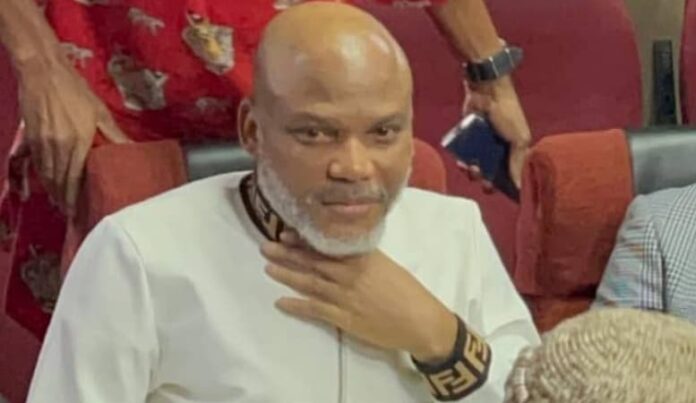
In some quarters, political analysts and regional stakeholders are raising unanswered questions regarding whether President Bola Ahmed Tinubu, during his time as the national leader of the All Progressives Congress (APC), covertly provided financial backing to Nnamdi Kanu and the Indigenous People of Biafra (IPOB) to depress Igbo voting strength and secure victory for Muhammadu Buhari over the incumbent, Goodluck Jonathan.
While mainstream political actors dismiss the narrative as a complex conspiracy theory, the recent open alignment of Yoruba separatist Sunday Adeyemo (Igboho) with the Tinubu administration has reignited intense debate over whether the presidency historically funded regional agitators to achieve strategic electoral goals.
The Political Mathematics of the 2015 Boycott
The theory that Kanu may have operated as a covert political disruptor relies heavily on the electoral mathematics of the 2015 general election.
Leading up to the polls, Kanu utilized his Radio Biafra broadcasts to launch a fierce campaign directing Igbos across the South-East to completely boycott the Nigerian electoral process. At the time, the South-East was the undisputed voting bloc and fortress of President Goodluck Jonathan.
By commanding millions of voters to stay home or risk violence, IPOB’s rhetoric successfully triggered massive voter apathy across the region. Consequently, the total voter turnout in the South-East plummeted sharply compared to the 2011 elections.
Political theorists argue this drop directly weakened Jonathan’s defense, giving the APC coalition—meticulously engineered by Tinubu—the mathematical advantage needed to sweep Buhari into power. This has led critics to question whether Kanu acted out of pure ideological separatism or if he was a heavily funded asset used to dismantle Jonathan’s southern support base.
The Sunday Igboho Precedent
The suspicion of high-level sponsorship gained fresh traction following the recent public actions of Sunday Igboho.
During the Buhari administration, Igboho rose to prominence as a fierce militant fighting for a “Yoruba Nation,” an agitation that primarily targeted northern herders and aligned with southwest regional anger. However, his recent aggressive emergence into the open to issue final ultimatums and actively defend the interests of the Tinubu administration has raised eyebrows.
To many observers, Igboho’s sudden pivot from an anti-state separatist to an enforcement arm of the current presidency serves as visible evidence that southwestern political elites have historically managed, and potentially financed, regional agitators to deploy them when politically expedient. Critics argue that if Igboho could be managed so effectively, a similar arrangement could have existed with Kanu in 2015.
The Counter-Arguments: Operational Reality vs. Collusion
Despite the persistence of these rumors in some quarters, several major historical factors strongly challenge the theory of a Tinubu-Kanu alliance: