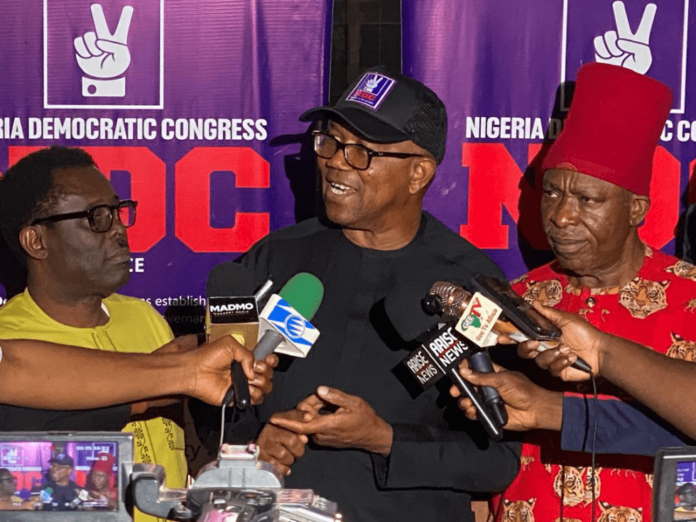


ABUJA — The presidential ambition of the Nigeria Democratic Congress (NDC) flagbearer, Peter Obi, is currently hanging in the balance following strong indications that he has threatened to abandon the party over deep-seated corruption and structural irregularities marring its ongoing nomination processes.
Sources close to the leadership structure reveal that Obi has expressed deep disgust behind closed doors, describing the internal handling of the party’s primaries as careless, compromised, and highly embarrassing to his political brand. The development leaves the opposition leader in a severe dilemma, facing either a compromised ticket or an outright forfeiture of his presidential run.
Party Tickets Allegedly Sold to Highest Bidders
According to a highly placed insider familiar with the internal friction, established political actors within the NDC have effectively transformed the newly formed party into a commercial venture. The source alleged that nomination forms and party tickets are being systematically auctioned off to the highest bidders, with zero regard for candidate competence, track record, or basic constitutional qualifications.
“The entire process leading up to the selection of candidates has been entirely corrupted,” the source stated under anonymity. “People who have no business holding public office are buying their way through, completely disregarding the core values that Peter Obi stands for. It has turned into a pure marketplace.”
Chaos in Edo and Anambra State Chapters
The internal crisis has reportedly manifested in total administrative anarchy across key state chapters, particularly in Edo and Anambra.
In Edo State, the party’s leadership is facing severe backlash after it was discovered that multiple nomination forms were deliberately issued to different aspirants for the exact same legislative seats, creating parallel contestants and legal landmines ahead of the general elections. This administrative failure aligns with recent public outcries, including that of Edo South senatorial aspirant Hon. Ehiozuwa Agbonayinwa, who openly regretted joining the party.
Similarly, the situation in Anambra State has triggered widespread outrage. Nomination forms and tickets were reportedly handed out secretly to favored aspirants without the party officially concluding, announcing, or publishing the results of the primary elections. Aspirants who participated in the process have been left completely in the dark, fueling accusations of daylight robbery by the party’s high command.
Broader Implications for Internal Democracy
The current administrative friction highlights a significant challenge facing emerging political platforms: the struggle to balance rapid growth with the maintenance of strict internal democratic standards. Political analysts suggest that when a party experiences a surge in interest, its internal mechanisms for candidate selection often come under immense pressure.
Across several regions, the lack of transparency in primary results has led to a sense of disenfranchisement among aspirants. This phenomenon is often cited by observers as a primary driver of post-primary litigation, which can drain party resources and distract from general election campaigning.
Comparative Analysis of Political Fractures
The movement of high-profile figures between parties often coincides with these periods of internal restructuring. When prominent leaders seek new alliances, it frequently triggers a public debate regarding political loyalty versus ideological consistency. Such shifts are common in a multi-party system where leaders often navigate complex landscapes to find platforms that align with their stated visions.
The Path Forward for Political Integrity
For any movement centered on integrity and systemic change, the presence of structural irregularities creates a difficult path. Leaders within such movements face the ongoing challenge of addressing internal grievances while attempting to project a unified front to the electorate.
The resolution of these internal disputes will likely determine the long-term viability of the platform. Experts emphasize that the ability of a party to manage its internal selection process transparently is a key indicator of its readiness to manage public office.
As of the conclusion of this report, official representatives for the party leadership have maintained a reserved stance, indicating that internal reviews of the nomination processes are ongoing.