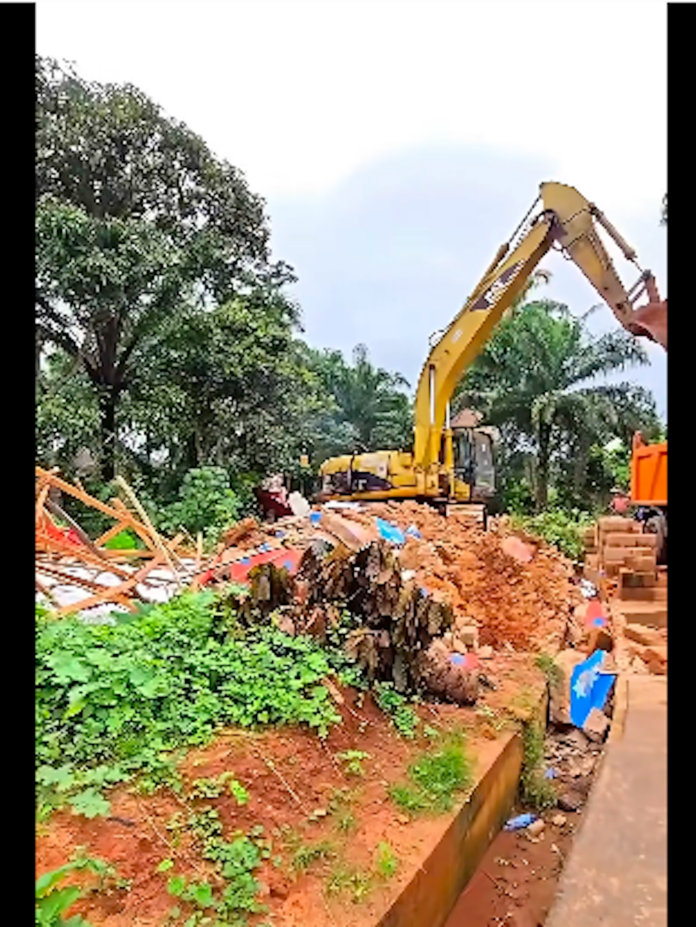


AWKA — Fresh facts have emerged surrounding the recent demolition of the Obu Nanka shrine in Umudala village, Nanka community, Orumba North Local Government Area of Anambra State, contradicting official security claims and exposing an underlying, religious intolerance, and high-handedness.
While the Anambra State Commissioner for Works, Arc. Okey Ezeobi, publicly justified the demolition on the grounds of community security, a deeper investigation by 247ureports.com reveals that the exercise was driven by private interests, religious motives, and political leverage rather than criminal activity.
Addressing journalists on the development, Commissioner Ezeobi—whose personal residence sits barely 200 meters from the site—insisted the shrine posed a threat to public peace. He claimed the structure was attracting suspicious young men and unknown faces into the area, adding that the building was erected without the consent or knowledge of the village leadership.

However, new details gathered by 247ureports.com paint a drastically different picture.
Documentary and local evidence show that the traditional worshippers properly followed customary land protocols. Before erecting the temple, the adherents approached the legitimate landowner, fulfilled all traditional requirements, and duly “settled” him prior to construction.
Furthermore, sources within the community disclosed to 247ureports.com that the destruction of the sacred site also carries deep religious underpinnings. According to multiple insider sources, an Anglican Bishop operating in Anambra State has long held a keen interest in seeing the Obu Nanka shrine brought down.
The cleric had allegedly made discreet, underground efforts over time to have the shrine demolished as part of an ongoing “evangelical” push for his church and Christian faith, aligning his crusade with local interests hostile to traditional worship practitioners.
Village sources who spoke on the condition of anonymity revealed that the sudden drive to tear down the shrine stems from a convergence of these religious motives and powerful community figures.
“There is no security threat here; they simply want to take over the land to build something else,” a source disclosed. “Combined with religious zealotry from senior church figures, these bigwigs are using money and access to government machinery to harass the worshippers. They do not care that the Nigerian Constitution guarantees every citizen freedom of worship.”
The source further revealed that the state executive is being misled regarding the true nature of the operation. “Governor Chukwuma Soludo is completely unaware of what these heavyweights are doing. They are using government instruments for private gain and religious bias, and in the process, tarnishing the Governor’s image.”
The new revelations have also stirred panic within the executive leadership of Umudala village. Executive members are reportedly uneasy over the arbitrary enforcement, with several expressing fear of intimidation or political victimisation should they oppose the destruction.
The forced removal of the Obu Nanka shrine echoes a long-standing pattern of targeted attacks against traditional religious structures across Anambra State and the wider South East. In similar instances—such as in Umuchukwu (formerly Nkerehi), where US-based businessman Dr. Godwin Maduka financed an extensive campaign against traditional worship centers—practitioners have faced sustained harassment from the Christian majority.
Despite explicit guarantees under Section 38 of the 1999 Constitution (as amended) protecting freedom of thought, conscience, and religion, law enforcement agencies in the region have continuously failed to investigate or hold perpetrators accountable for demolishing traditional places of worship.
With tensions remaining high in Nanka, traditional worshippers are calling on Governor Soludo and human rights organisations to step in, halt further intimidation, and protect their constitutional right to freedom of religion.