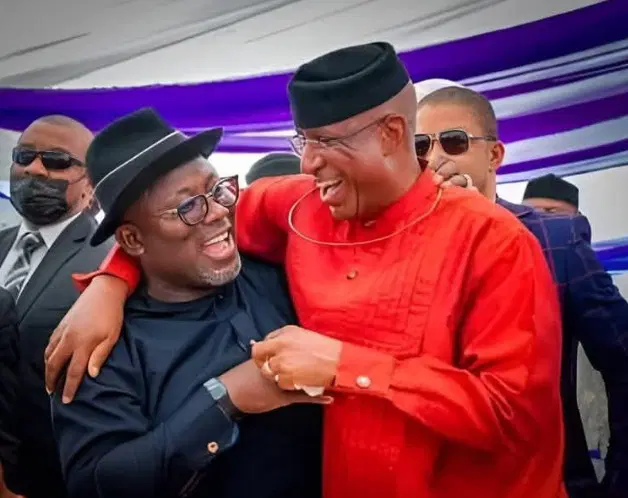

ASABA — The political landscape of Delta State has been set completely ablaze ahead of the 2027 general elections as Governor Sheriff Oborevwori and the former Deputy Senate President, Senator Ovie Omo-Agege, trade blistering public insults over party defections, alleged betrayals, and broken power-sharing arrangements.
The long-standing rivalry between the two political giants, which dates back to the fiercely contested 2023 gubernatorial election, has reached a toxic new peak during separate media appearances on Arise News Television.
The recent media war was triggered by massive realignments within the state, featuring Governor Oborevwori’s previous cross-carpeting from the Peoples Democratic Party (PDP) to the All Progressives Congress (APC) and Omo-Agege’s subsequent, controversial exit from the APC.
Oborevwori Fires First: “Omo-Agege Cannot Be Trusted”
Speaking on national television, Governor Oborevwori dismissed Omo-Agege as an spent force who is no longer a political threat in Delta State. The Governor mocked Omo-Agege for losing the recent APC Delta Central Senatorial District primary election to Senator Ede Dafinone, claiming that the APC leadership saw Omo-Agege’s exit coming months in advance.
Oborevwori went further to launch a direct attack on Omo-Agege’s political character, listing a string of prominent political figures he claims the former Deputy Senate President has betrayed over the decades.
“This state made him. The people that made him, he fought them,” Oborevwori stated sharply. “Who made him? James Ibori made him. He left. Betrayed [Great] Ogboru. He left. Betrayed O’tega Emerhor. He’s not somebody that can be trusted.”
The Governor added that Omo-Agege’s failure to engage party leaders or properly consult before abandoning the primary processes was clear evidence that his exit from the APC was predetermined and entirely inconsequential to the fortunes of the state.
+————————————————————————–+
| THE DELTA STATE HEAVYWEIGHT CLASH |
+———————+—————————————————-+
| POLITICAL ACTOR | CORE LINE OF ATTACK / ALLEGED GRIEVANCE |
+———————+—————————————————-+
| Gov. Oborevwori | Labels rival untrustworthy; cites alleged past |
| | betrayals of James Ibori and Great Ogboru. |
+———————+—————————————————-+
| Sen. Omo-Agege | Accuses Governor of chickening out of PDP to avoid |
| | a 2027 clash; alleges breach of Tinubu’s 60-40 deal|
+———————+—————————————————-+
Omo-Agege Fires Back: “Oborevwori Chickened Out to Avoid Defeat”
Refusing to back down, Senator Omo-Agege released an aggressive counter-statement, mocking Oborevwori’s historical migration from the PDP to the APC. Omo-Agege boldly claimed that the Governor abandoned his former platform out of absolute panic, knowing he could not survive a direct gubernatorial rematch in 2027.
“Oborevwori chickened out from PDP to APC because he couldn’t face me,” Omo-Agege countered. “He ran to avoid defeat in a direct contest with me in the 2027 governorship election in the state.”
Furthermore, Omo-Agege leveled heavy administrative allegations against the Governor, accusing his camp of deliberately undermining the directives of President Bola Ahmed Tinubu regarding party unity. According to Omo-Agege, the presidency had mandated a strict 60-40 power-sharing formula in Delta State to balance influence between existing APC loyalists and incoming PDP defectors.
Omo-Agege alleged that while other states respected the protocol, Oborevwori’s camp completely disregarded the agreement, launching a political purge to wipe out and sideline the foundational APC members who originally delivered over 100,000 votes for President Tinubu.
A Fractured Foundation for 2027
The escalation of hostilities between Oborevwori and Omo-Agege has effectively fractured any hope of immediate political reconciliation within the regional elite. While pro-Oborevwori groups maintain that the Governor’s administrative record and landslide 2023 victory in 21 out of 25 local governments give him undisputed statewide dominance, Omo-Agege’s camp insists that their grassroots support remains solid and ready for war.
As Nigeria inches closer to the next general election cycle, this ongoing public battle confirms that the political control of Delta State will be fought through intense personal vendettas, legal disputes, and uncompromising regional power plays.