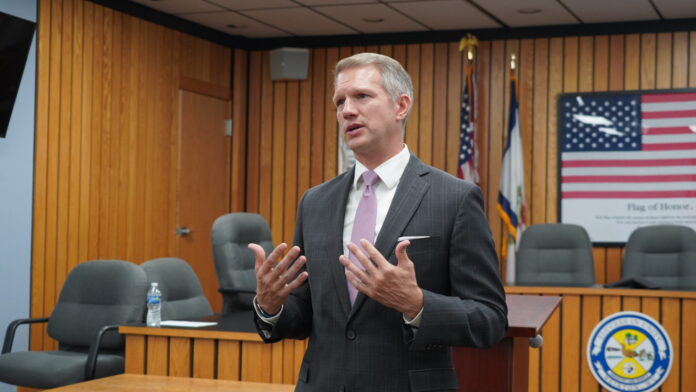


WASHINGTON D.C. — United States Congressman Riley M. Moore has issued a sharp critique of the Nigerian government, accusing the administration of demonstrating the military capacity to intervene in foreign conflicts while failing to protect its own citizens from domestic “genocide.”
In a statement released on Thursday, May 7, 2026, Moore contrasted Nigeria’s swift military action to foil a recent coup attempt in the Benin Republic with what he described as “unconscionable” silence regarding recurring massacres in the Middle Belt.
The Contrast in Intervention
Moore highlighted the disparity between Nigeria’s foreign and domestic security priorities, specifically referencing the December 2025 intervention in Benin. He noted that Nigeria acted with surgical precision to quell the coup attempt in the neighbouring country, yet this same capacity is conspicuously absent when it comes to defending Christian communities in Plateau State.
The Congressman argued that these communities are being “viciously murdered” by radicalised militants despite authorities often receiving early warnings of impending attacks.
Calls for Forceful Action
Reacting to a fresh attack on mourners during a mass burial in Plateau State, Moore formally presented a congressional report to the White House. He characterised the situation as an ongoing “Christian genocide,” claiming that attackers enjoy “total impunity” due to state negligence.
The report urges the Trump administration to move beyond rhetoric and take forceful action to defend Nigerian Christians. Proposed measures include imposing targeted sanctions, travel bans, and asset freezes on Nigerian officials linked to the failure to protect religious minorities.
Rising International Pressure
Moore’s remarks align with a broader legislative push in Washington to re-designate Nigeria as a Country of Particular Concern (CPC). Other lawmakers have echoed these sentiments, accusing the Tinubu administration of underestimating the gravity of the insecurity crisis.
While the Nigerian government has historically attributed the violence to complex farmer-herder conflicts, Moore dismissed these explanations as a refusal to acknowledge the religious motivations behind the killings. He warned that the international community can no longer ignore the “lambs being led to slaughter” in rural Nigeria.