

ABUJA — Outrage has greeted comments made by Nigeria’s former military Head of State, General Yakubu Gowon (rtd), during a recent interview on Arise News, where he claimed that most bullets fired by federal troops during the Nigerian Civil War hit palm trees rather than human targets.
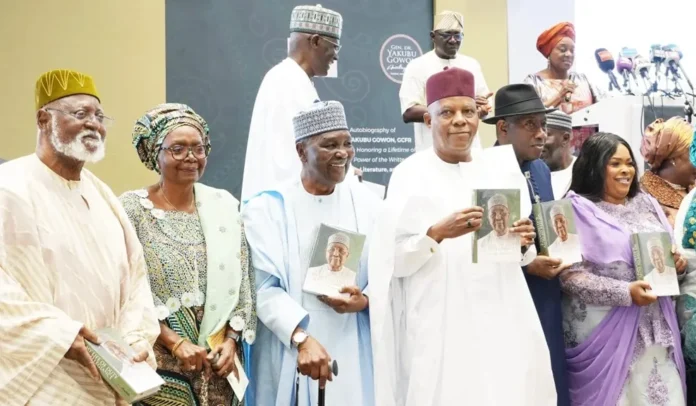
The remarks were made during media appearances surrounding the launch of his new 20-chapter autobiography, My Life of Duty and Allegiance, on May 19, 2026, at the International Conference Centre in Abuja.
The Controversial “Palm Tree” Remarks
Reflecting on his visits to the former Biafran territories shortly after the conclusion of the 1967–1970 conflict, Gowon described seeing extensive physical markings on the regional landscape.
“I saw many black spots on the trees and asked what they were. I was told they were bullet marks,” Gowon stated during the Arise News broadcast. “So most of the bullets were more on those trees, not on people.”
The statement has triggered immediate and intense criticism across Nigeria, particularly from historians, civil society groups, and representatives of the South-East region. Critics have accused the former head of state of revisionism and attempting to minimize the immense human suffering, mass casualties, and widespread starvation that claimed an estimated one to three million lives during the 30-month war.
Billion-Naira Book Launch Sparks Debate
The controversy has also cast a sharp spotlight on the high-profile funding behind Gowon’s new memoir.
During the Abuja book presentation, General Theophilus Danjuma (rtd), who served as the chief presenter, announced a donation of ₦3 billion to fund the distribution of the book to university libraries across the country.
Other major donations included ₦500 million from the Chairman of the Dangote Group, Aliko Dangote, and ₦25 million from the Chairman of BUA Group, Abdul Samad Rabiu.
While organizers framed the book—reviewed by Bishop Matthew Kukah—as a vital historical record of the 1966–1975 military regime and the preservation of Nigerian unity, critics have labeled the multi-billion-naira event an elite attempt to institutionalize a whitewashed narrative of wartime history.
The Question of Accountability
In the wake of the broadcast, calls for historical accountability have resurfaced, with some commentators renewing symbolic demands for international tribunals to investigate wartime actions.
However, legal experts note that the International Criminal Court (ICC), established by the Rome Statute in 2002, lacks retroactive jurisdiction and cannot legally prosecute actions committed during the 1960s.
Fifty-six years after the war ended under the declaration of “No Victor, No Vanquished,” Gowon’s latest comments demonstrate that the memory, trauma, and historical narrative of the Nigeria-Biafra conflict remain deeply polarized.