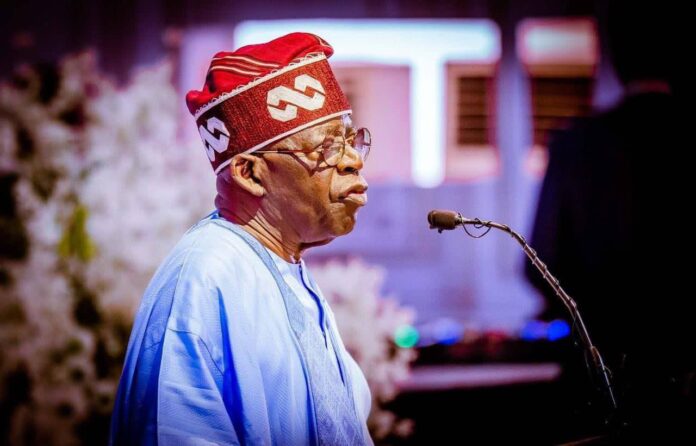

ABUJA, NIGERIA — As the current administration navigates intense economic pressure and institutional reshuffling, long-standing global and domestic scrutiny regarding the financial record of President Bola Ahmed Tinubu and his close political associates has returned to the forefront of national discourse.
Despite maintaining a record free of judicial convictions in Nigeria, President Tinubu’s career—stretching from his corporate days in the United States to his influential tenure as Governor of Lagos State—remains accompanied by a dense trail of asset forfeitures, allegations of corporate proxies, and multi-billion Naira controversies involving members of his inner circle.
The U.S. Asset Forfeiture and Early Inquiries
The foundational controversy surrounding the President’s personal wealth dates back to the early 1990s in Chicago, Illinois. Following a coordinated investigation by the United States Internal Revenue Service (IRS), the Federal Bureau of Investigation (FBI), and the Drug Enforcement Administration (DEA), the U.S. government instituted a civil forfeiture case against bank accounts held in Tinubu’s name.
- The $460,000 Forfeiture: In 1993, Tinubu forfeited $460,000 to the U.S. government after federal authorities asserted there was probable cause to believe the funds were linked to transactions involving a white-heroin trafficking syndicate.
- The Legal Defense: The President’s legal representatives have consistently maintained that the funds were part of a civil compromise rather than a criminal indictment, emphasizing that he was never personally convicted or charged with a crime in connection with the funds.
- Renewed Record Releases: The historical issue resurfaced under active public debate following a U.S. court order mandating the comprehensive release of relevant FBI and DEA archival records concerning the case.
The Lagos Treasury and the ‘Alpha Beta’ Monopoly
During his dual terms as Governor of Lagos State (1999–2007), Tinubu established a highly centralized financial model that critics argue institutionalized a system of state-backed patronage.
- The Tax-Collection Framework: Central to this system was Alpha Beta Consulting, a private financial firm granted exclusive statutory rights to manage and collect Lagos State’s Internally Generated Revenue (IGR) in exchange for a lucrative percentage-based commission.
- Whistleblower Litigation: In 2020, the firm’s former Managing Director, Dapo Apara, filed a comprehensive lawsuit at the Lagos High Court, formally accusing Tinubu of utilizing Alpha Beta as a financial proxy for money laundering, massive tax evasion, and concealing a 70 percent controlling stake in the enterprise. The multi-billion Naira suit was later settled out of court under confidential terms, leaving the structural transparency of the state’s revenue architecture deeply questioned by anti-corruption watchdogs.
- The Bullion Van Incident: Public concern over the unchecked flow of cash culminated on the eve of the 2019 general elections, when armoured bullion vans were filmed driving into Tinubu’s private residence in Ikoyi, Lagos. When questioned by journalists, Tinubu dismissed the uproar, stating that the funds belonged to him personally and not the public, which prompted formal petitions to the Economic and Financial Crimes Commission (EFCC) regarding potential breaches of the Money Laundering Act.
The Network of Associates: Corporate Favours and Kinship Ties
The scrutiny tracking the President has consistently extended to his immediate family and handpicked political associates, with critics pointing to a pattern of nepotism and strategic corporate advantages:
- The OPL 245 Settlement and Family Deals: Concerns over state-facilitated corporate advantages intensified after the administration withdrew long-standing multi-billion dollar civil corruption lawsuits against European oil majors Eni and Shell regarding the infamous Malabu Oil (OPL 245) dispute. Notably, the legal withdrawals occurred shortly after Eni finalized the sale of its Nigerian onshore subsidiary to Oando PLC—a major domestic energy firm headed by the President’s nephew, Wale Tinubu.
- Offshore Properties and Direct Kinship: International investigative disclosures have repeatedly linked his son, Seyi Tinubu, to offshore shell companies. A notable Bloomberg investigation revealed that an offshore vehicle controlled by the younger Tinubu was utilized to purchase an ultra-luxury $10.8 million mansion in London, England, which had previously been seized by the Nigerian government from a fugitive oil trader accused of massive public fraud.
- The Federal Housing Appointment: Further accusations of administrative favoritism emerged following the direct appointment of Oyetunde Oladimeji Ojo—the President’s son-in-law—as the Managing Director and Chief Executive Officer of the Federal Housing Authority (FHA), drawing sharp condemnation from public interest groups over institutional nepotism.
- Cabinet Irregularities: Beyond family ties, the administration’s initial anti-graft posture suffered a severe blow when the Minister of Humanitarian Affairs and Poverty Alleviation, Dr. Betta Edu, was suspended following documented revelations that she had authorized the illegal diversion of ₦585 million in public social intervention funds directly into a private bank account.
Global Watchdog Recognition and the Official Stance
The cumulative weight of these historical records and contemporary contracting decisions led the Organized Crime and Corruption Reporting Project (OCCRP) to name President Tinubu as a global finalist for its 2024 “Corrupt Person of the Year” distinction, placing Nigeria’s leadership under an intense international spotlight.
The Presidency and the ruling All Progressives Congress (APC) continue to vigorously defend the administration’s integrity. Official spokespersons consistently argue that the President’s wealth was legally accumulated through high-level private-sector consulting prior to entering public life. Furthermore, defenders emphasize that despite decades of intense investigation by successive political adversaries, no domestic or international court has ever handed down a criminal conviction against Bola Ahmed Tinubu.
The administration maintains that the recurring allegations are part of a coordinated campaign of political subversion aimed at distracting from its ongoing fiscal reforms.