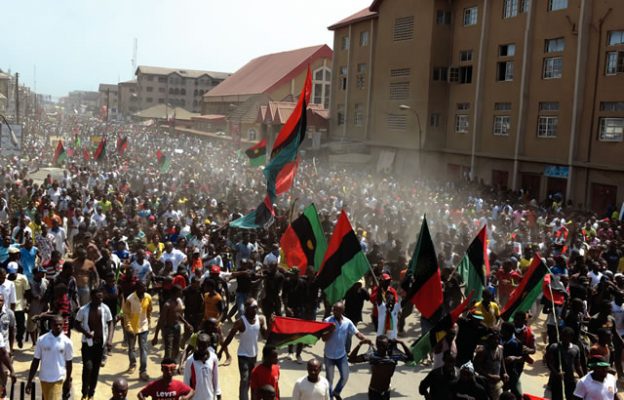

ENUGU – Legal counsel Aloy Ejimakor has called for the immediate de-proscription of the Indigenous People of Biafra (IPOB), arguing that the 2017 “terrorist” label is a politically motivated tool used to suppress the Igbo people rather than a genuine security measure.
In a statement released on April 20, Ejimakor highlighted that major world powers and international bodies have rejected Nigeria’s classification of the group. He noted that the United States and the United Kingdom have both refused to designate IPOB as a terrorist organization, with the UK citing a lack of evidence to meet legal thresholds for a ban.
The demand follows a landmark 2023 ruling by the Enugu State High Court, which declared the proscription “illegal, unconstitutional, and void.” Justice A.O. Onovo ruled at the time that the tag violated Section 42 of the Constitution, which prohibits ethnic discrimination. The court also ordered the Federal Government to pay N8 billion in damages to IPOB leader Nnamdi Kanu.
Ejimakor also pointed to a 2020 communication from UN Special Rapporteurs warning that the Nigerian government was using anti-terror laws to “quell legitimate political expression” and “prevent peaceful assembly.”
“De-proscription is not an act of mercy; it is an act of justice,” Ejimakor stated. “It is time to end the weaponization of anti-terror laws against an entire ethnic group and engage in genuine dialogue.”
The legal team is now calling on the Federal Government to comply with these domestic and international rulings by repealing the ban and releasing members held solely for their affiliation with the movement.